
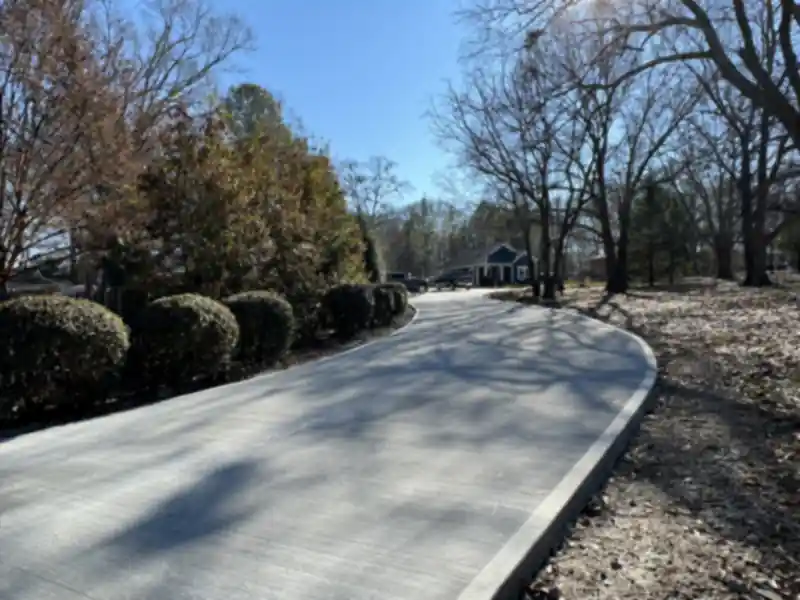
Why Quality Concrete Work Matters: Long-Lasting Results from Ace Concrete Construction
We at Ace Concrete Construction pour driveways, patios, foundations and commercial slabs in Greenville and across the Upstate, SC. A driveway, a patio, a foundation: the quality of that concrete work affects your property for decades.
Last updated
- SC licence RBS.65343
- 20+ years in the trade
- Free on-site estimates
- Financing through Wisetack
Fast & Free
Get Your Free Concrete Estimate
Poor concrete installation leads to cracking, settling, water damage and costly repairs that proper planning and execution would have avoided. That shows up in structural integrity and service life, past what you can see on the surface.
Concrete services we handle in Greenville and the Upstate
We pour driveways, patios, stamped decorative concrete and pool decks for homes, and foundations, warehouse slabs, parking lots and other flatwork for commercial sites, across Greenville and the Upstate.
Our residential concrete services center on driveways and patios built to stand up to the region’s climate.
Beyond plain slabs, our decorative work includes stamped concrete that looks like natural stone, brick or tile at a fraction of the cost. We also pour pool decks with slip-resistant finishes.
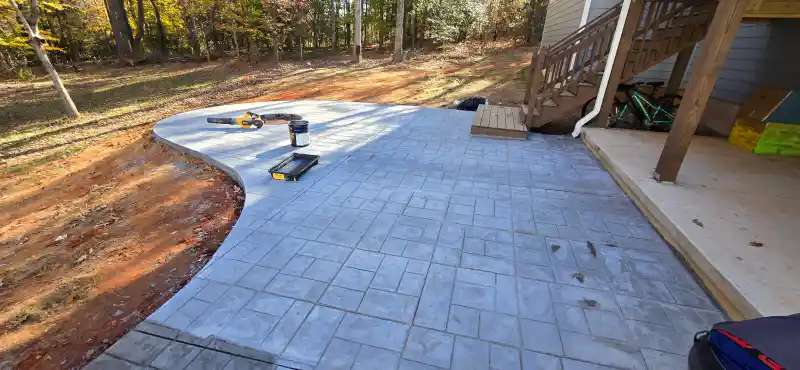
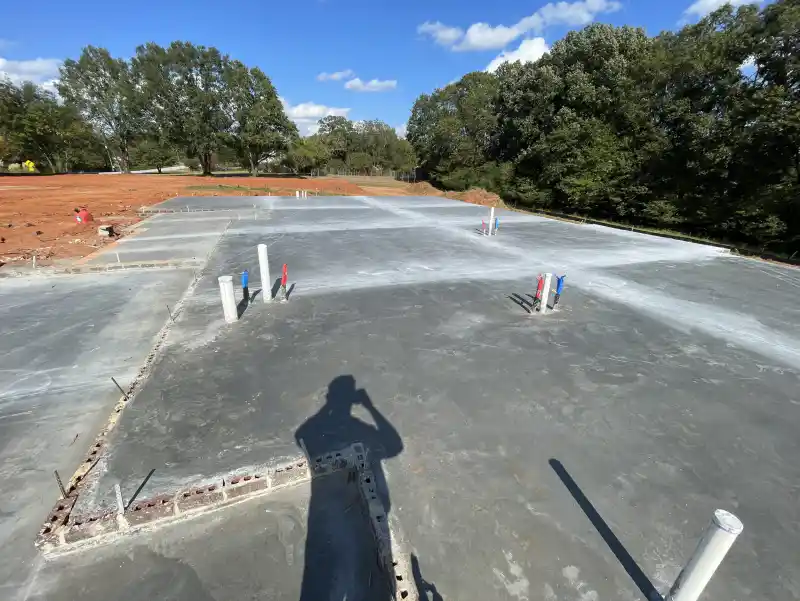
Foundation work is the core of our commercial concrete services, from retail centers to industrial facilities.
Warehouse slabs, parking lots and other commercial flatwork need the loads, the drainage and the local building codes worked out before the pour.
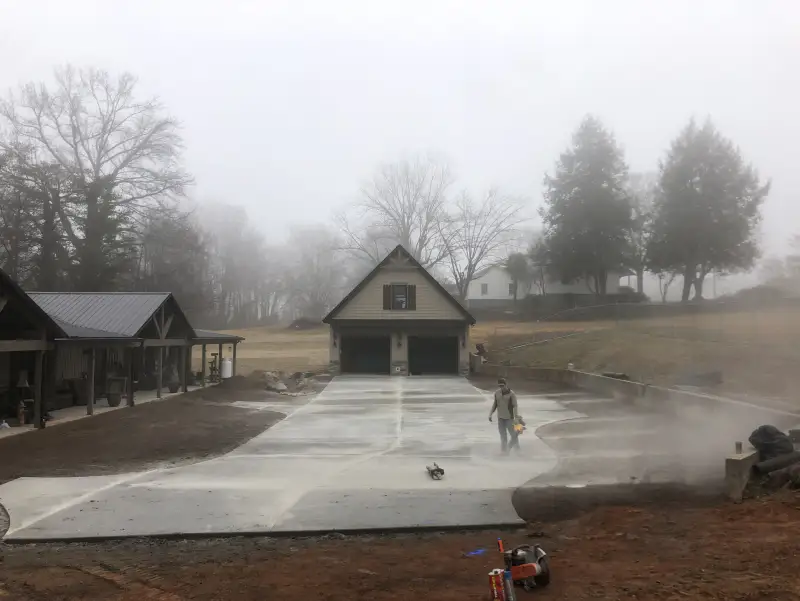
Why hire an experienced concrete crew in Greenville?
Hiring an experienced concrete crew gets the job done right the first time, and the durability shows up for years afterward: our crews handle the soil preparation, reinforcement placement, mix ratios, timing and curing that decide how long a slab lasts.
Badly installed concrete creates trip hazards, drainage problems and structural instability, which is why we follow industry safety standards and local building codes.
Appearance counts too, and it comes from smooth, even finishes, proper joint placement and consistent coloring.
What Sets Ace Concrete Apart in Upstate South Carolina
Working locally, we know the regional soil conditions, the climate and the building requirements: how Greenville’s clay soils behave, how seasonal temperature swings affect concrete, and which techniques hold up here.
Our turnaround is fast because our project management is tight and our crews are well coordinated. We work around our clients’ schedules and keep disruption to a minimum without lowering the standard of the work.
We hold South Carolina residential builder licence RBS.65343, and anyone can look the number up on the SC LLR register.
Reviews of Ace Concrete regularly mention our communication through the project.
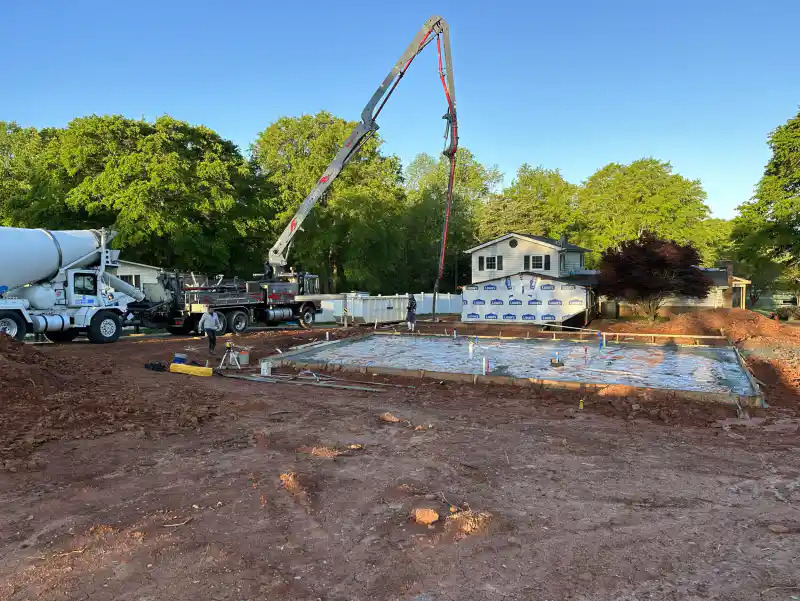
What actually separates a durable concrete slab from one that fails early
Most of what decides whether a slab lasts happens before the concrete looks like anything: the ground underneath it, the air mixed into it, where it is told to crack, and how it is kept wet in the first days after the pour. Concrete industry standards, NRMCA's Concrete in Practice technical series and the American Concrete Institute's codes, cover all four in detail, because a mix that is right on paper still fails if any one of them is skipped. None of this is proprietary. It is the same standard every SC-licensed concrete contractor is building against in Greenville County, and it is worth a homeowner knowing before they compare quotes. The four sections below walk through each one in order: subgrade, air content, joints, and curing.
Subgrade prep: the part nobody sees after the pour
NRMCA's guidance on slab construction lays out a standard cross-section for a slab on grade: a compacted subgrade first, then 6 to 8 inches of granular fill as a capillary break, a vapor retarder over that, and the concrete slab on top, with the exterior grade sloped away from the structure so water does not pool against the edge. Skip the compaction or the capillary break, and the clay underneath, common across Greenville and the Upstate, keeps moving as it wets and dries long after the concrete has cured, which is how a level slab ends up cracked or settled within a few years.
A vapor retarder belongs in that same section, specified to ASTM E1745 and installed at a minimum of 10 mils thick. Ground moisture that migrates up through a slab with no vapor retarder is a documented cause of coating and flooring failures, and NRMCA's own guidance is blunt about where that leads without one: delamination, discoloration, and, in its words, "possibly fungal growth and odors."
Air-entrained concrete and why the code requires it
Chapter 19 of ACI 318, the model structural concrete code, defines an exposure category, "F," specifically for concrete exposed to cycles of freezing and thawing, running from F0 (not exposed) to F3 (frequent saturation plus deicing chemicals), and ACI 332, the residential code, carries a matching set of categories for houses. Exterior slabs are typically assigned to class F1, which sets a maximum water-to-cementitious-materials ratio of 0.55, a minimum specified strength of 3,500 psi, and an air content requirement, because resistance to that freeze-thaw cycling comes from strength, low permeability, and entrained air together.
The mechanism is mechanical, not chemical: when saturated concrete nears freezing, the water inside it expands into ice and stresses the surrounding paste. Millions of microscopic air bubbles mixed into the concrete give that expanding ice somewhere to go, which is why NRMCA credits entrained air with preventing the "stress buildup" behind scaling, the surface flaking freeze-thaw damage leaves behind. For exterior slabs that stay continuously moist or ever see deicing chemicals, NRMCA's own recommendation, consistent with ACI 332, is a specified strength of at least 4,000 psi with total air content around 6 percent. Air content and strength are both locked in at the batch plant, before the truck leaves, which is exactly why they cannot be fixed after the fact.
Joint spacing: a crack you planned versus one you did not
Concrete shrinks as it cures, and it is going to crack somewhere. A joint is simply a planned crack: NRMCA's guidance on joints in slabs on grade sets the maximum spacing at 24 to 36 times the slab's thickness, about 10 feet on a typical 4-inch driveway or patio slab, with panels kept square rather than long and narrow. Saw-cut joints are normally run 4 to 12 hours after finishing; cut too early and the joint edges ravel, cut too late and the slab may have already cracked on its own line instead of yours.
Isolation joints do a different job: separating a driveway or patio from the sidewalks, garage slabs, stairs, and light poles it touches, so each piece of concrete can move independently instead of cracking where two pours meet. A slab poured tight against another structure with no isolation joint between them is one of the more common, and most avoidable, cracks a homeowner finds later.
Curing: the step that decides whether the rest holds up
Everything above still depends on curing. NRMCA's curing guidance calls for concrete to be kept moist and protected, typically for 3 to 7 days after placement and finishing, with the concrete's own temperature held above 50°F throughout that window. Permeability, the thing that decides whether concrete resists water, freeze-thaw, and the deterioration that follows, is set largely during those first days. In NRMCA's own words, concrete "that has a low permeability to water and dissolved chemicals will generally be durable in most exposure conditions," and that permeability cannot be added back in once the slab has cured wrong.
Cut the curing window short on a hot Upstate afternoon, and the surface can dry out before the concrete underneath has gained enough strength, which shows up later as dusting, cracking, or a surface that scales the first hard winter it sees.
What South Carolina requires of the contractor holding the trowel
South Carolina backs a version of this same standard with law, beyond the industry recommendation above. Under South Carolina Code Section 40-59-240(D), once a job for an individual homeowner runs past $5,000 in materials and labor, the residential specialty contractor performing it has to carry a surety bond, set at $5,000 under the Residential Builders Commission's own registration rules and filed with the state before work starts. Separately, under Section 42-1-360(2), the state's workers' compensation law applies once an employer regularly has four or more employees in South Carolina, the threshold that decides whether a crew is required to carry it.
That bond and that license exist to give a homeowner recourse if a job is not finished or not done to code, which is worth checking before any concrete goes down. Our South Carolina residential builder licence number is RBS.65343, noted above, and that is the credential that section of the law is built around.
South Carolina's licensing law is narrower here than many homeowners assume. Title 40, Chapter 59, the statute governing residential builders, sets no general liability insurance requirement for a residential builder or specialty contractor; its only insurance language treats workers' compensation as one factor the Commission may weigh when deciding whether to issue a license, not a fixed requirement of holding one. That gap is worth knowing before hiring any contractor for a driveway or slab: the law alone does not guarantee general liability coverage, which makes it a fair question to ask directly, of us or anyone else you are getting a quote from.
What quality looks like to the people who hired us
These are excerpts from verified Google reviews, quoted verbatim:
"Ace concrete is one of the best contractors I've ever dealt with, their attention to detail and quality is impressive. They got the work done on time and the quality was very good. I was very pleased with the quality of the actual work."
"I recently had concrete work done at my house by Ace Concrete Construction, and I couldn't be more pleased with the results! The team delivered exceptional quality, with the finished work looking sturdy, smooth, and professionally executed."
That is what the standards above are supposed to add up to: a slab that is still sturdy and smooth years after the crew has left, well past the day it was poured. Every standard described above, from the compacted base to the final cure, is why. If you want that standard on your own Greenville driveway, patio, or slab, request a free estimate and we will look at the site before we quote it.
Why commercial concrete work follows an even stricter standard
The commercial side of this business runs under its own set of rules. South Carolina's Contractor's Licensing Board classifies commercial and highway concrete driveways, parking lots, sidewalks and curbs under a "Concrete Paving" subclassification, and a general contractor bidding jobs above $10,000 has to file a financial statement that clears a net-worth or working-capital test set by license group, $20,000 net worth or $10,000 working capital for the smallest group, jobs up to $100,000, before the license is issued.
The concrete itself is designed for a longer service life, too. The American Concrete Institute's guide to commercial parking lots and site paving states it plainly: concrete parking lots "typically have service lives of 20 years or more," which is part of why commercial flatwork, warehouse slabs, loading areas and parking lots, is treated as a different design problem than a residential driveway, with its own thickness, joint, and subgrade requirements built to reach that lifespan.
How do I get a concrete estimate in Greenville and the Upstate?
We price driveway and patio jobs for your home and commercial concrete for your business the same way: on site, and the estimate is free.
Contact us for a free consultation and a detailed quote on your project anywhere in Greenville and upstate South Carolina.
Call us at 864-214-5271 or request your free estimate online.
What do jobs like these look like when we pour them?
These are driveway jobs our crews poured.
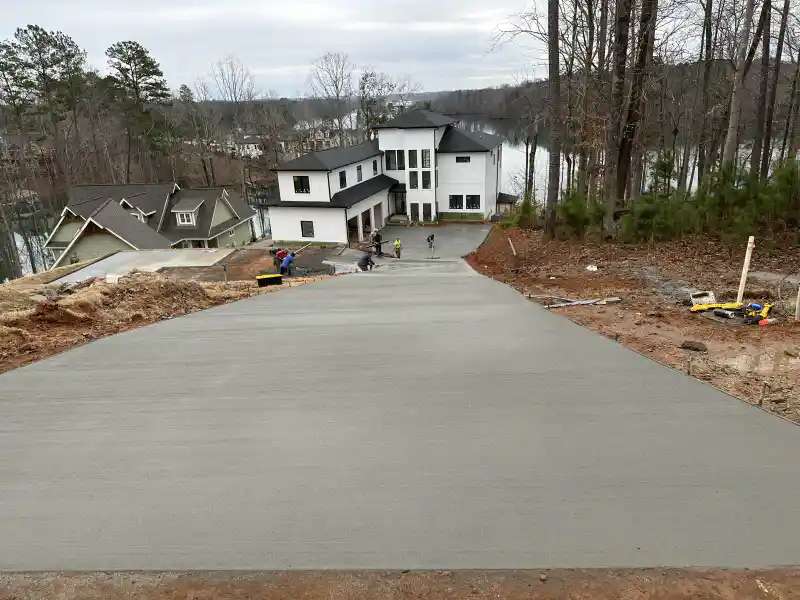
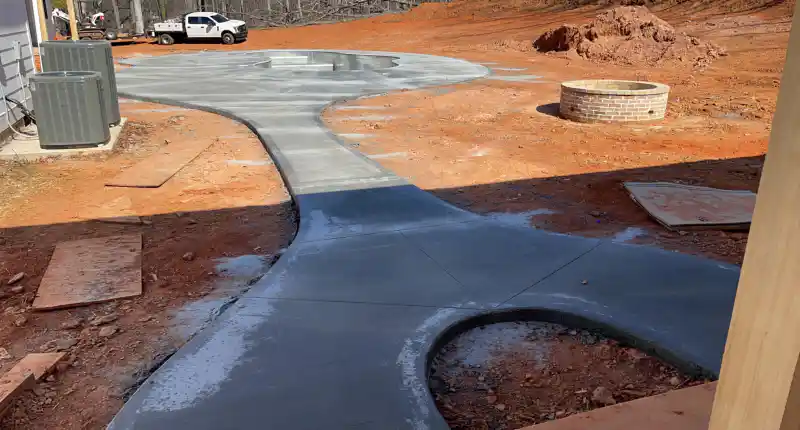
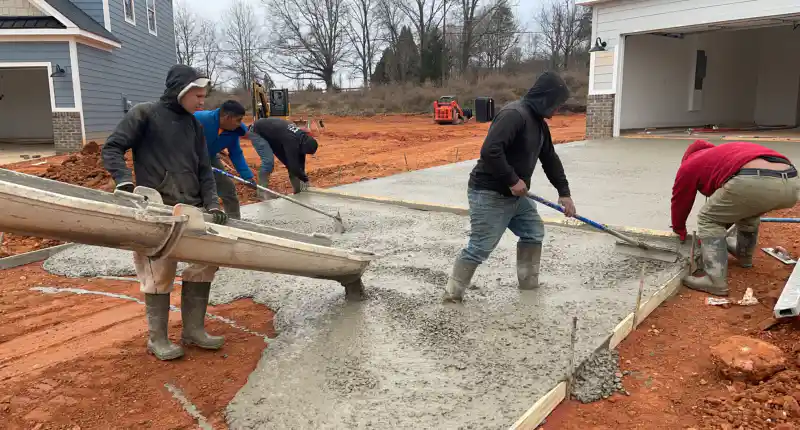
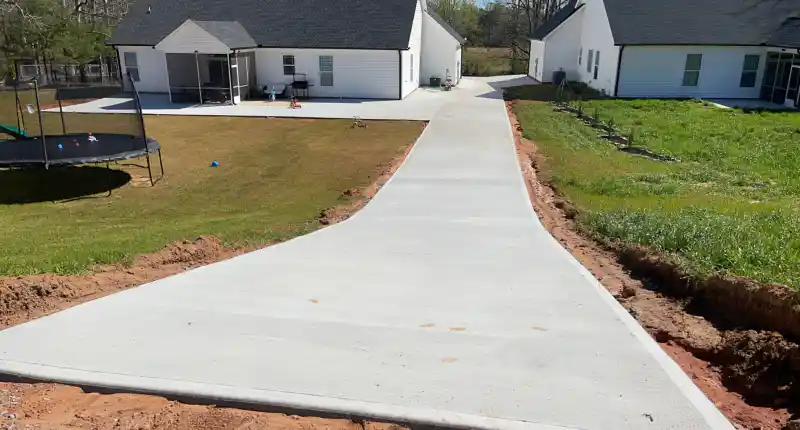
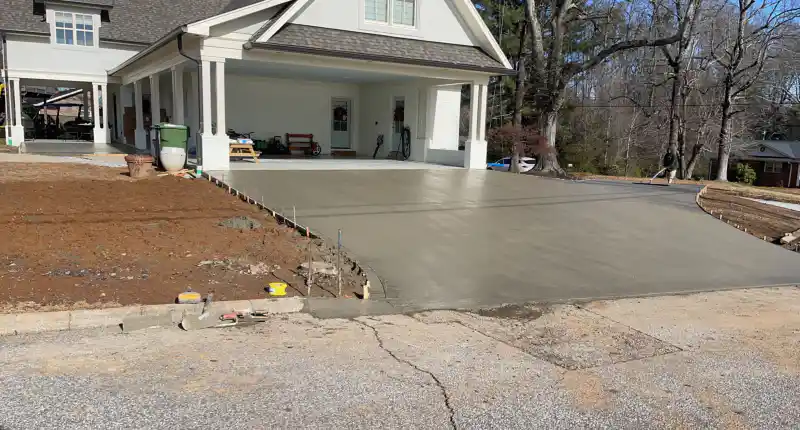
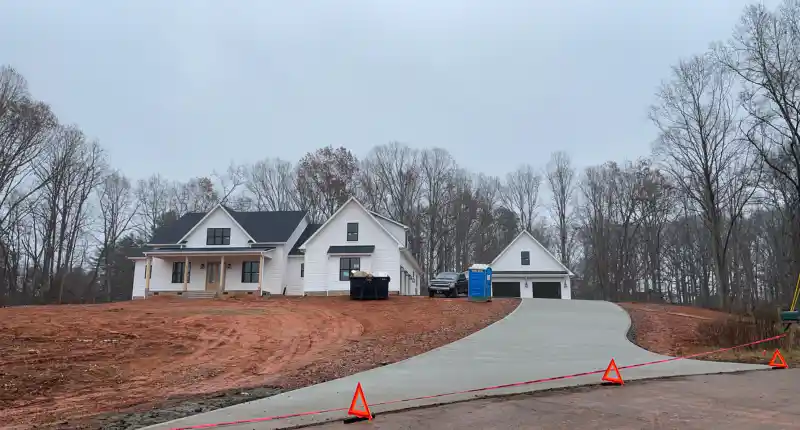
Pouring a driveway in Greenville and the Upstate, on video
A driveway going in: base prepped, forms set and braced, then the pour worked and finished before it sets.
Concrete reviews from Greenville and the Upstate
Ace concrete was excellent. They did a wonderful job. Very great experience with the workers and was very surprised that the owner showed up at the job and he actually did smoothing of…Google review
Ace installed a small patio on a sloping area requiring a poured concrete wall on one side. They removed the existing patio block structure and installed the concrete patio in one day. The results were fantastic…Google review
Ace knocked it out the park for me on a large concrete driveway pour in Taylors, SC.…Google review
Great job, the pad for our generator is perfect I highly recommendGoogle review
I needed a 24' x 40' concrete floor for a metal building. After getting several quotes I decided to go with Ace Concrete Construction.…Google review
Great work team was finished in a day and all the areas look great.Google review
Concrete guides for Greenville and Upstate homeowners
More guides from our crew on concrete work in Greenville and the Upstate.
Cracked, Lifted, or Crumbling: When to Repair a Concrete Sidewalk in Greenville and When to Replace It
Cracked, lifted, or crumbling concrete walkway or steps in Greenville? How to tell a repair from a replacement, why Upstate walks fail early, and the honest fix. Free estimates.
September 9, 2026Old Garage Floor Cracking or Flaking? When to Replace a Garage Slab in Greenville
Is your old garage floor cracking, flaking, or settling? How to tell a resurface from a full garage slab replacement in Greenville, why they fail, and what a proper pour includes. Free estimates.
September 8, 2026Freeze-Thaw in the Upstate: What January and February Do to Concrete That Was Poured Wrong
How Upstate SC freeze-thaw cracks and spalls concrete each winter, why a badly poured slab fails first, and what protects a driveway or patio. Free estimates.
Licensed concrete contractor in Greenville: who we are
Concrete service areas around Greenville
We work from our shop at 4706 Locust Hill Rd in Taylors, SC across Greenville, Spartanburg, Anderson and Laurens counties, from our offices at 10 Accountants Circle, Suite 1B in Seneca, SC and 405 S Pine St, Suite J in Spartanburg, SC, and from an office in Asheville, NC.
Free concrete estimates in Greenville
We price the job on site.
Concrete work we pour across the Upstate: driveways, garage and building slabs, stamped and decorative concrete, commercial concrete, and industrial concrete.
Request a concrete estimate in Greenville
Someone comes out and prices it standing on it. Estimates are free.
- Driveways
- Patios & Outdoor Living
- Decorative Concrete
- Garage & Building Slabs
- Foundation & Retaining Walls
- Commercial Concrete
- Industrial Concrete
- Epoxy Flooring
- Foundation Repair & Concrete Restoration
Financing available through Wisetack. Check your options in about a minute without impacting your credit score.
See financing options*All financing is subject to credit approval. Your terms may vary. Payment options through Wisetack are provided by our lending partners.
Fast & Free
Get Your Free Concrete Estimate