
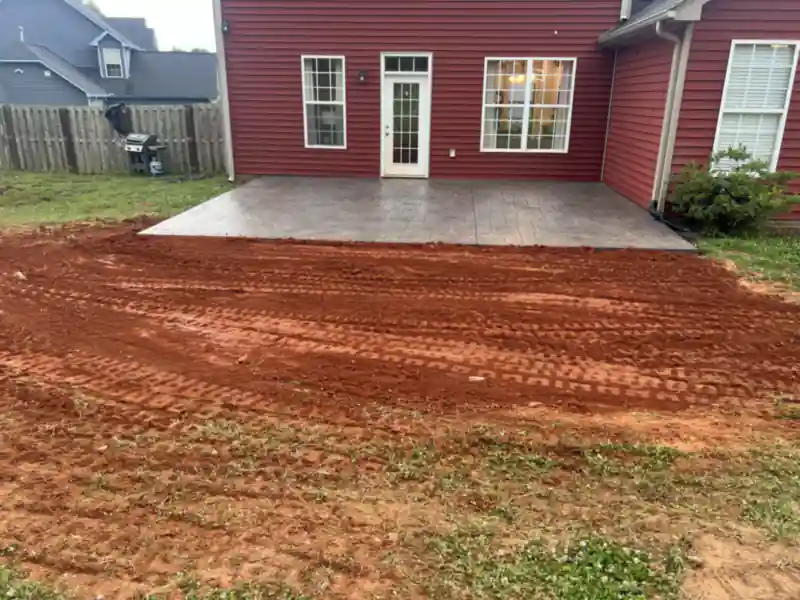
Stamped Concrete vs Broom Finish for a Greenville Patio
We at Ace Concrete Construction pour stamped and broom-finish patios in Greenville and across the Upstate, SC. Same slab, two very different patios. The finish you choose sets the look, the budget, and the upkeep of your Greenville patio, so it is worth understanding before you pour.
Last updated
- SC licence RBS.65343
- 20+ years in the trade
- Free on-site estimates
- Financing through Wisetack
Fast & Free
Get Your Free Concrete Estimate
Same slab, two very different patios. The finish you choose sets the look, the budget, and the upkeep of your Greenville patio, so it is worth understanding before you pour.
By the crew at Ace Concrete Construction, Taylors, SC
When homeowners around Greenville call about a new concrete patio, this is the fork in the road. Underneath, both patios are the same reinforced concrete slab poured on a compacted base. The difference is all in the last few hours of the job, when the surface gets its finish.
What is a broom finish patio good for?
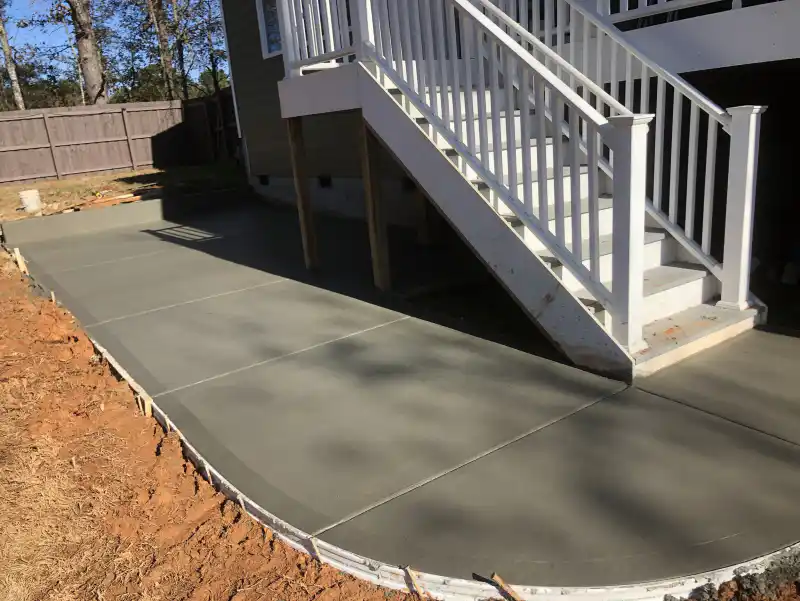
A broom finish suits a patio that gets used hard, or one where the goal is a clean, functional surface at a sensible price: after the concrete is placed and smoothed, the crew drags a broom across it to leave a fine, even texture. It is the standard finish because it is durable, gives good grip when wet, hides wear well, and is the budget-friendly baseline.
What does stamped concrete add to a Greenville patio?
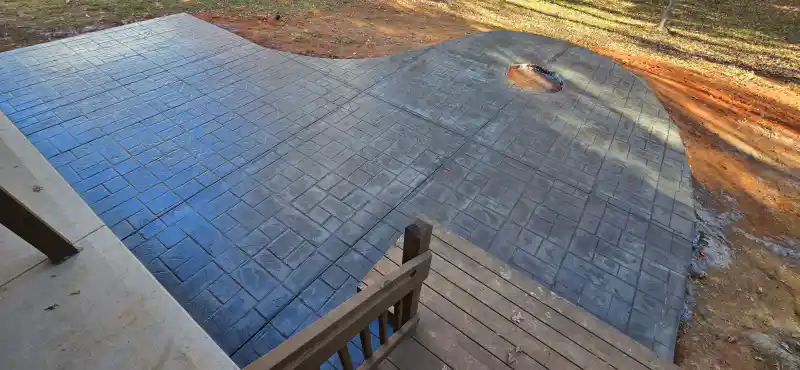
Stamped concrete takes that same fresh slab and presses a pattern into it while it is still workable, then colors and seals it, so it can read like flagstone, slate, brick, or wood plank at a fraction of what those materials cost to install for a patio, entry, or pool deck and decorative surface. It is the higher-ticket choice because it is more material, more labor, and more skill, all on the clock while the concrete sets.
How to choose between them
The decision usually comes down to three things: budget, look, and upkeep.
Budget
A broom finish is the lower-cost option and always will be, because it is fewer steps, while stamped costs more for the coloring, the stamping, and the sealing. Neither has a fixed price on a web page, because patio size, access, and the pattern all move the number; we quote both on your actual patio.
Look
If you want a clean, understated surface that disappears under the furniture and the grill, a broom finish is right. If the patio is part of the view from the house and you want it to look like stone or plank, stamped is the better fit.
Upkeep
A broom finish is close to no-maintenance. Stamped concrete needs resealing every few years to keep its color and protect the surface, which is easy but real. In the Upstate that sealer also carries the patio through the January and February freeze-thaw, so it is not a step to skip. For a stamped patio or pool deck in Easley, our guide to stamped concrete in Easley, SC covers the first seal date and slip resistance.
Where we see each one fit best
A broom finish tends to be the right call for big, hard-working surfaces, a full backyard patio the kids and the dog live on, a pool deck that has to stay slip-resistant when wet, or a side patio that is really about function, and it needs no resealing. Stamped tends to win where the patio is part of the picture: a small entry patio you see every time you pull in, a courtyard off the kitchen, or a fire-pit or outdoor-kitchen feature area, where the pattern and color do work a plain surface cannot.
What slab prep do stamped and broom patios both need?
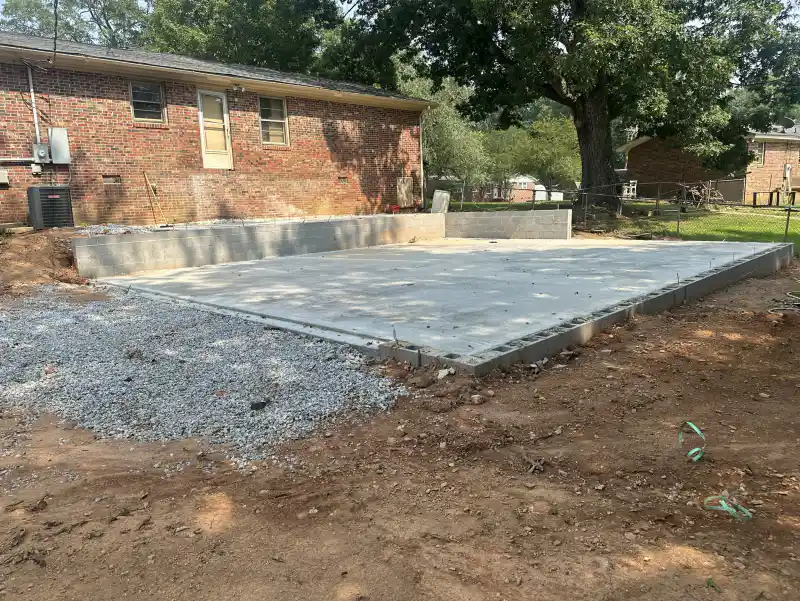
Whichever finish you pick, the patio only lasts if the slab under it is built right: a compacted base, the correct thickness, reinforcement, and control joints cut so it cracks on a clean line instead of across your new surface, the same build for both broom and stamped. You can read how we build the slab itself on our concrete slab page.
Not sure which finish fits your patio and your budget? Tell us how you want to use the space and we will walk you through both on-site, with a free estimate for each.
What joint spacing does a concrete patio actually need?
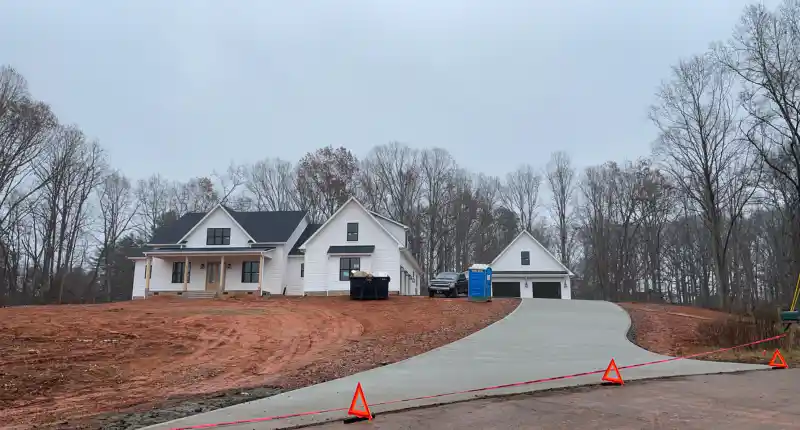
A patio cracks on its own timeline if nothing tells it where to crack. NRMCA's technical guidance on joints in slabs on grade sets the rule: maximum joint spacing should run 24 to 36 times the slab's thickness, which on a typical 4-inch patio works out to roughly 10 feet between control joints, with each panel kept square rather than long and narrow. Saw-cut joints are typically run 4 to 12 hours after the concrete is finished, while early-entry dry-cut joints go in sooner, 1 to 4 hours after finishing, depending on how the mix is setting.
Isolation joints matter just as much on a patio, because NRMCA's own list of where they belong names patios specifically: separating a patio from the sidewalks, garage slabs, stairs, and light poles it touches, so each piece of concrete can expand and contract without cracking where two pours meet. A patio poured tight against a walkway or a foundation with no isolation joint between them is one of the more common reasons a crack shows up exactly on that seam.
How an Upstate city writes its own concrete specs
Joint spacing and thickness are not only national guidance, either. The City of Clemson's own construction code sets new sidewalks at a minimum 4-inch depth, concrete of at least 3,000 psi, control joints every 10 feet, and expansion joints at least every 100 feet, and a separate section of that same code requires an expansion joint at the street right-of-way line on every concrete driveway in the city. That is one Upstate municipality's own written standard for exterior concrete flatwork, and it lines up closely with the national guidance above: real thickness, real strength, and joints on a real schedule.
Patios sit outside most city permitting (driveways and sidewalks in the right-of-way are what draws the permit requirement), but the same underlying standard, thickness, strength, and jointing, still decides whether the slab under a patio holds up. A concrete driveway in Greenville and a patio next to it get built to the same base and jointing rules, even where only one of them needs a city permit.
Greer, a short drive northeast, writes its own version in its Unified Development Ordinance: new sidewalks there have to be at least 5 feet wide along roadways in every zoning district, with a waiver from the City Engineer needed to go narrower. Every Upstate municipality has its own written version of the same idea, a minimum thickness, a minimum strength, and a jointing schedule, for the concrete that sits where the public can see it or ties into a public street.
Why sealer matters more here than in most climates
The advice above, that a sealer carries a stamped patio through January and February, lines up with the concrete code. Chapter 19 of ACI 318 assigns most exterior slabs to its "F1" freeze-thaw exposure class, concrete exposed to freezing with limited water saturation, which sets a minimum specified strength of 3,500 psi and caps the water-to-cementitious-materials ratio at 0.55. A sealer's job on a stamped patio is keeping water from soaking into the surface in the first place, the same principle behind that exposure class: concrete that stays drier through a freeze-thaw cycle is not fighting the ice expansion behind scaling, the surface flaking NRMCA describes when water trapped near the surface freezes and pushes outward. A broom finish does not lean on that sealer to get through winter the same way, which is one more real cost behind the upkeep comparison above, beyond looks.
Whichever finish you are weighing, request a free estimate and we will walk the site with you before either one goes down.
What Upstate homeowners say after the patio goes in
These are excerpts from verified Google reviews of past patio jobs, quoted verbatim:
"Ace recently did a large 16' x 31' concrete patio for us. The crew was polite, professional, very skilled, and fast! They did an absolutely amazing job and we highly recommend them!"
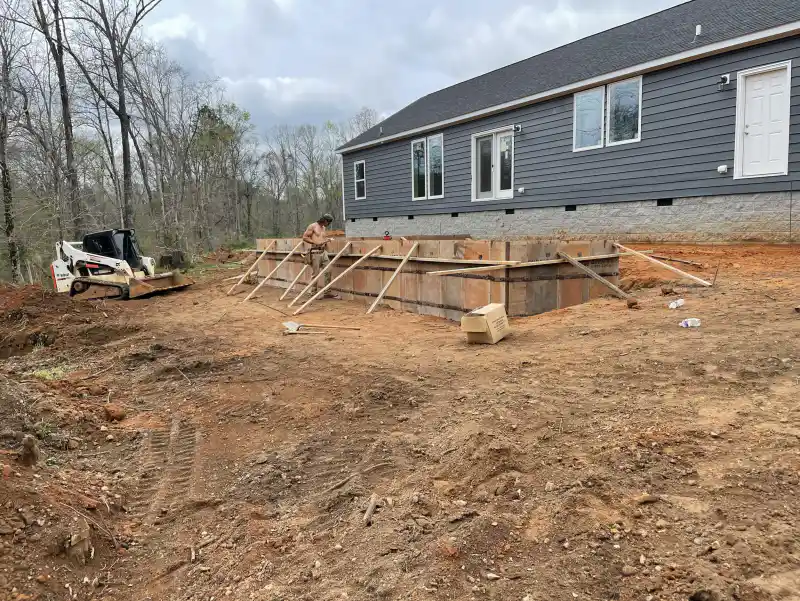
"Ace installed a small patio on a sloping area requiring a poured concrete wall on one side. They removed the existing patio block structure and installed the concrete patio in one day. The results were fantastic, better than I envisioned."
That second job is a good example of why the on-site look matters before either finish gets picked: a patio on a slope sometimes needs a short poured wall to hold the grade before any concrete goes down, broom or stamped, which is not something a quote over the phone can catch.
How long does a patio slab actually last?
The concrete under either finish is built to last regardless of what goes on top of it. The U.S. Department of Housing and Urban Development's own guide for residential builders lists exposed concrete slabs at an estimated life of 25 years, drawn from a 1997 national homeowner survey, with its only maintenance note being to inspect for cracking and reseal to keep water out. The Michigan Concrete Association's driveway page, crediting the National Ready Mixed Concrete Association, says a concrete driveway lasts "often over 30 years." That figure is written for driveways, which carry cars every day.
What changes between broom and stamped over that lifespan is maintenance, not durability. A broom finish needs essentially none. A stamped surface needs its sealer renewed every few years in the Upstate climate, as noted above, to keep the color from fading and the surface from soaking up water it was never meant to hold. Skip that resealing long enough through an Upstate winter, and the surface is back to fighting the same freeze-thaw exposure described above with none of the protection the sealer was providing.
South Carolina's own residential code backs the same range. The 2021 International Residential Code, Table R402.2, sets exterior slabs exposed to the weather, such as porches and steps, at a minimum of 2,500 psi, rising to 3,000 or 3,500 psi under the code's more severe weathering columns. A patio poured to that floor, with the base and jointing described above, is concrete built to the same code minimum every other exterior slab in the Upstate has to meet.
Questions Greenville homeowners ask us
Is stamped concrete more expensive than a broom finish?
Yes, stamped costs more than a standard broom finish: stamping adds coloring, the stamping work itself, and sealing, all on a tight clock while the concrete sets, so it takes more labor and skill, while a broom finish is the workhorse and the budget-friendly baseline. We price both on your patio so you can decide with real numbers in front of you.
Does stamped concrete hold up in Upstate SC weather?
It does when it is poured and sealed right. Stamped concrete is the same durable slab underneath; the pattern and color are on the surface, protected by a sealer. In the Upstate that sealer matters, because it is what stands up to sun, rain, and the freeze-thaw we get in January and February. Stamped surfaces need resealing every few years to keep looking their best, which is the main upkeep difference from a broom finish.
Can you match stamped concrete to my house or pavers?
Usually, yes. Stamped concrete comes in a range of patterns and colors, from stone and slate looks to wood plank, and we can tune the color to work with your home, pavers, or pool. Bring us a photo of what you are going for and we will tell you honestly how close we can get it in concrete.
Related guide: can you stain an existing concrete patio?
Who pours concrete in Greenville and the Upstate?
We at Ace Concrete Construction are a licensed South Carolina contractor (RBS.65343) based at 4706 Locust Hill Rd in Taylors, and our own crews handle every pour from grading to finish. Estimates are free, and we offer senior and military discounts. Request a free estimate online or call 864-214-5271.
What do jobs like these look like when we pour them?
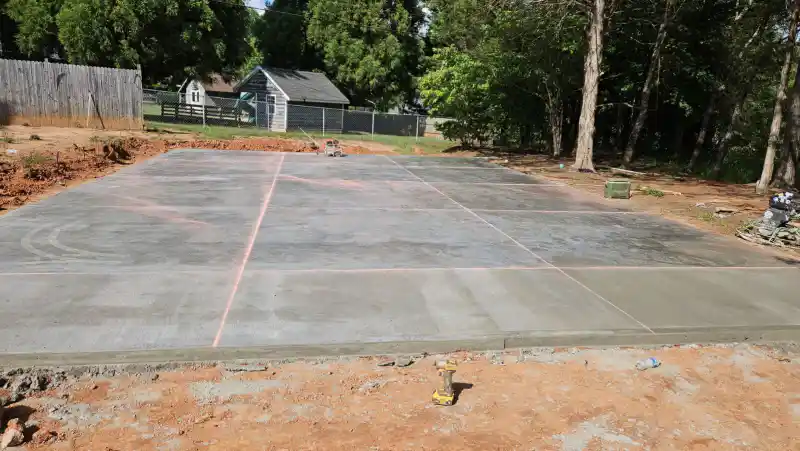
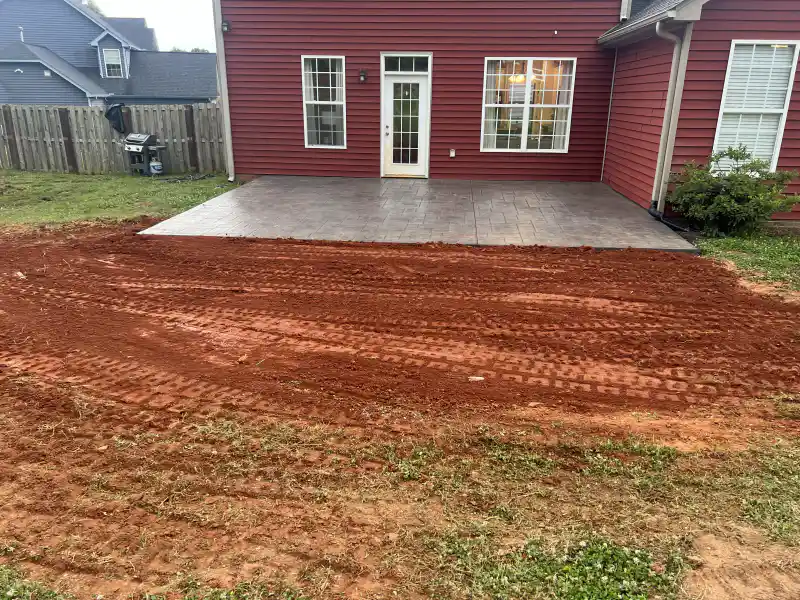
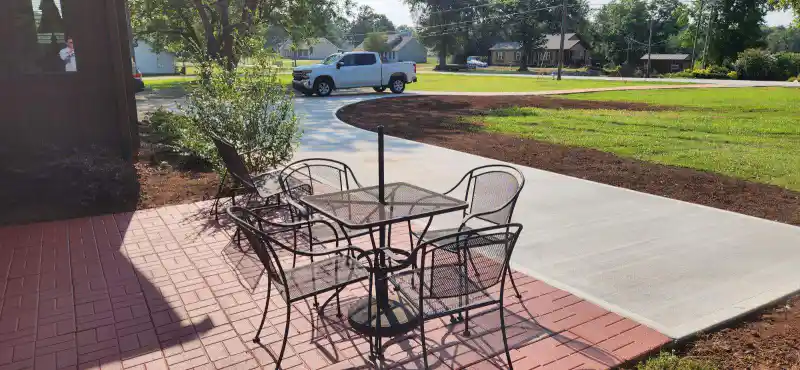
These are patio and outdoor living jobs our crews poured.
Stamping and finishing decorative concrete in Greenville and the Upstate, on video
Stamping and finishing decorative concrete. The pattern goes in during a short window while the slab is still workable.
Concrete reviews from Greenville and the Upstate
Ace concrete was excellent. They did a wonderful job. Very great experience with the workers and was very surprised that the owner showed up at the job and he actually did smoothing of…Google review
Ace installed a small patio on a sloping area requiring a poured concrete wall on one side. They removed the existing patio block structure and installed the concrete patio in one day. The results were fantastic…Google review
Ace knocked it out the park for me on a large concrete driveway pour in Taylors, SC.…Google review
Great job, the pad for our generator is perfect I highly recommendGoogle review
I needed a 24' x 40' concrete floor for a metal building. After getting several quotes I decided to go with Ace Concrete Construction.…Google review
Great work team was finished in a day and all the areas look great.Google review
Concrete guides for Greenville and Upstate homeowners
More guides from our crew on concrete work in Greenville and the Upstate.
Cracked, Lifted, or Crumbling: When to Repair a Concrete Sidewalk in Greenville and When to Replace It
Cracked, lifted, or crumbling concrete walkway or steps in Greenville? How to tell a repair from a replacement, why Upstate walks fail early, and the honest fix. Free estimates.
September 9, 2026Old Garage Floor Cracking or Flaking? When to Replace a Garage Slab in Greenville
Is your old garage floor cracking, flaking, or settling? How to tell a resurface from a full garage slab replacement in Greenville, why they fail, and what a proper pour includes. Free estimates.
September 8, 2026Freeze-Thaw in the Upstate: What January and February Do to Concrete That Was Poured Wrong
How Upstate SC freeze-thaw cracks and spalls concrete each winter, why a badly poured slab fails first, and what protects a driveway or patio. Free estimates.
Licensed concrete contractor in Greenville: who we are
Concrete service areas around Greenville
We work from our shop at 4706 Locust Hill Rd in Taylors, SC across Greenville, Spartanburg, Anderson and Laurens counties, from our offices at 10 Accountants Circle, Suite 1B in Seneca, SC and 405 S Pine St, Suite J in Spartanburg, SC, and from an office in Asheville, NC.
Free concrete patio estimates in Greenville
We price the job on site.
Concrete work we pour across the Upstate: driveway installs, garage slabs, stamped concrete, commercial jobs, and industrial jobs.
Request a concrete patio estimate in Greenville
Someone comes out and prices it standing on it. Estimates are free.
- Driveways
- Patios & Outdoor Living
- Decorative Concrete
- Garage & Building Slabs
- Foundation & Retaining Walls
- Commercial Concrete
- Industrial Concrete
- Epoxy Flooring
- Foundation Repair & Concrete Restoration
Financing available through Wisetack. Check your options in about a minute without impacting your credit score.
See financing options*All financing is subject to credit approval. Your terms may vary. Payment options through Wisetack are provided by our lending partners.
Fast & Free
Get Your Free Concrete Estimate