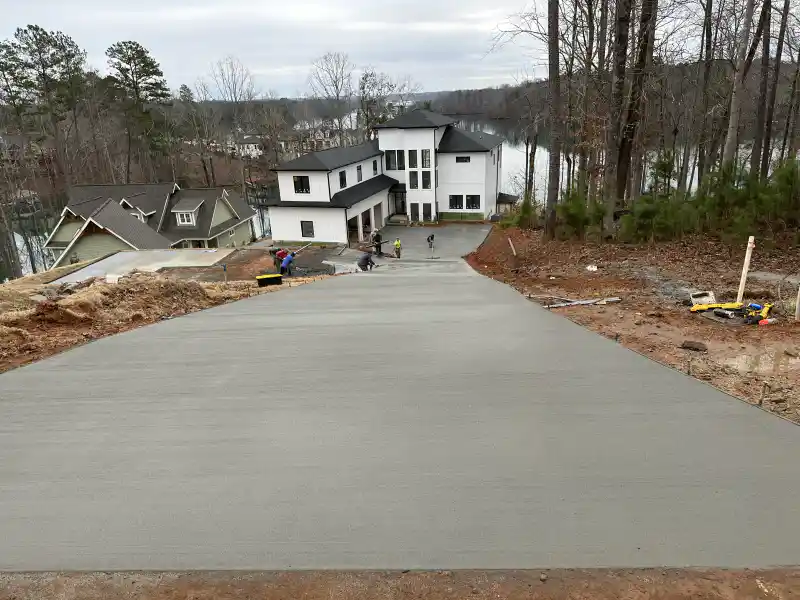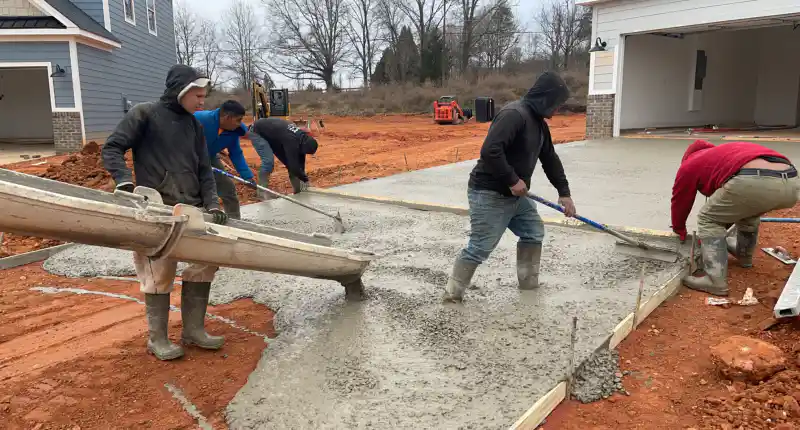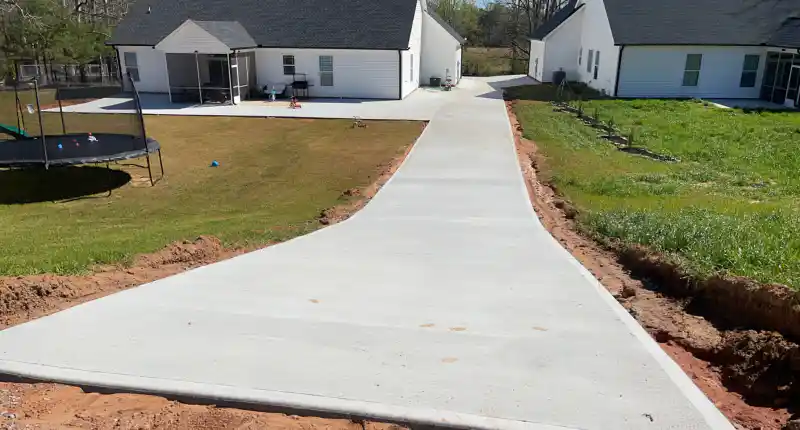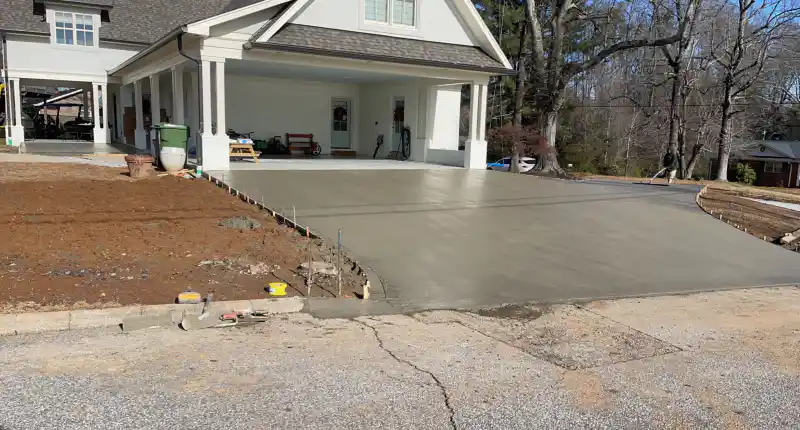
Upstate winters are mild, but they are not kind to concrete that was cut corners on. Here is what freeze-thaw does to a driveway, patio, or slab over January and February, and why a slab poured right shrugs it off.
By the crew at Ace Concrete Construction, Taylors, SC
Every winter we get calls in late February and March about driveways and patios that suddenly look older than they did in the fall. The surface is flaking, the edges are crumbling, and a crack that was hairline before Christmas is now something you can catch a shoe on. Nine times out of ten the cause is the same thing: freeze-thaw working on concrete that was not built to handle it. The good news is that it is preventable, and knowing what is happening tells you whether your concrete is at risk.
What freeze-thaw actually is
Concrete looks solid, but the surface is full of tiny pores that soak up water like a very slow sponge. When that trapped water freezes, it expands, and it pushes outward on the concrete around it. When it thaws, the pressure releases. One cycle does nothing you would notice. But repeat that freeze-and-release enough times and the surface starts to give way, flaking off in thin layers and opening up small pits. That is freeze-thaw, and it is the main way winter damages concrete in our part of the state.
The reason it matters here is counterintuitive. A place that freezes hard in December and stays frozen until spring actually puts concrete through fewer cycles. The Upstate does the opposite: it dips below freezing at night and thaws by day, over and over through January and February. More cycles means more chances for that water to freeze, expand, and work the surface loose.
Why a slab poured wrong fails first
Two driveways on the same street can go through the exact same winter and come out completely differently. The difference is how they were poured. A slab is far more likely to take freeze-thaw damage when:
The mix carried too much water
Adding extra water to a mix makes it easier to place and finish, but it leaves the hardened concrete weaker and more porous, which means more of those water-holding pores for freeze-thaw to attack. A properly proportioned mix placed at the right consistency is denser and takes on far less water.
The surface was overworked or sealed wrong
Overtroweling a surface, or finishing it while there is still bleed water on top, weakens the very top layer, and that top layer is exactly what freeze-thaw peels first. A good broom finish and, where it makes sense, a quality sealer give the surface a fighting chance against standing water.
Water had nowhere to go
Freeze-thaw needs water to work with, so the slabs that fail first are the ones where water pools. That comes back to slope and drainage. A driveway or patio that sheds water dries out between cold nights; one that holds puddles is feeding the problem every time it rains.
There was no real base under it
Most of the Upstate sits on Piedmont red clay, and clay holds moisture and moves with it. A slab poured straight onto poorly compacted clay with no proper stone base sits on wet ground all winter and moves as that ground freezes and thaws, which opens cracks that then let even more water in. Good base prep is the unglamorous work that keeps water and movement out from underneath.
The Upstate freeze-thaw pattern, up close
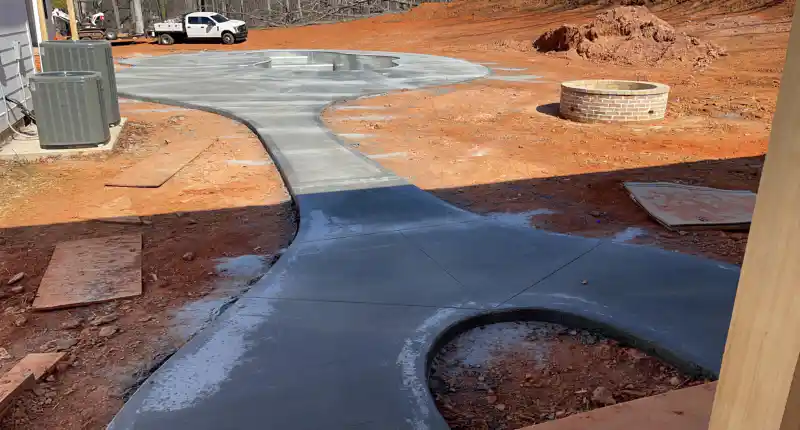
Because our winters swing across the freezing line so often, the damage here tends to show up as surface scaling and spalling rather than the dramatic heaving you see further north. It concentrates where water lingers: along control joints, at slab edges, around downspout splash zones, and in any low spot that stays damp. If your driveway has a section that is always the last to dry after rain, that is the section to watch as winter goes on.
What actually protects concrete through winter
None of the fixes are exotic. They are just the parts of the job that are easy to skimp on and impossible to add later: a correctly proportioned mix, a compacted stone base over the clay, slope that moves water off the slab, control joints cut so the concrete cracks on a clean line instead of wandering, a sound finish, and a sealer where the exposure calls for one. Get those right and an Upstate winter is a non-event for your concrete. Skip them and every January chips away at it a little more. It is the same reason we tell homeowners that fall is the best window to pour in the Upstate, so the slab is fully cured and protected before the first freeze arrives.
Signs your concrete already took freeze-thaw damage
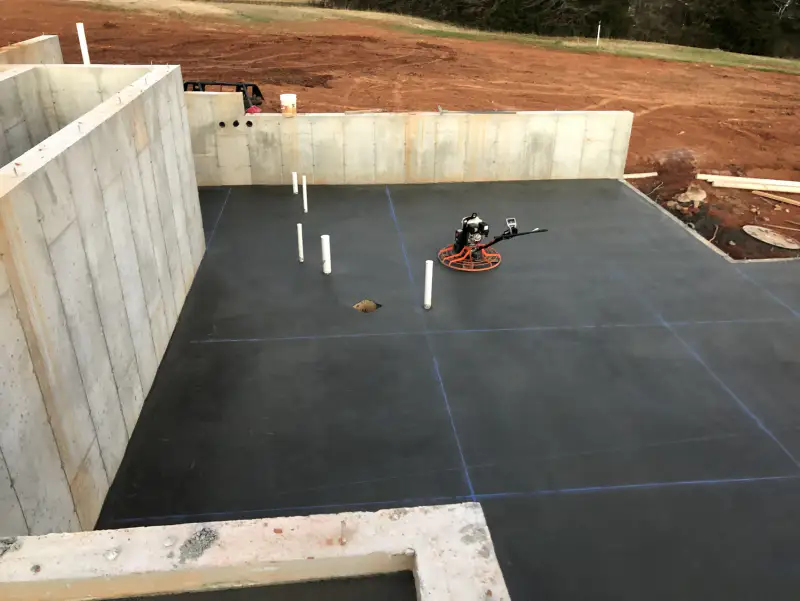
Walk your driveway, patio, and any exterior slabs after a cold stretch. The surface flaking off in thin sheets or dime-sized pits, especially near joints and edges, is the classic early tell. A crack that has opened wider than it was in the fall is another. So is any section that moves or sounds hollow underfoot, or a rough, exposed texture where the smooth top used to be. Surface scaling caught early can often be cleaned up and sealed. Damage that has worked deep, or joints that have broken apart, is usually telling you the slab has reached the end of a patch-it approach, and our concrete repair and tear-out crew can lay out the options once we see how far it has gone. If you are not sure whether a crack is cosmetic or serious, our guide to concrete crack repair in Greenville walks through how to read them.
Build it to last the winters, not just the summer
A new driveway or patio looks great in July no matter how it was poured. Winter is the test. If you are planning a new concrete driveway or concrete slab, the base prep, drainage, joints, and mix are what decide whether it still looks new after five Upstate winters. That is where we spend the effort you never see, because it is the part you cannot go back and add once the concrete is down.
Questions Upstate property owners ask us
Does the Upstate SC actually get enough cold to cause freeze-thaw damage?
Yes, and the pattern here is the tricky part. The Upstate does not get a deep, steady freeze the way the mountains do, but January and February bring stretches where it drops below freezing overnight and climbs back above it by afternoon. Concrete that keeps freezing and thawing takes more of a beating from that back-and-forth than from one long cold snap, because every cycle is another chance for water inside the surface to freeze and push.
What does freeze-thaw damage look like on a driveway or patio?
The early signs are surface flaking and small pits, called scaling and spalling, usually worst along edges, joints, and low spots where water sits. You may see the smooth top layer peeling away to show the rougher concrete underneath, or hairline cracks that were there last fall opening wider. If you catch it early it is a surface problem; left alone through a few winters it works deeper into the slab.
Can freeze-thaw damage be repaired, or does the concrete have to be replaced?
It depends how far it has gone. Surface scaling on an otherwise sound slab can often be cleaned up and protected. Once the damage runs deep, the joints have opened, or sections have started to break apart, patching stops being worth it and a tear-out and repour is the honest fix. We look at how deep it goes before we tell you which one you are dealing with, so you are not paying to patch a slab that needs replacing.
Get on the schedule
Ace Concrete Construction is a licensed South Carolina contractor (RBS.65343) based at 4706 Locust Hill Rd in Taylors, and our own crews handle every pour from grading to finish. Estimates are free, and we offer senior and military discounts. Request a free estimate online or call 864-214-5271. We answer seven days a week, 7am to 7pm.