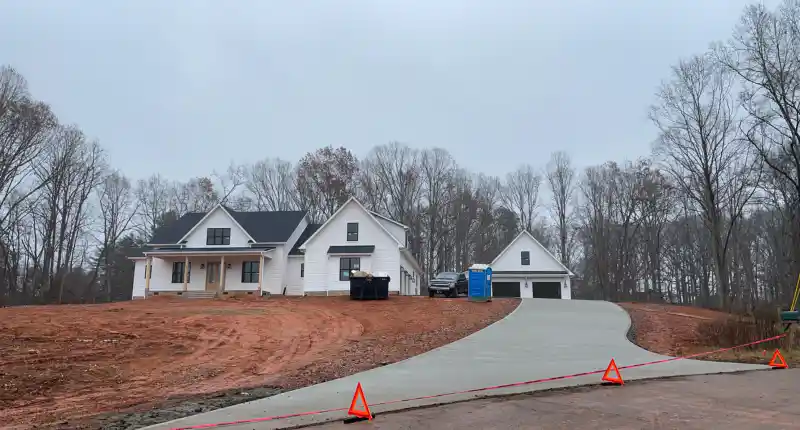
Sealing a concrete driveway in the Upstate is worth considering, but it is the last layer of protection. The National Ready Mixed Concrete Association (NRMCA) lists a breathable sealer as one of its steps for preventing winter damage to exterior slabs. Most of its other steps happen on pour day.
Below is what a sealer protects a Greenville or Upstate driveway against, and what has to be right before it can help.
What a sealer does for a concrete driveway
The main threat to a driveway surface here is scaling, the flaking or peeling of the top layer. NRMCA's technical sheet on scaling (CIP 2) explains the cause: when concrete is saturated with water and the temperature drops toward freezing, the water expands as it turns to ice and stresses the concrete. The more freeze-thaw cycles, the higher the risk, and deicing salts make it worse by keeping the surface wetter.
A sealer works by keeping water out of the surface. CIP 2 recommends a commercially available silane or siloxane-based breathable sealer or water repellent made for concrete slabs, applied following the manufacturer's directions.
How much freeze-thaw an Upstate driveway gets
NOAA's 1991-2020 climate normals for the Greenville-Spartanburg airport station show about 54 nights a year at or below freezing, and about 41 of them fall in December, January and February. A driveway that holds water through those nights is the kind of surface CIP 2 is written about.
Our guide to freeze-thaw damage in the Upstate goes deeper on what that winter pattern does to concrete.
What matters more than the sealer
CIP 2 lists the usual causes of scaling, and a sealer addresses none of them directly. Five of the six are settled on pour day.
| Common cause of scaling (NRMCA CIP 2) | What prevents it |
|---|---|
| No entrained air, or too little | Air-entrained concrete; CIP 2 recommends 6 percent total air for concrete with 3/4 or 1 inch stone |
| Low-strength concrete that lets water in | A 4,000 psi mix for exterior slabs that stay moist and see deicers, in line with ACI 332 |
| Extra water added at the truck | Placing at a 3 to 5 inch slump and using water reducers instead of water |
| Finishing with bleed water on the surface, or overworking it | Waiting for bleed water to leave; CIP 2 says a broom finish is adequate for most exterior surfaces |
| Poor curing | Proper curing, with a curing compound or wet burlap and plastic |
| Heavy deicing salt, especially in the first winter | Sand for traction the first winter, moderate salt after that |
CIP 2 lists the sealer as one rule among six, and four of the other five are about the concrete and how it is placed. The fifth is go easy on deicing salt. You can read how we approach the pour itself on our concrete driveway page.
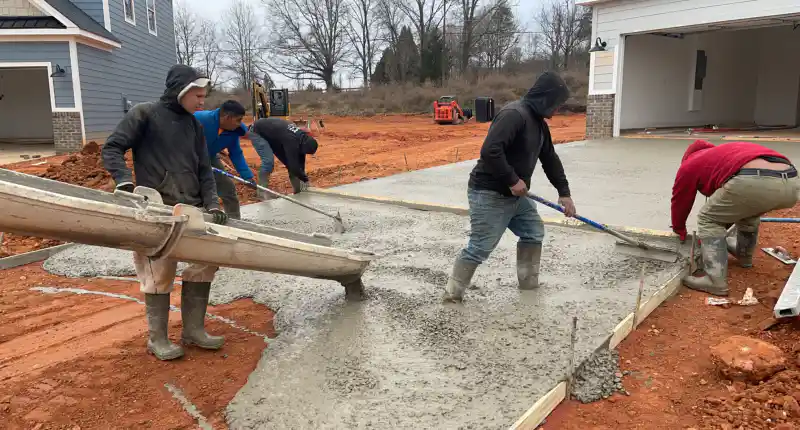
When to seal, and how
CIP 2 says the concrete should be reasonably dry before a sealer goes on, and names late summer, after a few dry days, as an ideal time. On a brand-new driveway, follow the sealer label for how long the concrete has to cure before it can be applied.
If you are planning a new driveway this time of year, the pour date matters too. CIP 2 cautions against placing exterior concrete in late fall, winter or early spring when it could freeze while still saturated. Our guide to pouring concrete in fall in the Upstate covers the weather side.
Stamped and colored driveways are a different case. Their color and pattern sit at the surface, and the sealer is part of the finish. Our stamped vs broom finish guide covers resealing for decorative concrete.
The first winter on a new driveway
CIP 2's advice for new concrete is to avoid deicing chemicals in the first winter if possible and use clean sand for traction instead. After that, use salt in moderate amounts. It names calcium chloride and sodium chloride (rock salt) as acceptable, and says never to use ammonium sulfate, ammonium nitrate or magnesium-based salts, which attack the concrete surface. Road salt tracked in on tires collects on driveways and garage slabs, so hosing it off when the weather allows helps too.
What if the driveway is already flaking?
CIP 2 treats minor scaling as a cosmetic issue that may not need repair. Light to moderate scaling can be repaired with a thin bonded resurfacing over sound, cleaned concrete, though the repair will not match the color of the original. Excessive scaling that keeps progressing may not be practical to repair at all. Our guide to driveway repour vs resurfacing walks through that call.
If you are weighing a new driveway, or want someone to look at the one you have, our concrete driveway service page covers how we build them, and the estimate form below gets a person out to see it.
Sources: NRMCA, Concrete in Practice CIP 2, Scaling Concrete Surfaces (read October 5, 2026); NOAA NCEI 1991-2020 U.S. Climate Normals, Greenville-Spartanburg Airport station USW00003870.