
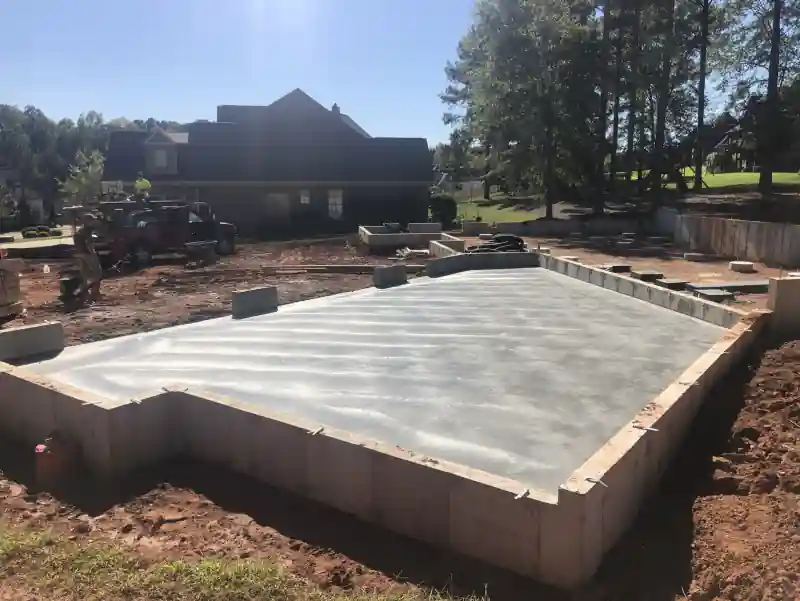
Cement vs Concrete: What Is the Difference?
Cement is an ingredient. Concrete is what you get when that cement is mixed with water, sand and gravel or crushed stone, and the American Cement Association puts cement at typically 10 to 15 percent of the mix by volume. So a "cement driveway" is a concrete driveway, one where the cement is the smaller part.
Last updated
- SC licence RBS.65343
- 20+ years in the trade
- Free on-site estimates
- Financing through Wisetack
Fast & Free
Get Your Free Concrete Estimate
Cement is an ingredient. Concrete is what you get when that cement is mixed with water, sand and gravel or crushed stone, and the American Cement Association puts cement at typically 10 to 15 percent of the mix by volume. So a "cement driveway" is a concrete driveway, one where the cement is the smaller part.
By the crew at Ace Concrete Construction, Taylors, SC
Lots of people in the Greenville area search for a "cement driveway" or a "cement patio," and any concrete contractor knows what they mean. The difference is still worth five minutes, mostly because it explains why a new slab needs time before you park on it.
What is cement?
Cement is a fine gray powder, and the kind used in concrete is portland cement. Per the American Cement Association, it starts as limestone, clay and sand pulled from a quarry, which get ground, blended and run through a kiln where a flame takes the material to about 2,700 degrees Fahrenheit. What comes out is called clinker. A ball mill grinds the clinker with gypsum into the finished powder, about 150 billion grains per pound by their count.
Mixed with water it turns into a paste, and the paste is what sets.
What goes into concrete?
Cement, water, sand and stone. The cement and water make a paste that coats every piece of sand and stone, and once it hardens the whole thing is one solid mass. Sand and stone take up most of the volume, which is the reason the mix you get delivered is mostly rock. The ACA calls portland cement the basic ingredient of concrete, and a driveway and a commercial pad start from that same short list, in different amounts and thicknesses.
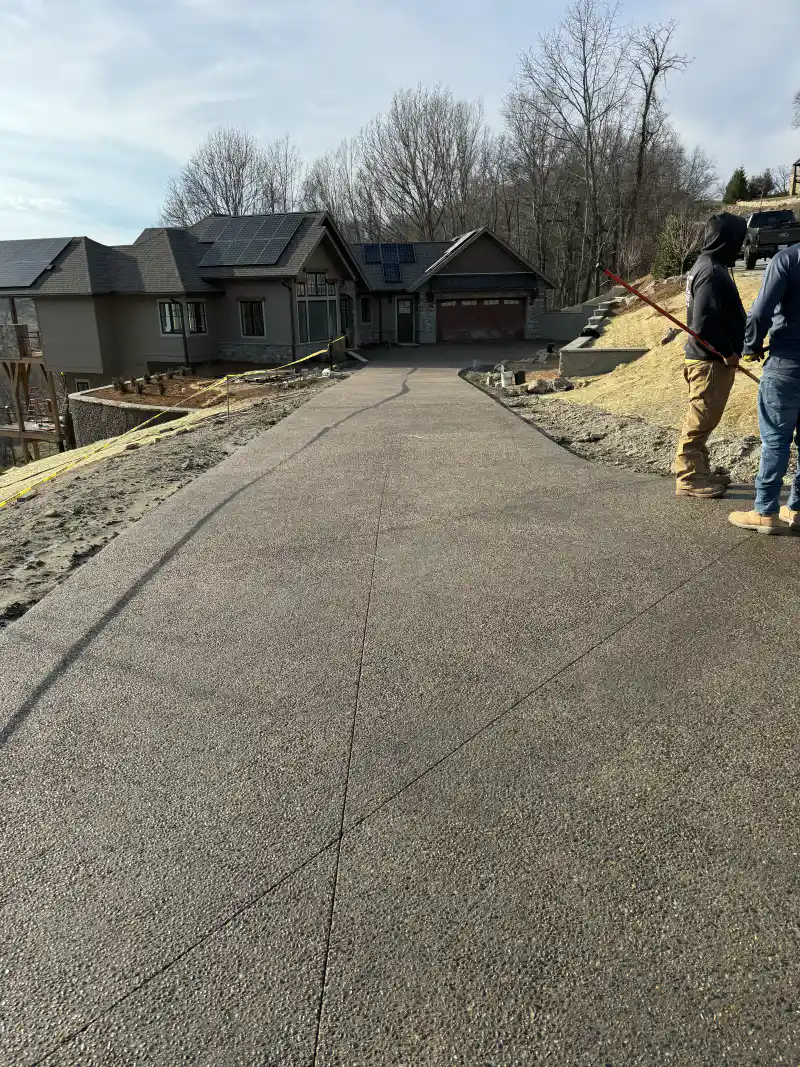
Exposed aggregate shows you the inside of that mix. The paste on the surface is taken off before it sets, so the stone sits right at the top, like the driveway in this photo from one of our jobs. Stamped and colored finishes are a different route to a decorative surface, and our decorative concrete page shows the ones we pour.
Why people say cement driveway
Mostly habit, and nobody on a job site is going to correct you. When you collect quotes you're pricing concrete either way, and what separates one quote from another is usually the base under the slab and how it's reinforced. For what it's worth, our crews are all in-house.
Where the steel goes
Rebar isn't part of the mix. It goes into the forms before the truck shows up, set on supports so the concrete flows around it and the steel ends up inside the slab instead of lying on the dirt under it.
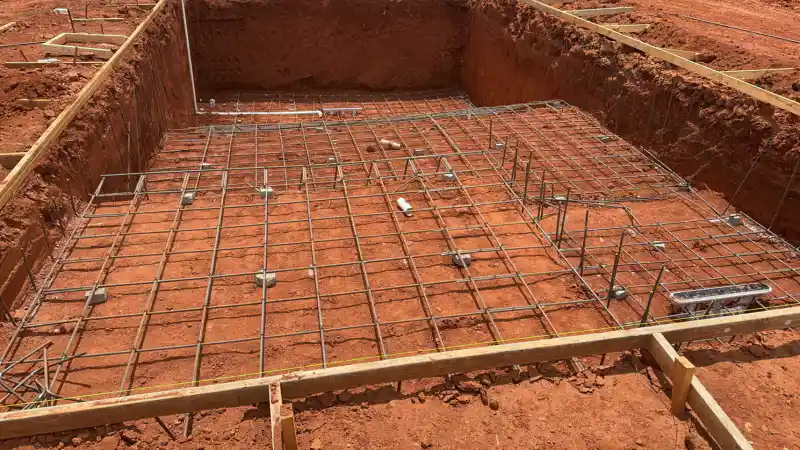
Whether a particular slab calls for steel, and how much, depends on the job, so ask about it when you get a quote. Our concrete slab page covers the slabs we pour for garages, shops and buildings.
How does concrete harden?
Concrete hardens because the cement reacts with the water, a chemical reaction, and not because the water evaporates. The ACA's wording is that as the cement reacts with the water it binds the aggregates into a rock-like mass. The same source says concrete keeps gaining strength over time, with most of it developing in the first few weeks after placement.
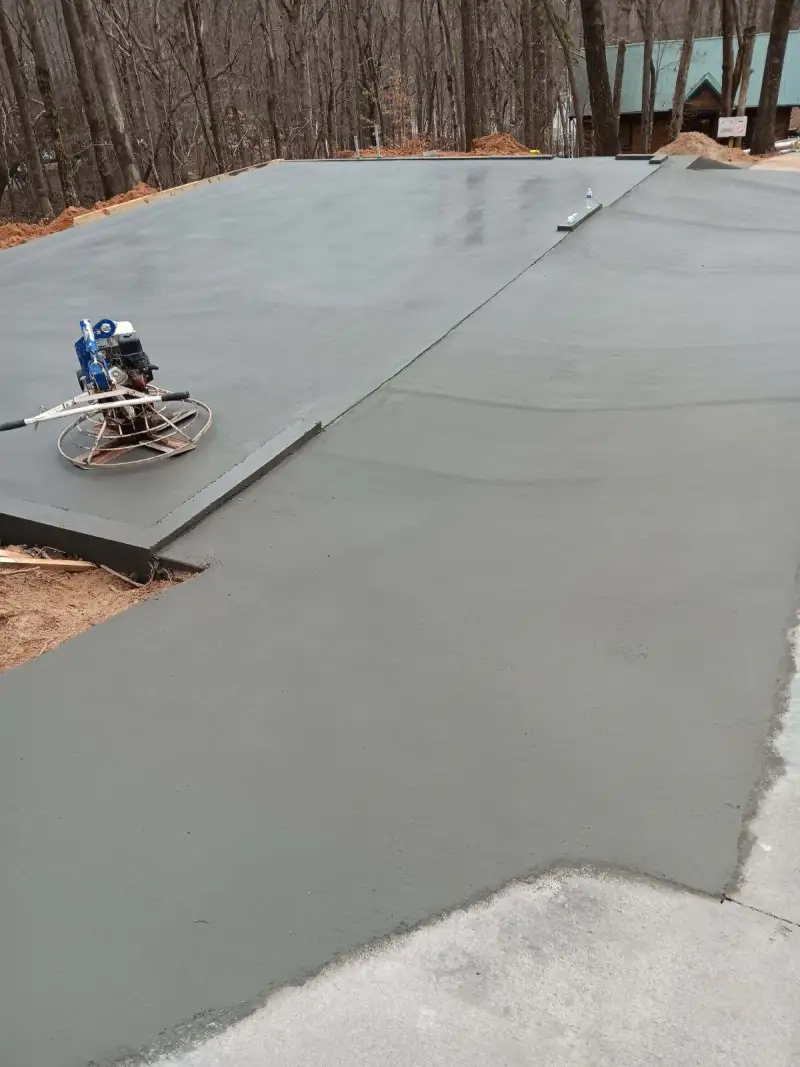
A slab that looks hard the next morning is still gaining strength for weeks, so the crew will tell you when it's ready to walk on and when it can take a car. Pour-day weather matters for the same reason, and we wrote about why fall is a good window to pour in the Upstate. If you're still choosing a surface, our guide to concrete vs asphalt driveways is the next read.
How strong does concrete need to be around a house?
Cement content and water are what set concrete's strength, and building codes put numbers on how strong is strong enough. Table R402.2 of the 2021 International Residential Code sets minimum 28-day compressive strengths by how exposed a pour is to weather. Foundations and interior slabs that never see weather need at least 2,500 psi at every weathering level. Exposed walls and other above-grade work step up to 2,500, 3,000 or 3,000 psi depending on the weathering category where the job sits. Porches, carport slabs, steps and garage floor slabs need 2,500, 3,000 or 3,500 psi. A note on that same table lets a steel-troweled garage floor drop its air content to as little as 3 percent if the mix is raised to at least 4,000 psi instead. Which weathering column applies on a given lot is set by the jurisdiction's own local Table R301.2.
None of this is a target to aim for, it's the code floor, the least concrete is allowed to be, and South Carolina cities are already enforcing that 2021 edition. Spartanburg's own Building Inspections department says publicly that the city began enforcing the 2021 International Codes, along with the 2020 National Electrical Code, on January 1, 2023, which is the same code edition Table R402.2 above comes from. The American Concrete Institute's residential concrete standard, ACI CODE-332-20, covers this same territory in more depth: it sets requirements for cast-in-place concrete on one- and two-family homes and townhouses, including footings, foundation walls and slabs-on-ground specifically, rather than commercial paving. The full standard and its own strength tables sit behind ACI's paywall, so for the actual numbers a homeowner or contractor works from, Table R402.2 above is the citable source.
How long does concrete need to cure before it reaches that strength?
Cement doesn't stop reacting with water the day the truck leaves, and curing is the industry's word for keeping that reaction going long enough for the concrete to reach the strength a table like R402.2 assumes. The National Ready Mixed Concrete Association's CIP 11 sheet on curing in-place concrete says curing should begin immediately after placement and finishing and continue for a sufficient period of time, typically 3 to 7 days, with the concrete's own temperature kept above 50 degrees Fahrenheit. The Federal Highway Administration's guide to curing concrete pavements, summarizing the older ACI 308-92 standard practice for curing concrete, puts a similar number on pavements and slabs: cure for 7 days, or until the concrete reaches 70 percent of its specified strength, above 5 degrees Celsius, about 41 Fahrenheit. A newer standard the same FHWA guide summarizes, ACI 308.1-98, sets a 7-day default above 10 degrees Celsius, about 50 Fahrenheit, with the same early-stop rule at 70 percent of design strength.
Those numbers are minimums for the chemistry, not the same thing as when a slab can safely carry weight. A parking lot standard, ACI 330R-92, is more specific about traffic: it is summarized as recommending pavement open to passenger car traffic no sooner than 3 days and to all other traffic no sooner than 7 days, when temperatures stay above 16 degrees Celsius, about 61 Fahrenheit, with more time needed in cooler weather. Upstate SC pours in a shoulder season, like the ones we cover in our guide to fall pouring in the Upstate, sit close to that temperature line, which is one more reason the crew pouring your slab, not a blanket rule found online, should be the one telling you when it's ready to walk or drive on.
Who is actually allowed to pour concrete in South Carolina?
South Carolina licenses two different kinds of residential concrete contractor, and the line between them is dollars, not the type of work. Under the state's residential builder law, anyone who constructs, repairs or improves a residential building or structure, which can include driveway, patio or slab work, needs a residential builder license once a job's cost passes $5,000. Below $5,000 but above $500, the same law treats that work as residential specialty contracting, a category built for trades like masonry and carpentry that the state's separate commercial rules don't reach; the statute does not list concrete as a trade of its own.
Getting a residential builder license takes more than passing a test. State law requires the Residential Builders Commission to issue that license only once the applicant either posts a surety bond of at least $15,000 or gives the Commission proof of financial responsibility it accepts, and the Commission's own registration instructions set a $5,000 bond for a residential specialty contractor once a single job for one property owner tops $5,000 in materials and labor. Workers' compensation coverage is one factor the Commission may weigh when it licenses a residential builder, but state law does not make it a flat condition of the license. Separately, South Carolina's Workers' Compensation Act itself only applies to a business once it regularly employs four or more people in the state, or paid more than $3,000 in total payroll the year before, so a smaller outfit sits outside that law altogether, whatever kind of concrete work it does.
On the commercial side, a different board, the Contractor's Licensing Board, groups driveways, parking lots and sidewalks over $100,000 under a subclassification the state defines as Concrete Paving, which it spells out as covering "the construction, rehabilitation and repair of concrete streets, roads, highways, driveways, parking lots, airport runways and aprons, and concrete work incidental thereto including, but not limited to, sidewalks, curbs, medians, and barrier walls." That subclassification requires the bidding contractor to pass a financial test tied to job size: a Group One general contractor, bidding jobs up to $100,000, needs $20,000 in net worth or $10,000 in working capital on file with the state. None of this tells a homeowner what a fair concrete price looks like, but it's worth asking whoever quotes a driveway or patio which license covers the job, and what it's bonded for.
What a 4,000 psi mix looks like on a real Upstate job
The numbers above are code minimums and standards language, not what every homeowner asks for. One Upstate customer, in a five-star Google review about replacing a front driveway, a curb and two sidewalks, wrote that the salesperson on the job "didn't insist we not overdo it," because the old cement driveways "were a total wreck" and the household wanted "tough as nails replacements," specifically calling out "4,000 psi, fiber and wire" in the quote. That's 500 psi above the IRC's top garage-floor number, and it's the same 4,000 psi threshold the code allows a crew to trade for a lower air content on a steel-troweled garage floor. It's a good reminder that the code numbers are a floor: what a particular slab actually gets poured at is a conversation between the homeowner and whoever is holding the quote.
Questions Upstate homeowners ask
Is a cement driveway in Greenville the same thing as a concrete driveway?
Yes. What gets called a cement driveway is a concrete driveway. Cement is one ingredient, typically 10 to 15 percent of the mix by volume according to the American Cement Association, and water, sand and stone make up the rest.
Why can't I drive on a new concrete driveway right away?
Concrete gets its strength from the cement reacting with the water, and most of that strength develops over the first few weeks after the pour. Your contractor should tell you when the slab is ready for foot traffic and when it's ready for a vehicle.
Is an exposed aggregate driveway in the Upstate still concrete?
Yes. It's ordinary concrete where the paste on the surface is removed before it sets, so the sand and stone that were inside the mix show on top instead of a smooth or broomed finish.
If you're planning a new driveway, our concrete driveway page has the details, and you can request a free estimate from there.
What do jobs like these look like when we pour them?
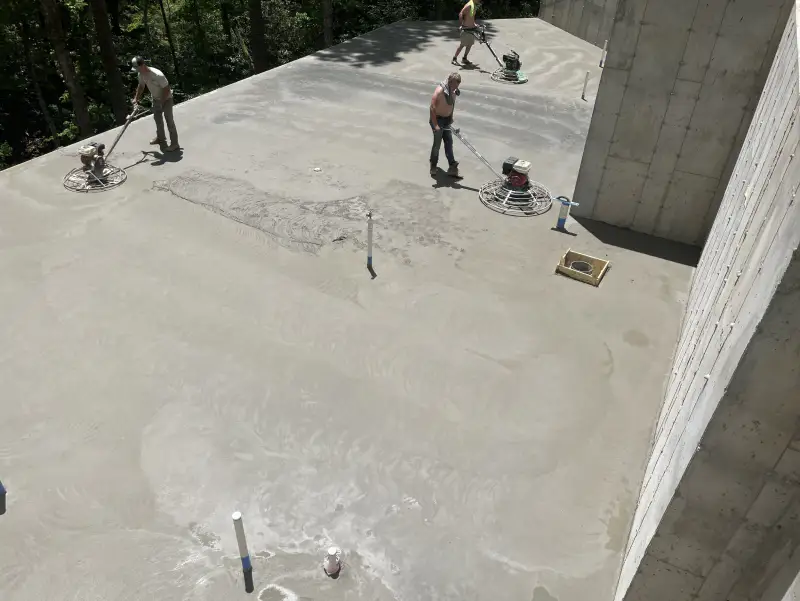
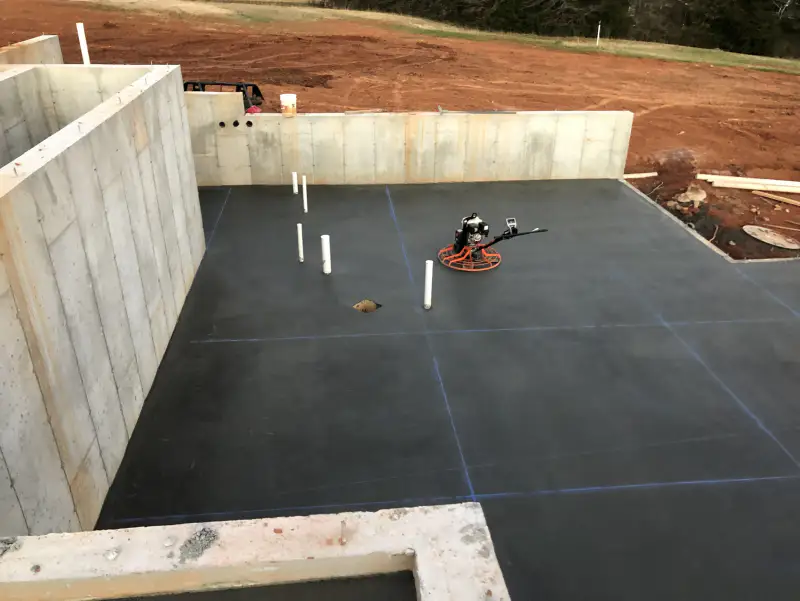
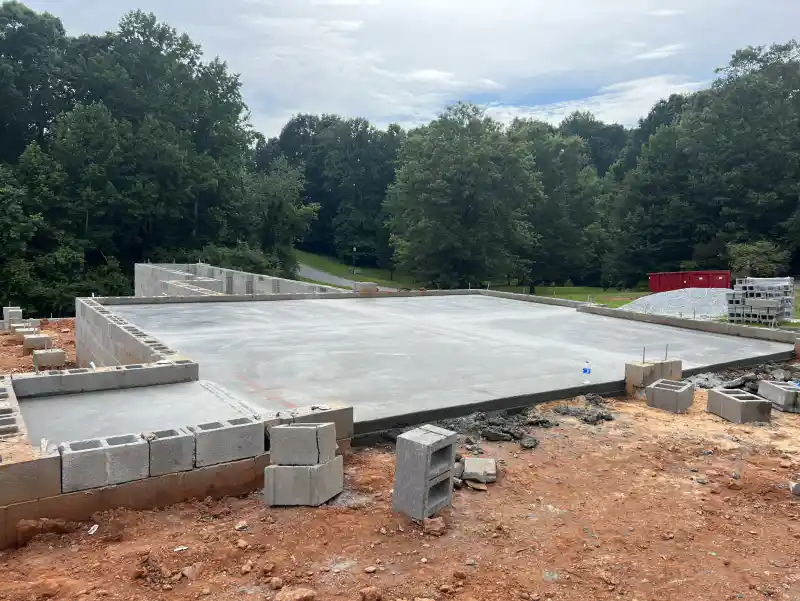
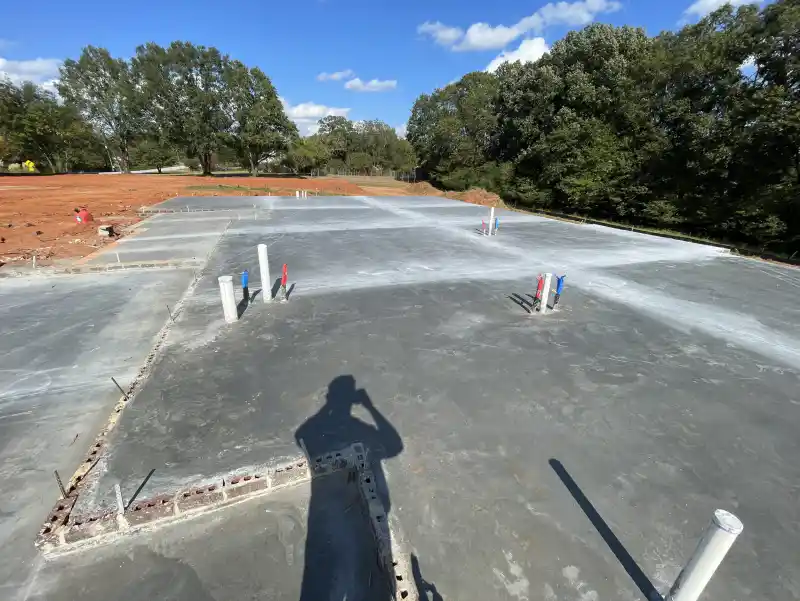
These are garage and building slabs our crews poured.
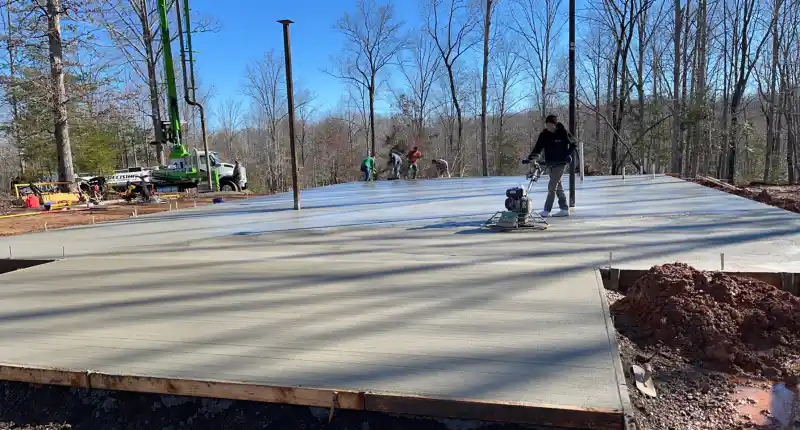
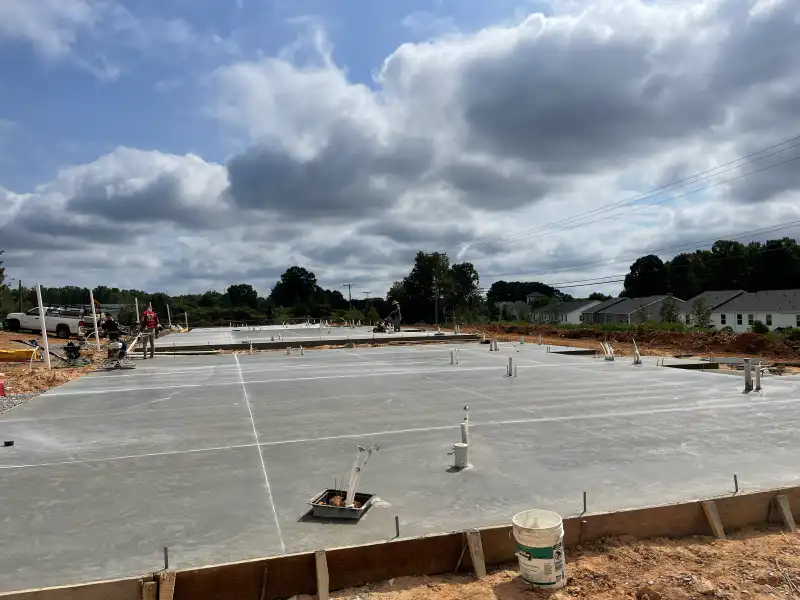
Pouring garage and building slabs in Greenville and the Upstate, on video
A building slab from forms to finish: perimeter set, reinforcement placed, concrete placed and screeded, then floated and finished flat.
Concrete reviews from Greenville and the Upstate
Ace concrete was excellent. They did a wonderful job. Very great experience with the workers and was very surprised that the owner showed up at the job and he actually did smoothing of…Google review
Ace installed a small patio on a sloping area requiring a poured concrete wall on one side. They removed the existing patio block structure and installed the concrete patio in one day. The results were fantastic…Google review
Ace knocked it out the park for me on a large concrete driveway pour in Taylors, SC.…Google review
Great job, the pad for our generator is perfect I highly recommendGoogle review
I needed a 24' x 40' concrete floor for a metal building. After getting several quotes I decided to go with Ace Concrete Construction.…Google review
Great work team was finished in a day and all the areas look great.Google review
Concrete guides for Greenville and Upstate homeowners
More guides from our crew on concrete work in Greenville and the Upstate.
Cracked, Lifted, or Crumbling: When to Repair a Concrete Sidewalk in Greenville and When to Replace It
Cracked, lifted, or crumbling concrete walkway or steps in Greenville? How to tell a repair from a replacement, why Upstate walks fail early, and the honest fix. Free estimates.
September 9, 2026Old Garage Floor Cracking or Flaking? When to Replace a Garage Slab in Greenville
Is your old garage floor cracking, flaking, or settling? How to tell a resurface from a full garage slab replacement in Greenville, why they fail, and what a proper pour includes. Free estimates.
September 8, 2026Freeze-Thaw in the Upstate: What January and February Do to Concrete That Was Poured Wrong
How Upstate SC freeze-thaw cracks and spalls concrete each winter, why a badly poured slab fails first, and what protects a driveway or patio. Free estimates.
Licensed concrete contractor in Greenville: who we are
Concrete service areas around Greenville
We work from our shop at 4706 Locust Hill Rd in Taylors, SC across Greenville, Spartanburg, Anderson and Laurens counties, from our offices at 10 Accountants Circle, Suite 1B in Seneca, SC and 405 S Pine St, Suite J in Spartanburg, SC, and from an office in Asheville, NC.
Free concrete estimates in Greenville
We price the job on site.
Concrete work we pour across the Upstate: driveway installs, garage slabs, stamped concrete, industrial jobs, patios and outdoor living, and retaining wall work.
Request a concrete estimate in Greenville
Someone comes out and prices it standing on it. Estimates are free.
- Driveways
- Patios & Outdoor Living
- Decorative Concrete
- Garage & Building Slabs
- Foundation & Retaining Walls
- Commercial Concrete
- Industrial Concrete
- Epoxy Flooring
- Foundation Repair & Concrete Restoration
Financing available through Wisetack. Check your options in about a minute without impacting your credit score.
See financing options*All financing is subject to credit approval. Your terms may vary. Payment options through Wisetack are provided by our lending partners.
Fast & Free
Get Your Free Concrete Estimate