
Concrete vs Asphalt Driveway: Which One Suits a Greenville, SC Home?
For a house you plan to stay in, concrete is usually the driveway that holds up longer and needs less work each year. Asphalt usually costs less up front. On a lot of Greenville County roads the answer is some of each, because the county has a rule about the strip closest to the road.
Last updated
- SC licence RBS.65343
- 20+ years in the trade
- Free on-site estimates
- Financing through Wisetack
Fast & Free
Get Your Free Concrete Estimate
For a house you plan to stay in, concrete is usually the driveway that holds up longer and needs less work each year. Asphalt usually costs less up front. On a lot of Greenville County roads the answer is some of each, because the county has a rule about the strip closest to the road.
By the crew at Ace Concrete Construction, Taylors, SC
We pour concrete and don't pave asphalt, so weigh our side of this with that in mind.
Both work in the Upstate. Which one fits comes down mostly to how long you'll own the place and what you want to spend now, and on a county road with no curb, the last few feet have to be asphalt anyway.
What is the difference between a concrete and an asphalt driveway?
Both start as crushed stone and sand. In asphalt a petroleum-based binder holds it together, in concrete it's portland cement and water, and pavement engineers file the two under different names: asphalt is a flexible pavement, concrete a rigid one.
Flexible means an asphalt drive gives a little under a heavy load and moves with the ground under it. A concrete slab spreads the load out instead, and when it does give up, it cracks. That is why joints get cut into a concrete driveway on purpose, so the crack lands on a straight line where you want it. If you're curious what the cement part of concrete actually is, we wrote up cement vs concrete separately.
How does each one handle an Upstate summer?
An Arizona pilot study cited by the EPA found conventional asphalt reaching surface temperatures up to 152 degrees Fahrenheit at midday. On a July afternoon here that binder can soften, and it can scuff where a tire turns in place or dent under a trailer jack left sitting on it.
Concrete stays hard in the heat. It's also lighter in color and reflects more of the sun. Oil and gas drips are worth a thought too, since petroleum can eat into an asphalt surface; on concrete a drip mostly leaves a stain you clean up.
Red clay and the base underneath
Upstate red clay swells when it's wet and shrinks when it dries, and a driveway on a thin base goes along for the ride whichever surface it has. That's the reason for a compacted stone base under any driveway, and enough fall on the surface that rain runs off instead of soaking the clay at the edges.
Winter is the other half of it. Our post on freeze-thaw concrete damage in the Upstate goes into what January and February do to a slab that was built wrong.
What is Upstate red clay, technically, and why does it move so much?
The clay under most Greenville County driveways has an official name and an official description. USDA's soil survey classifies it as the Cecil series, "fine, kaolinitic, thermic Typic Kanhapludults," found on "interstream divides, ridges, and side slopes" of the Piedmont uplands, formed in residuum weathered from felsic igneous and high-grade metamorphic rock, the granite and gneiss that make up the ground under the Upstate. The series was first described in Cecil County, Maryland in 1899 and is now mapped across a large extent of the Piedmont from Virginia through North Carolina, South Carolina, Georgia and Alabama.
USDA's series description puts the subsurface horizon at "clay loam, clay, or sandy clay," rated well drained with moderately high saturated hydraulic conductivity but only medium surface runoff. In plain terms, that subsurface layer is mostly clay rather than sand or loam, and clay particles hold water and swell when wet, then shrink as they dry out. A driveway base sitting on that kind of soil moves with the season unless the stone base under the slab, and the surface's own drainage, are doing the job of keeping water from reaching the clay directly under the pavement.
USDA's series description also lists the Cecil profile as "very deep" with slopes running from 0 to 25 percent, which matches the rolling terrain most Upstate lots sit on. That depth is worth noting on its own: a soil this deep does not stop moving a few inches down, so a driveway base has to be built on properly compacted stone rather than counting on the clay itself to stay put under the load.
What does a concrete mix built for freezing and thawing actually require?
Engineers do not leave freeze-thaw resistance to chance; it is a written specification. The Portland Cement Association's own durability requirement for concrete that will face freezing, thawing and deicing salts calls for air-entrained concrete with 5 to 8 percent total air content and a maximum water-cement ratio of 0.45. Those tiny, deliberately mixed-in air bubbles give the water already inside the concrete somewhere to go when it freezes and expands, instead of pushing outward against the surrounding paste and cracking it from the inside.
Timing matters too. NRMCA's CIP 27 says concrete that will sit saturated with water and face cycles of freezing and thawing needs to reach a compressive strength of at least 3500 psi before that first freeze-thaw season arrives, well above the roughly 500 psi threshold where fresh concrete is simply safe from freezing at all. That two-tier standard, protected from freezing within about two days, but not truly freeze-thaw ready until it has gained most of its strength, is the reason the timing of a pour matters as much as the mix design itself for anything poured close to winter in the Upstate.
The ready-mix side of the spec matters too. ASTM C94, the standard both NRMCA and PCA point to for ready mixed concrete, is the reference a producer works from to keep aggregate source, cement type and slump inside the range a durable driveway mix calls for once the pour starts, since adding water at the jobsite to loosen a mix that has started to stiffen is one of the more common ways a freeze-thaw-rated mix ends up short of its own spec.
Why do control joints get cut into a concrete driveway, and how far apart do they go?
NRMCA's CIP 6 spells out the spacing rule finishers actually use: maximum joint spacing should run 24 to 36 times the slab's thickness, which works out to roughly 10 feet on a standard 4-inch residential driveway, and the guide recommends staying under 15 feet even on thicker slabs. Each panel the joints create should be close to square, since CIP 6 flags any panel whose length runs more than 1.5 times its width as more likely to crack outside the joint lines the crew intended.
Depth matters as much as spacing. CIP 6 calls for a contraction joint groove at least one-quarter of the slab's thickness, and a sawed joint specifically has to be cut within 4 to 12 hours of finishing, early enough to guide the crack before the slab shrinks on its own, but late enough that the blade does not tear or ravel the fresh edges. Get the spacing or the timing wrong and the concrete still cracks, just wherever it wants to instead of on the line the joint was cut to control, which is the whole point of jointing a slab in the first place.
Why does a driveway need isolation joints as well as control joints?
Control joints are only half of what NRMCA's CIP 6 covers. The other kind, isolation joints, exist to "separate or isolate slabs from other parts of the structure, such as walls, footings, or columns; and driveways and patios from sidewalks, garage slabs, stairs, lightpoles and other points of restraint," in the guide's own words. A driveway that ties directly into a garage slab or a front walk without one of these joints has no room to move independently of the concrete next to it, and CIP 6 says that restraint is exactly what drives cracking at those junctions.
Isolation joints get filled differently than control joints do. CIP 6 calls for premolded joint filler, materials like asphalt-impregnated fiber sheeting or compressible foam strips, rather than a plain saw cut, so the two slabs can expand and contract without transferring stress across the joint. On a typical Greenville driveway that means a strip at the garage apron and another where the drive meets a front walk or a stoop, the two places a slab most often shares an edge with something that was poured separately and will move at its own rate through the year.
Cooling too fast in the first day matters here too. NRMCA's CIP 11 says a slab should not be allowed to cool faster than 5°F per hour during its first 24 hours, whether the drop comes from a cold front moving through behind a fall pour or from pulling insulation off too soon; a faster swing than that risks thermal cracking before the concrete has gained enough strength to handle it. That cooling-rate limit sits alongside the joint spacing and isolation rules as one more reason a driveway poured and cured under the right conditions outlasts one that was rushed.
Can a concrete driveway run all the way to the road in Greenville County?
Only where there's a curb. Greenville County's driveway installation guidelines, revised October 4, 2023, say that unless a curb is present, as in a subdivision, concrete driveways are not allowed in the right-of-way. The apron from the right-of-way to the road has to be asphalt, and the county does not maintain or repair concrete driveways.
So on a county road with a ditch and no curb, a new concrete drive typically stops at the right-of-way line and an asphalt apron ties it to the pavement. Same document says the culvert pipe under a driveway has to be reinforced concrete, corrugated metal or gray double-walled polypropylene. Black plastic pipe is out. City streets and SCDOT roads have their own rules, check with whoever owns the road before anybody forms up.
Which one needs more upkeep?
Asphalt, in general. Owners usually sealcoat it every so often to protect the binder from sun and water, and a paving company can tell you how often they'd do yours.
A concrete drive mostly wants water running off it and any crack looked at while it's still small. When one does fail, it's a choice between resurfacing and tearing out, and our guide to driveway repour vs resurfacing covers how to tell which one you're looking at.
Which one costs more?
Asphalt usually costs less to install. We don't price asphalt, so we can't tell you what the gap is on your lot. Get a quote for each. On the concrete side, tear-out of the old surface and base prep on the clay tend to move the number most, and our breakdown of concrete driveway cost in Greenville goes line by line.
Questions Upstate homeowners ask
Can I pour a concrete driveway all the way to the road?
Only where a curb is present, like in most subdivisions. On county roads without a curb, the county's driveway guidelines require the apron from the right-of-way to the road to be asphalt, and the county does not maintain or repair concrete driveways.
Does a concrete driveway get as hot as asphalt in an Upstate summer?
Concrete stays hard in summer heat and is lighter in color. An Arizona pilot study cited by the EPA found conventional asphalt reaching 152 degrees Fahrenheit at midday, and asphalt binder can soften in that kind of heat.
Is concrete or asphalt better on Upstate red clay?
It depends more on the base than the surface. Clay that swells and shrinks will move either one if the stone base under it is thin or the water has nowhere to go.
If concrete is the way you're leaning, our concrete driveway page shows how we build them, and you can ask there for a free estimate.
What do jobs like these look like when we pour them?
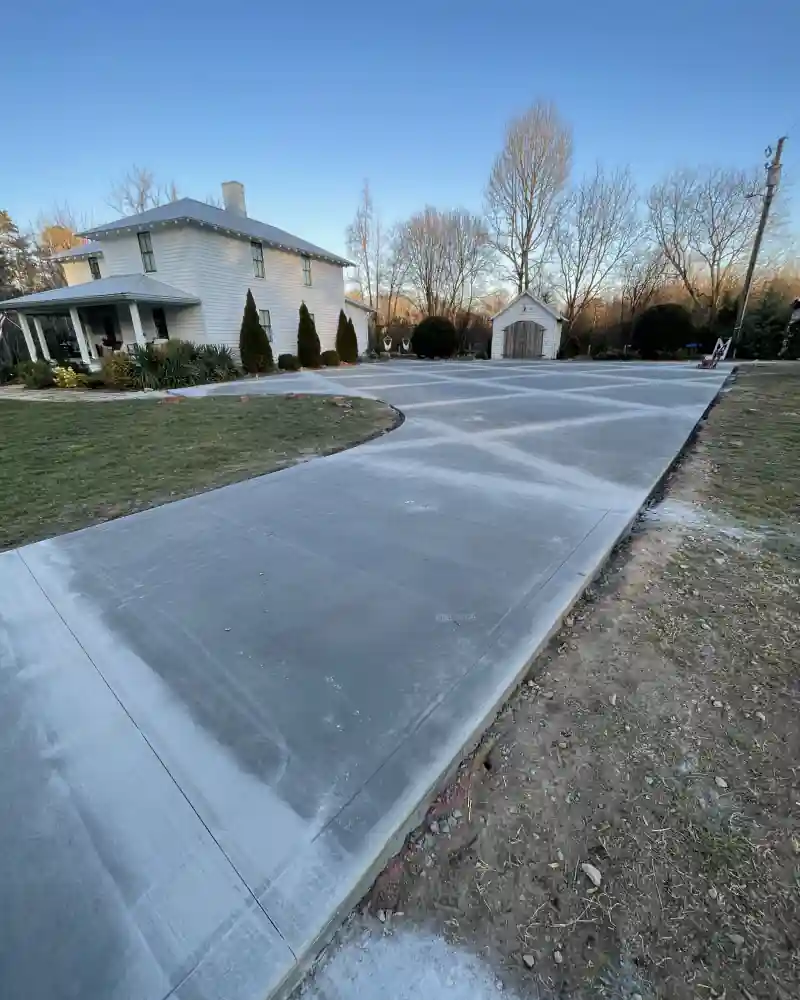
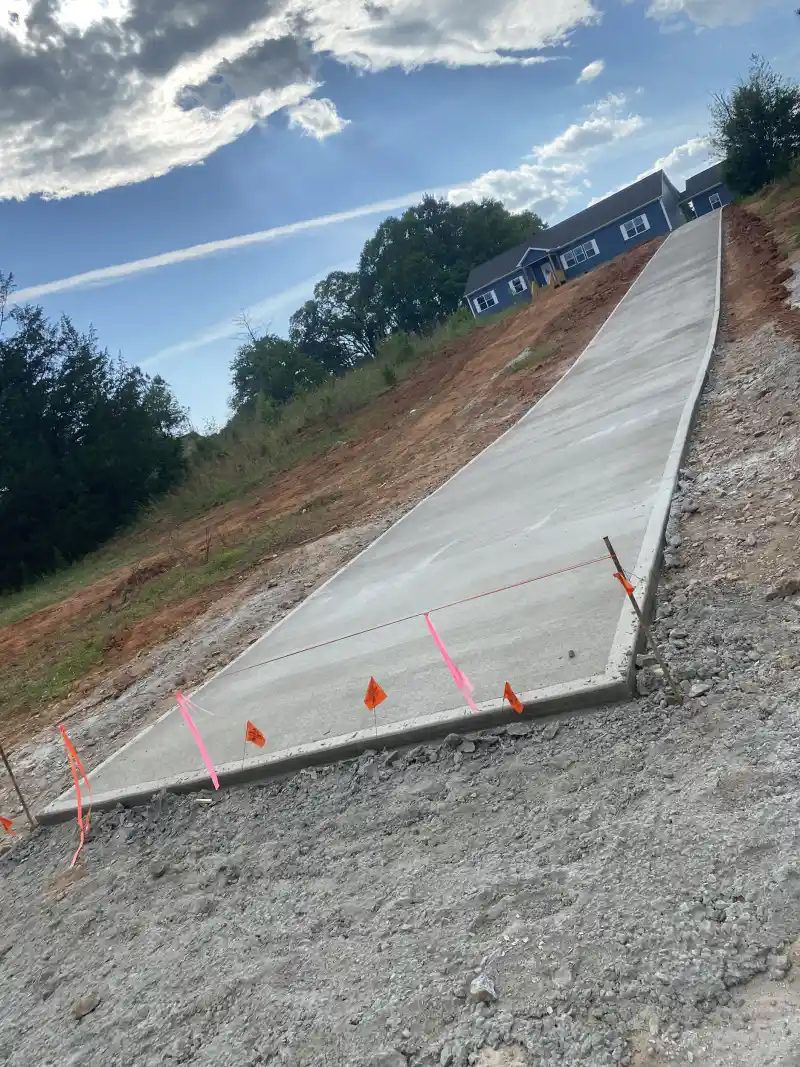
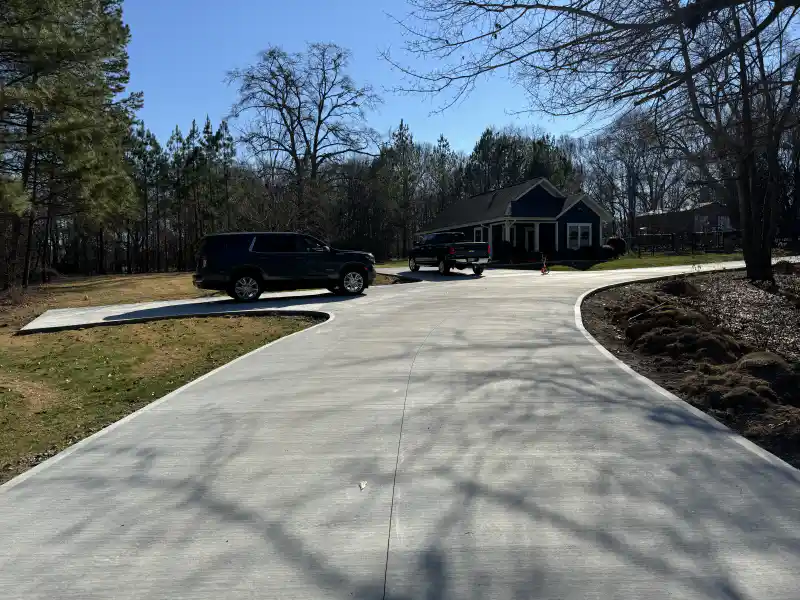
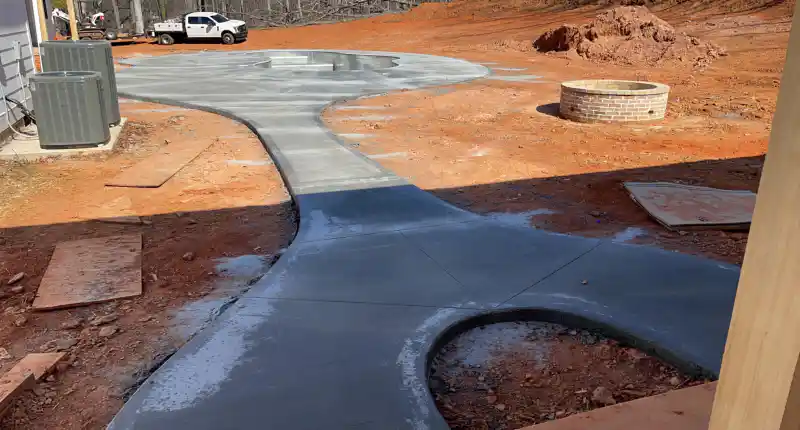
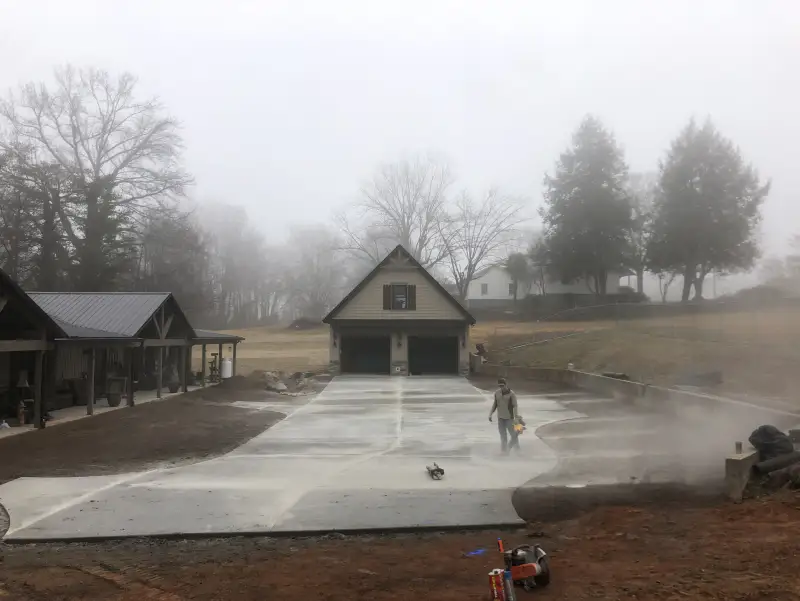
These are driveway jobs our crews poured.
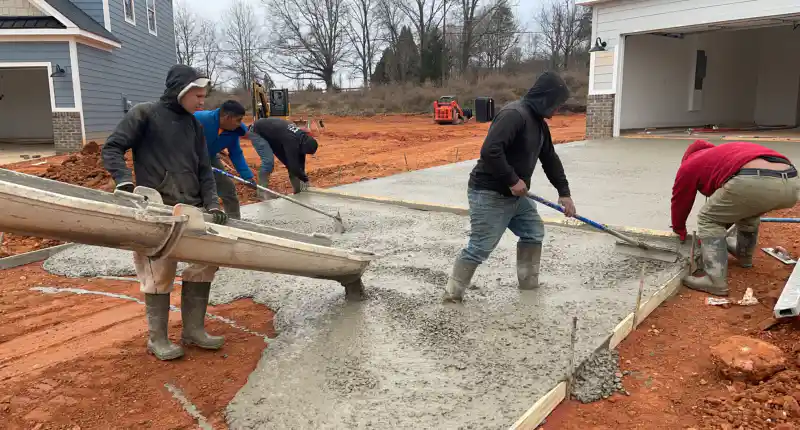
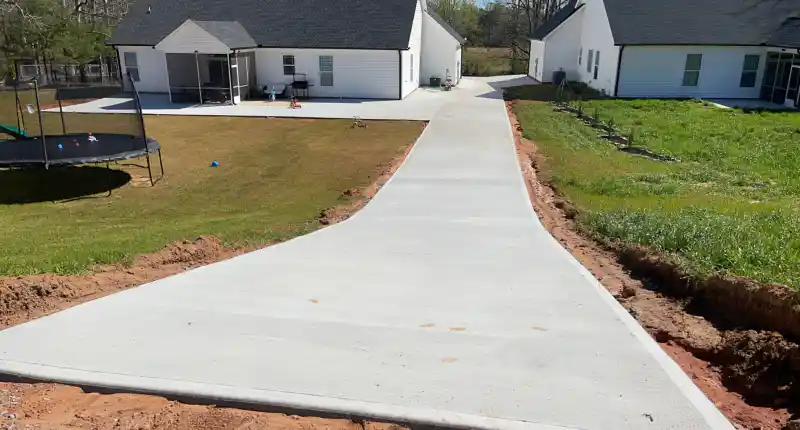
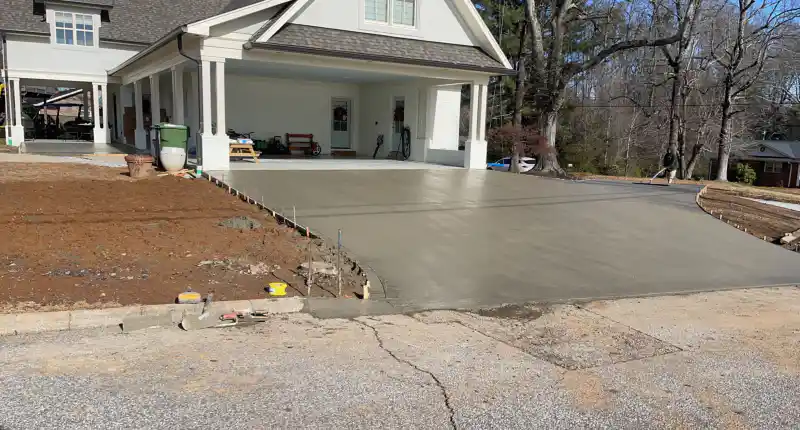
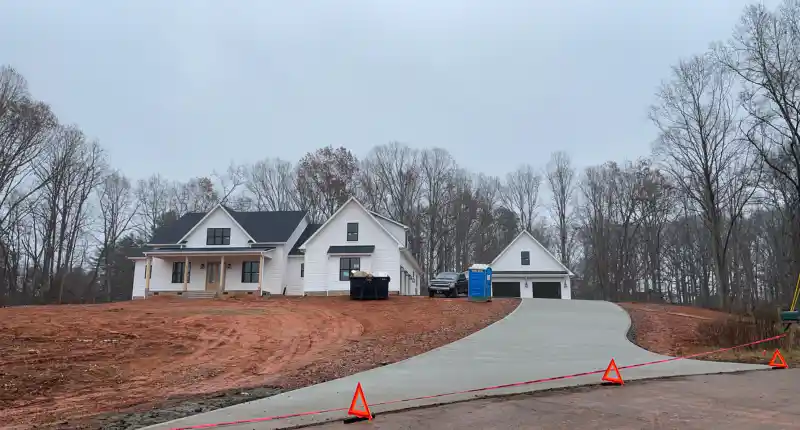
Pouring a driveway in Greenville and the Upstate, on video
A driveway going in: base prepped, forms set and braced, then the pour worked and finished before it sets.
Concrete reviews from Greenville and the Upstate
Ace concrete was excellent. They did a wonderful job. Very great experience with the workers and was very surprised that the owner showed up at the job and he actually did smoothing of…Google review
Ace installed a small patio on a sloping area requiring a poured concrete wall on one side. They removed the existing patio block structure and installed the concrete patio in one day. The results were fantastic…Google review
Ace knocked it out the park for me on a large concrete driveway pour in Taylors, SC.…Google review
Great job, the pad for our generator is perfect I highly recommendGoogle review
I needed a 24' x 40' concrete floor for a metal building. After getting several quotes I decided to go with Ace Concrete Construction.…Google review
Great work team was finished in a day and all the areas look great.Google review
Concrete guides for Greenville and Upstate homeowners
More guides from our crew on concrete work in Greenville and the Upstate.
Cracked, Lifted, or Crumbling: When to Repair a Concrete Sidewalk in Greenville and When to Replace It
Cracked, lifted, or crumbling concrete walkway or steps in Greenville? How to tell a repair from a replacement, why Upstate walks fail early, and the honest fix. Free estimates.
September 9, 2026Old Garage Floor Cracking or Flaking? When to Replace a Garage Slab in Greenville
Is your old garage floor cracking, flaking, or settling? How to tell a resurface from a full garage slab replacement in Greenville, why they fail, and what a proper pour includes. Free estimates.
September 8, 2026Freeze-Thaw in the Upstate: What January and February Do to Concrete That Was Poured Wrong
How Upstate SC freeze-thaw cracks and spalls concrete each winter, why a badly poured slab fails first, and what protects a driveway or patio. Free estimates.
Licensed concrete contractor in Greenville: who we are
Concrete service areas around Greenville
We work from our shop at 4706 Locust Hill Rd in Taylors, SC across Greenville, Spartanburg, Anderson and Laurens counties, from our offices at 10 Accountants Circle, Suite 1B in Seneca, SC and 405 S Pine St, Suite J in Spartanburg, SC, and from an office in Asheville, NC.
Straight-line from our shop at 4706 Locust Hill Rd in Taylors, SC, Greenville sits about 10.6 miles out. Crews reach jobs along routes we already list on our service-area pages, including Poinsett Highway, Wade Hampton Boulevard and U.S. Route 276.
Free concrete driveway estimates in Greenville
We price the job on site.
Concrete work we pour across the Upstate: driveways, garage and building slabs, stamped and decorative concrete, commercial concrete, industrial concrete, patios, and retaining walls.
Request a concrete driveway estimate in Greenville
Someone comes out and prices it standing on it. Estimates are free.
- Driveways
- Patios & Outdoor Living
- Decorative Concrete
- Garage & Building Slabs
- Foundation & Retaining Walls
- Commercial Concrete
- Industrial Concrete
- Epoxy Flooring
- Foundation Repair & Concrete Restoration
Financing available through Wisetack. Check your options in about a minute without impacting your credit score.
See financing options*All financing is subject to credit approval. Your terms may vary. Payment options through Wisetack are provided by our lending partners.
Fast & Free
Get Your Free Concrete Estimate