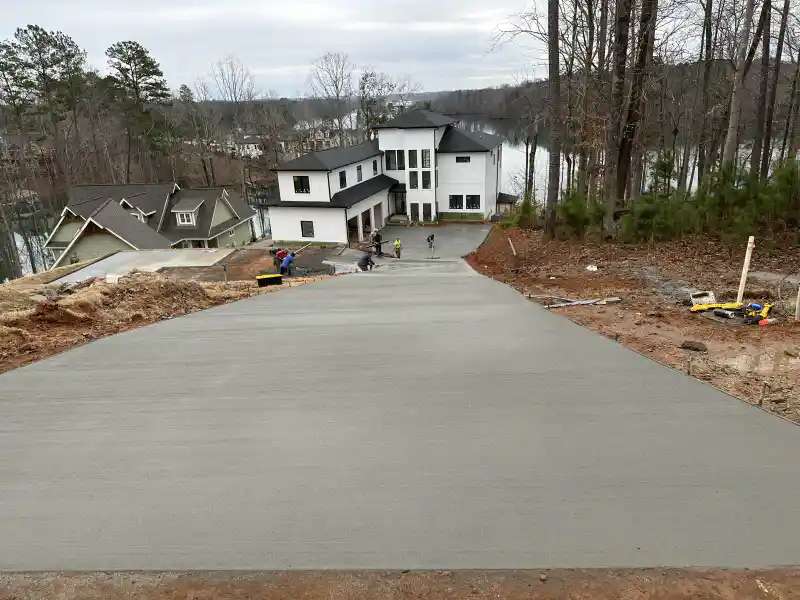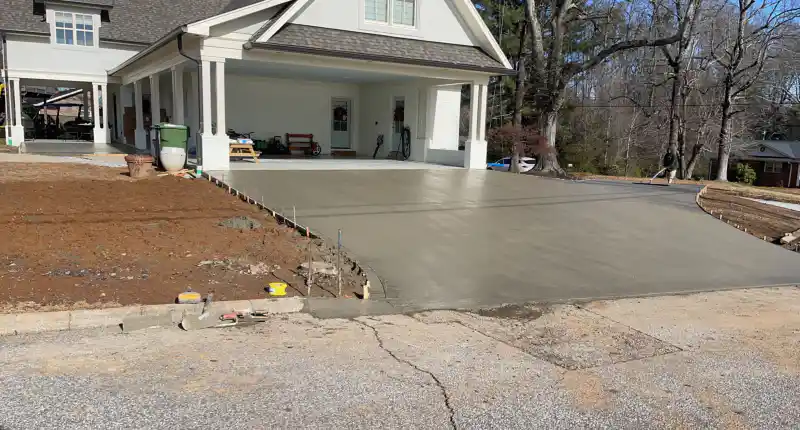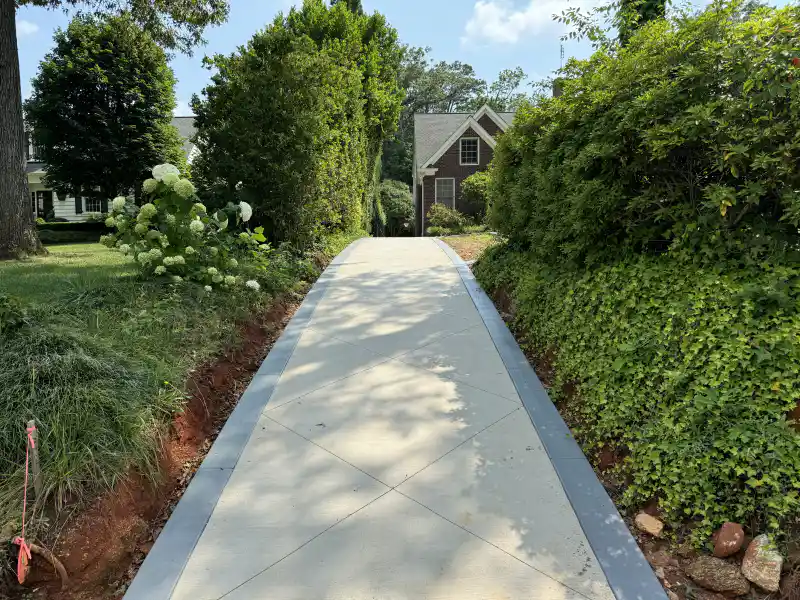
Most cracks in a driveway aren't a reason to tear it out. The National Ready Mixed Concrete Association (NRMCA) says most random cracks that show up early rarely affect the structural integrity or service life of the concrete, unsightly as they are. The seven signs below are a different kind of problem. Each one traces back to the base, the mix, the joints or the slope, and a patch on the surface doesn't reach any of those.
We pour driveways out of our own shop on Locust Hill Rd, so a Taylors job starts close to home for our crew. If one of these fits yours, our page on concrete driveway replacement covers how a tear-out and new pour gets priced, and our page for a concrete contractor in Taylors covers which county office handles permits, since Taylors has no town hall of its own.
1. The surface has scaled down to the stone
Scaling is the top of the slab flaking or peeling off after freeze and thaw cycles. NRMCA grades it in three steps. Light scaling doesn't expose the coarse aggregate. Moderate scaling exposes it and can take 1/8 to 3/8 inch of surface mortar with it, and in severe scaling the stone stands out clearly.
Taylors gets enough cold for this to matter. NOAA's 1991 to 2020 normals for the Greenville-Spartanburg airport weather station (listed under Greer) average about 54 nights a year at or below freezing, and about 41 of them fall in December, January and February.
Light to moderate scaling can sometimes take a thin bonded resurfacing, and our concrete resurfacing guide walks through when that works. NRMCA's own caveats are worth knowing first. The repair is only as strong as the old surface under it, and it won't match the color of the original. Where scaling is excessive and still spreading, the sheet says repair may not be feasible at all, and that's the point where we'd price a new pour instead.
2. One side of a crack sits lower than the other
Flat hairline cracks are usually cosmetic. The ones worth a closer look have an edge that dropped, and NRMCA's cracking sheet lists settlement cracks as their own type, with poor subgrade preparation among the main causes of cracking in general.
Filler seals the top of that crack and leaves whatever soft ground is under the low panel right where it was.
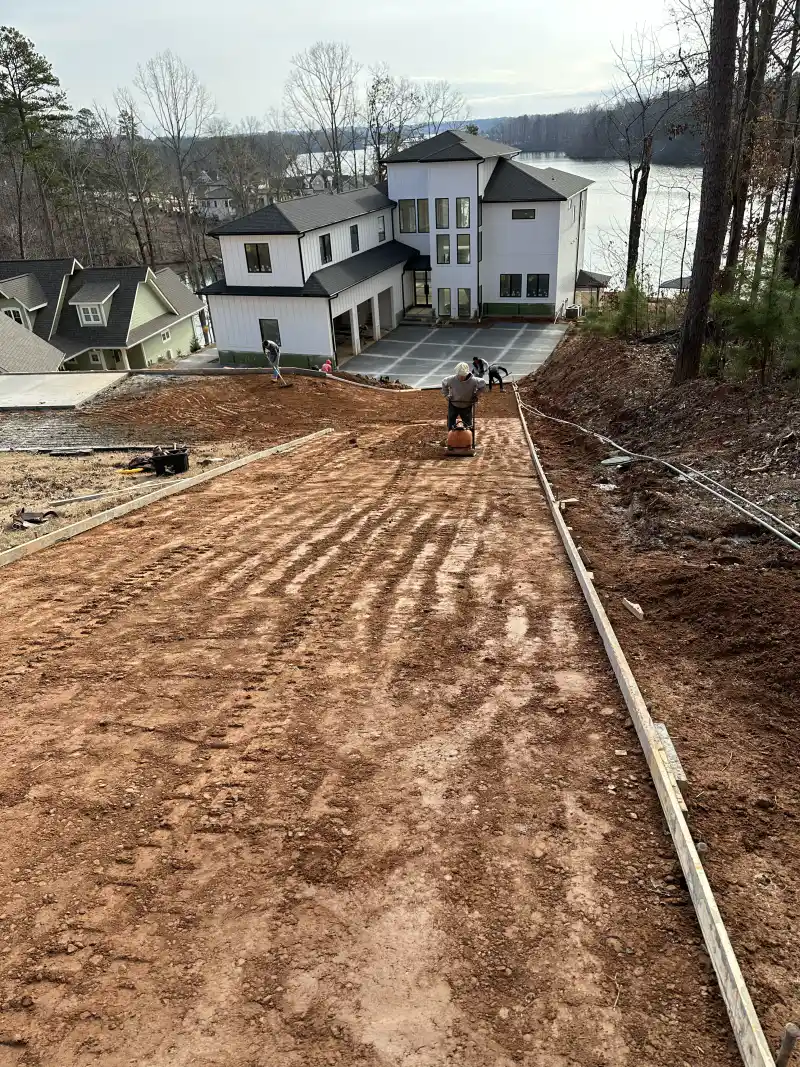
On a replacement the old slab comes out and the base gets reworked and compacted before new forms go down. NRMCA's prevention list starts in the same place: topsoil and soft spots out, the soil under the slab compacted, and the subgrade sloped for drainage.
3. Cracks run across the middle of long panels
Joints are planned cracks. NRMCA's joint sheet says contraction joints exist to control where cracking from shrinkage ends up, and it sets the spacing at 24 to 36 times the slab thickness. For a 4-inch slab that's about 10 feet, with 15 feet as the recommended maximum, and panels should be square or close to it, never longer than 1.5 times their width. L-shaped panels are on its avoid list.
An older driveway poured with long panels tends to crack partway between its joints. One crack in an otherwise sound panel you can live with, but when most of the panels have one it's the layout, and a new pour is the chance to cut joints to the right spacing.
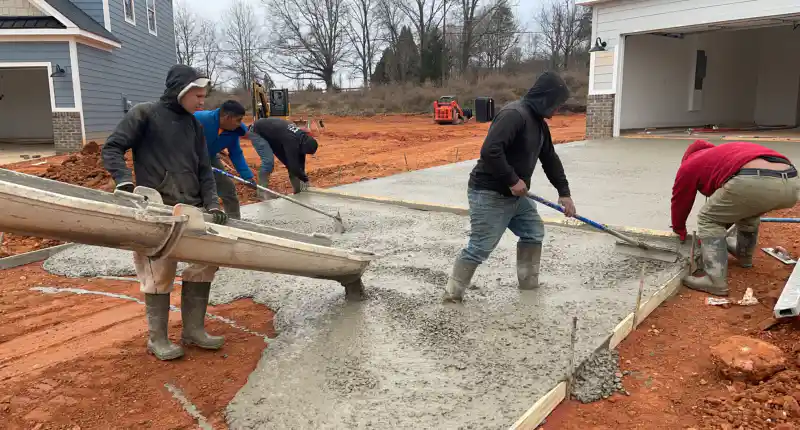
Timing counts too. The sheet puts conventional saw cuts at 4 to 12 hours after finishing. A customer's Google review of a driveway we poured in Taylors described it like this: "had the entire driveway poured by 11AM! An hour later they had all of the finishing complete and were ready to remove forms and sawcut joints by the afternoon."
4. Water runs back toward the garage or the house
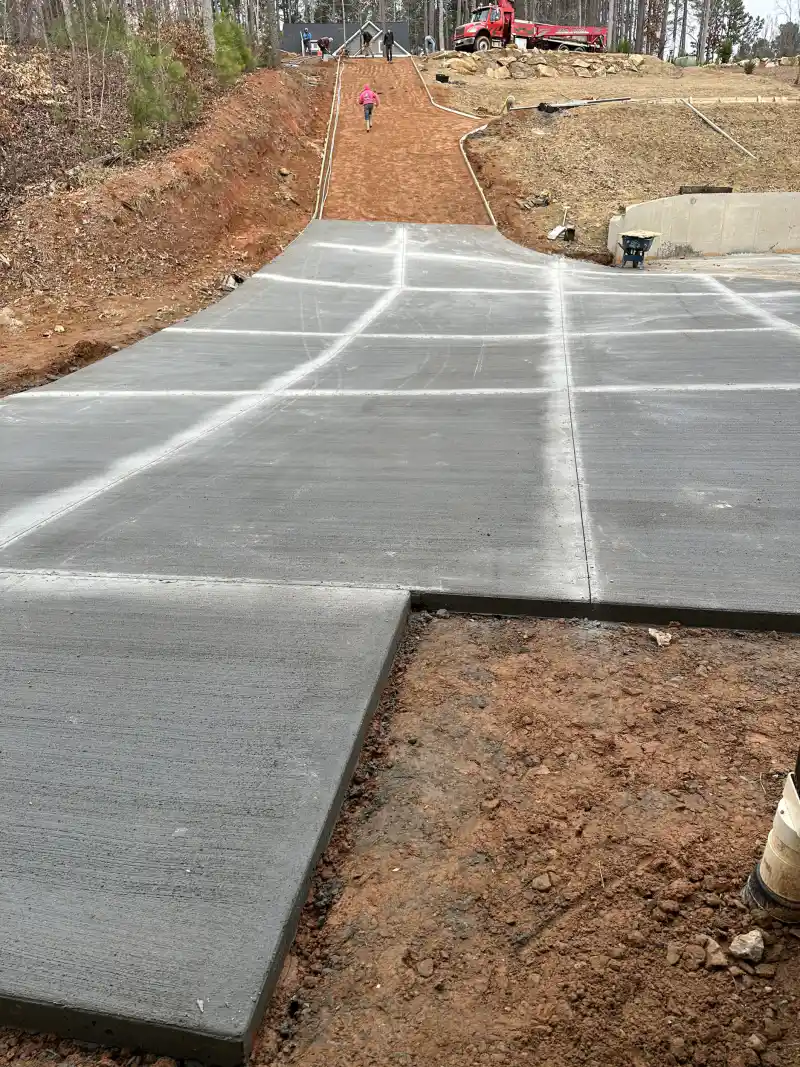
Watch the driveway in a hard rain. If water sheets toward the garage door or pools against the foundation, the slope is wrong. Section R401.3 of the 2021 International Residential Code says impervious surfaces within 10 feet of a building foundation have to slope at least 2 percent away from the building, which works out to just under a quarter inch per foot.
The Greer station's normals put average yearly precipitation at 49.67 inches, so a slab that tips the wrong way gets tested often. Standing water also feeds the first sign on this list. NRMCA's scaling sheet notes that poor drainage which lets salt solutions sit on the surface makes scaling worse.
Slope gets set when the base and forms go in, and you can't sand a slab into a new pitch. Fixing it means taking out the section that falls the wrong way and pouring it again.
5. Cracking starts where the driveway meets the garage, walk or steps
NRMCA calls for isolation joints between driveways and sidewalks, garage slabs, stairs and other points of restraint, so each piece can move on its own. Its cracking sheet lists cracks from missing isolation joints as one of the common forms.
The joint sheet calls for premolded filler there, foam strips or asphalt-impregnated fiber board. Depending on how far the cracking has run, it can be just the panels touching the garage slab or the steps that come out, a smaller job than a full tear-out.
6. Cracks start at the joints years after the pour
This is the one we'd want to look at in person before calling it. NRMCA describes D-cracks as cracking from freeze and thaw damage to some types of porous aggregate. They start at the joints at the bottom of exterior slabs and usually show up at later ages. Most early cracks rarely affect service life, but the sheet names D-cracking as one of two exceptions.
The problem sits in the stone inside the mix, so a coating on top doesn't reach it, and the affected panels are the ones that come out.
7. You can see wire mesh or rebar from the top
NRMCA's cracking sheet says at least 2 inches of concrete cover over the steel keeps salt and moisture away from it, which prevents the cracking that comes from rust expanding on reinforcement. If mesh or bar is visible at the surface, that cover is gone in that spot. The same sheet is also clear that mesh can't prevent cracking. Sitting at the right depth, it keeps crack widths down.
That section is a replacement candidate, with the new steel set at the right depth.
Before you call anyone
Walk the driveway and note which of the seven you see, and where. Light scaling, flat hairline cracks and a single cracked panel usually aren't tear-out problems, while dropped edges, bad slope, D-cracks and exposed steel are where we'd start talking about a new pour.
For a price on your Taylors driveway, call 864-214-5271 or use the estimate form below. Someone comes out and prices it standing on it, at no charge. If you're still weighing a new pour against a cheaper fix, read our driveway repour vs resurfacing guide first.
Sources: NRMCA, CIP 2 Scaling Concrete Surfaces; NRMCA, CIP 4 Cracking Concrete Surfaces; NRMCA, CIP 6 Joints in Concrete Slabs on Grade; International Code Council, 2021 International Residential Code, Section R401.3 Drainage; NOAA NCEI, 1991 to 2020 annual and seasonal normals, Greer SC station. All read October 24, 2026. The review quote is from a Google review of Ace Concrete Construction.