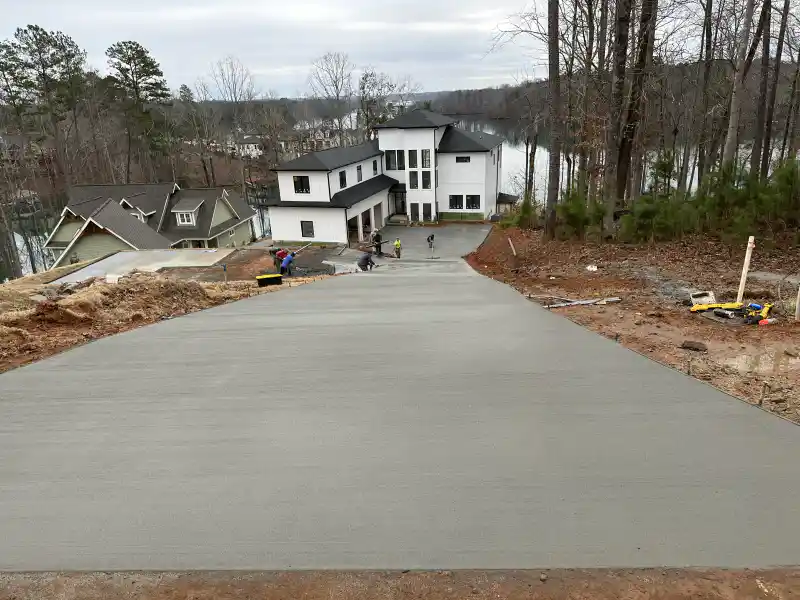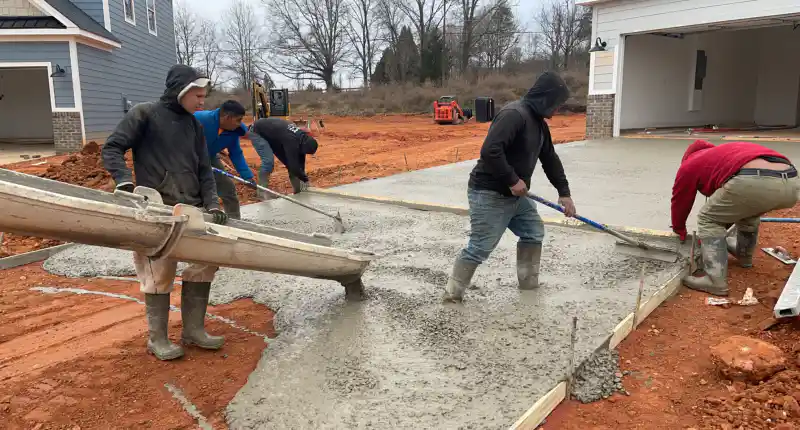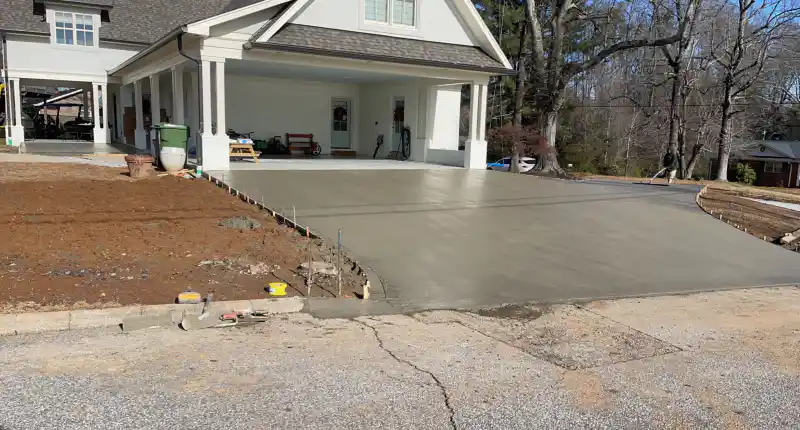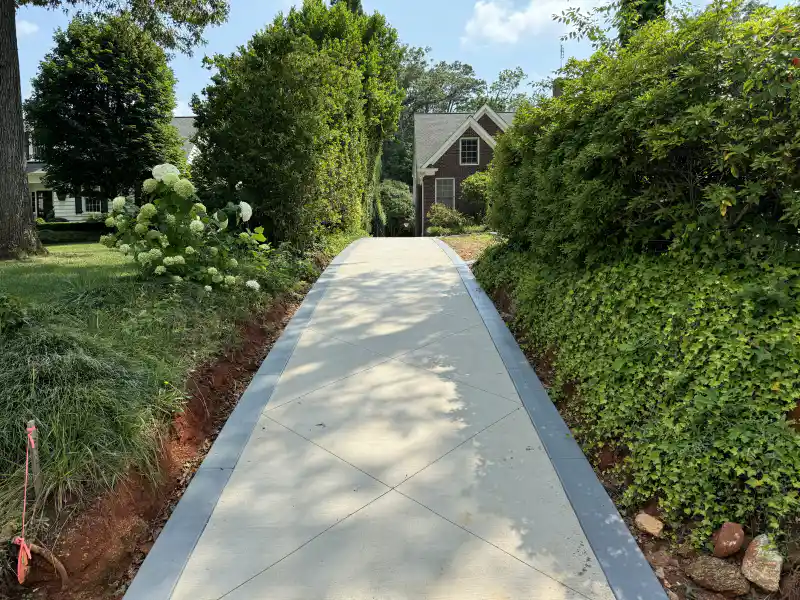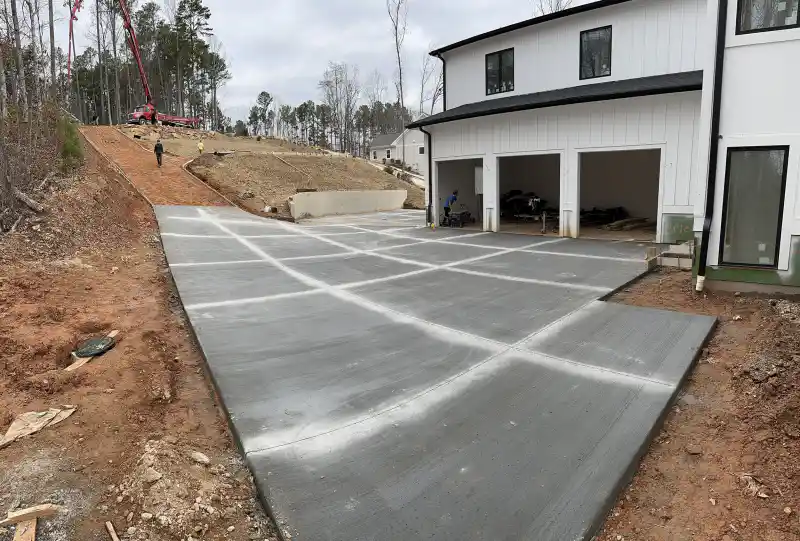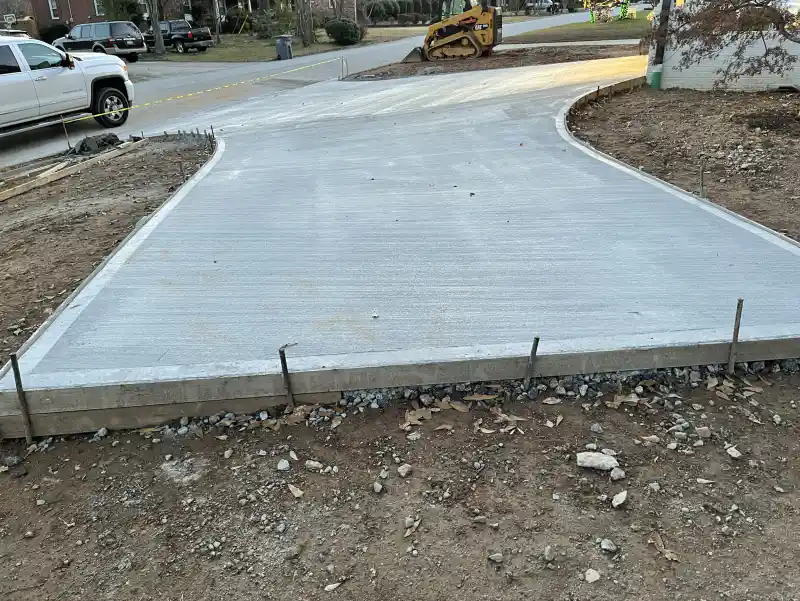
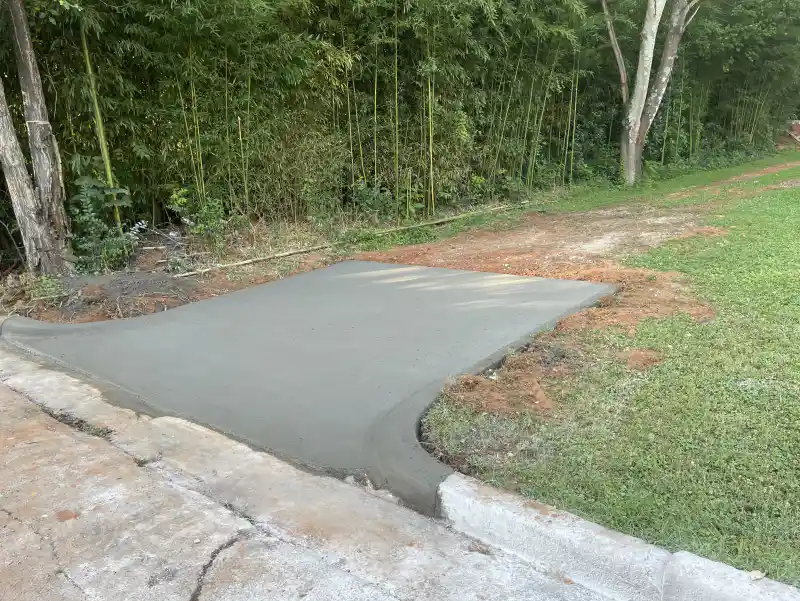
A driveway replacement in Spartanburg is mostly a private job on your own lot, right up until the crew reaches the street end. Where the slab crosses the curb, the sidewalk or the road shoulder, it sits in public right-of-way, and whoever owns that road has rules about what goes back in.
So on a replacement we look up who owns the road before anybody measures a crack.
Who owns the road in front of your Spartanburg driveway?
Usually one of three owners: the City of Spartanburg, Spartanburg County, or the South Carolina Department of Transportation. The mailing address won't settle it, because state roads run through city limits too, and the City's code has a section about exactly that.
The City's Street Maintenance page sends residents to SCDOT's Roadway Information System to look up whether a street is city-owned. It also notes that existing alleys in the city are considered private and are not owned or maintained by the City. Out in the county, the county code says a road only counts as a county road once the county formally accepts it, and accepted roads go in an official directory kept by the county planning department.
| Road at the end of the driveway | Who handles work in its right-of-way | Rule we read |
|---|---|---|
| City street, inside city limits | City of Spartanburg Public Works | City Code Sec. 30-128 |
| State road, inside or outside city limits | SCDOT encroachment permit (the City accepts it) | SCDOT ARMS Chapter 2; City Code Sec. 30-129 |
| County road, outside city limits | Spartanburg County Public Works, for any excavation in or across the road | County Code Sec. 62-17 |
Inside Spartanburg city limits, the curb and sidewalk belong to the street
The city code defines a street right-of-way to include sidewalks, curbs, gutters and the other areas dedicated for the street, whether or not they are physically part of the street. Sec. 30-122 says anyone doing repair work in a street right-of-way does it under that article of the code.
Sec. 30-128 is the one that matters for an apron. Before a pavement cut or any work in a street right-of-way, a permit comes from the public works department, and the fee follows the public works permit fee schedule. The same section says no permit is needed for normal maintenance that does not need a pavement cut or block traffic, so ask Public Works which side of that line your apron falls on before the saw comes out. Public Works is at 801 Union Street, 864-596-3690.
If the job cuts into the street pavement itself, Sec. 30-14 adds its own conditions. The building official issues a permit for each excavation in a public street, work has to start within 48 hours or the permit is void, and the permit stays at the excavation while the work goes on. No more than half the width of the street can be open at once.
That 48-hour clock is the reason we line up the street-side permit with the pour schedule instead of pulling it weeks early. The building permit for the driveway itself is a separate question, and our page for a concrete contractor in Spartanburg covers which office handles that.
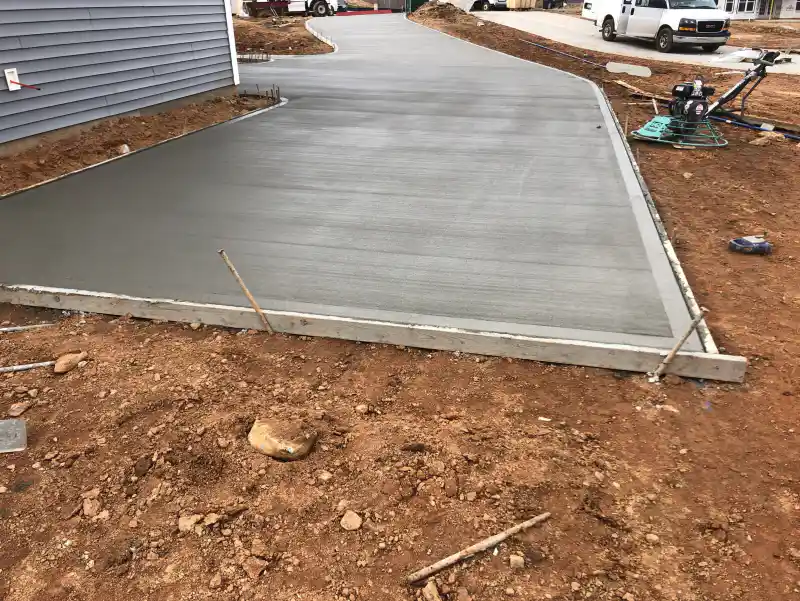
When your Spartanburg driveway meets an SCDOT road
SCDOT's Access and Roadside Management Standards (ARMS) manual says an encroachment permit must be obtained before any work on SCDOT right-of-way by anyone other than SCDOT, and that includes non-routine maintenance and revisions to an existing encroachment. Routine maintenance needs no permit, and the manual lists it: mowing, patching potholes, clearing pipes and ditches, seal coating, minor erosion repair. Tearing out and repouring the apron isn't on that list.
The same section puts maintenance of the driveway inside state right-of-way, drainage structures included, on the property owner. A single-family driveway falls in the manual's residential category. There the approved permit serves as the notice to proceed, and when the work is done the permittee calls the Resident Maintenance Engineer for a final inspection, which ends in a letter of acceptance or a punch list of fixes followed by a second inspection.
SCDOT's permits page says there are no fees for an encroachment permit, applications go through its EPPS Next system, and a preliminary meeting with county or district staff is strongly encouraged. Inside city limits the City recognizes that state permit for work in the right-of-way of a state road, and its code says no other permit will be required for that work. ARMS still says an SCDOT permit does not excuse anyone from local requirements that are stricter.
Outside city limits on a Spartanburg County road
County Code Sec. 62-17 covers excavation in or across a road outside any incorporated city or town that is not in the state highway system. The application goes in writing to the county public works department and has to state the location, nature, purpose, extent and depth of the work. The county can require a surety bond and resurfacing of the disturbed section, and repairs are at the expense of whoever dug.
Two more county sections are worth knowing before you budget the street end. Sec. 62-4 lets the county install drainage lines at private driveway entrances to fix drainage problems its engineer identifies, with county-furnished pipe limited to 20 linear feet, and Sec. 62-6 bars the county from repairing private driveways except to protect a public road.
What happens to the sidewalk where it crosses your driveway?
On a state road, ARMS treats a house driveway serving one or two single-family homes as Low Volume, with a recommended width of 10 to 24 feet. For low and medium volume driveways in curb and gutter or sidewalk sections, it says drop curb driveways are typically used.
Where a concrete sidewalk exists, the manual says it should continue across a Low Volume driveway, built to SCDOT's standard drawings, and it points to SC Code 56-5-3250: drivers yield to pedestrians on a sidewalk crossing. That strip of walk stays public even though your driveway runs over it.
Inside the city, Street Maintenance handles curb and gutter repairs and sidewalk repairs on City streets. If you want a stamped or colored finish on the new driveway, ask the road owner before carrying it across the sidewalk panel. We'd plan on a plain broom finish there unless someone with authority over that walk says otherwise.
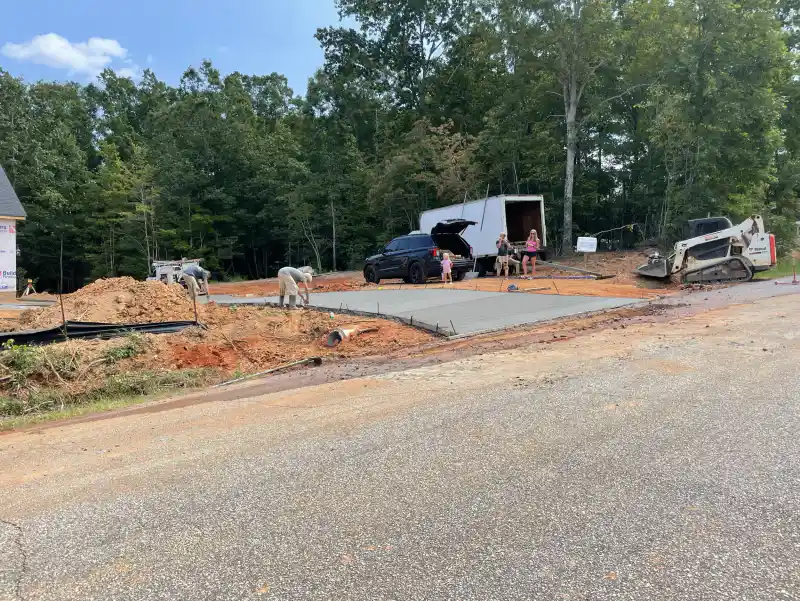
Putting a Spartanburg driveway replacement in the right order
Look up the road owner first, then talk to that office before anyone breaks concrete. For a state road that means the preliminary meeting SCDOT recommends. For a city street it means asking Public Works whether your apron needs the Sec. 30-128 permit, and if the street pavement gets cut, timing the excavation permit so the crew starts inside its 48 hours.
The private part of the slab, from the right-of-way line back to the garage, follows the building rules for your address. If you are still deciding whether the old slab has to come out at all, our repour vs resurfacing guide walks through that call.
We run tear-out and the new pour as one job from our shop in Taylors, street end included. Pricing for the whole thing starts with our page on concrete driveway replacement across the Upstate and the estimate form below.
Sources: City of Spartanburg Code of Ordinances, Chapter 30, Secs. 30-14, 30-122, 30-123, 30-128 and 30-129 (library.municode.com/sc/spartanburg), read October 9, 2026. City of Spartanburg, Street Maintenance page (cityofspartanburg.org/417/Street-Maintenance), read October 9, 2026. Spartanburg County Code of Ordinances, Chapter 62, Secs. 62-1, 62-4, 62-6 and 62-17 (library.municode.com/sc/spartanburg_county), read October 9, 2026. SCDOT, Access and Roadside Management Standards, 2008 Edition revised through September 3, 2021, Sections 2A, 2A-3, 2D-5, 3A-1 (Table 3-3), 3B-2 (Table 3-4), 3C-5 and 13B-1 (scdot.org), read October 9, 2026. SCDOT, Encroachment Permits page (scdot.org/business/permits.html), read October 9, 2026.