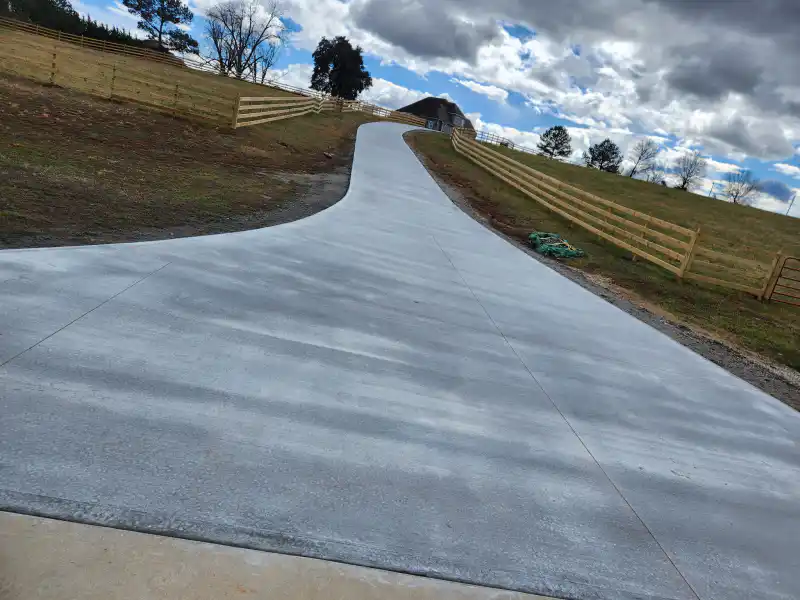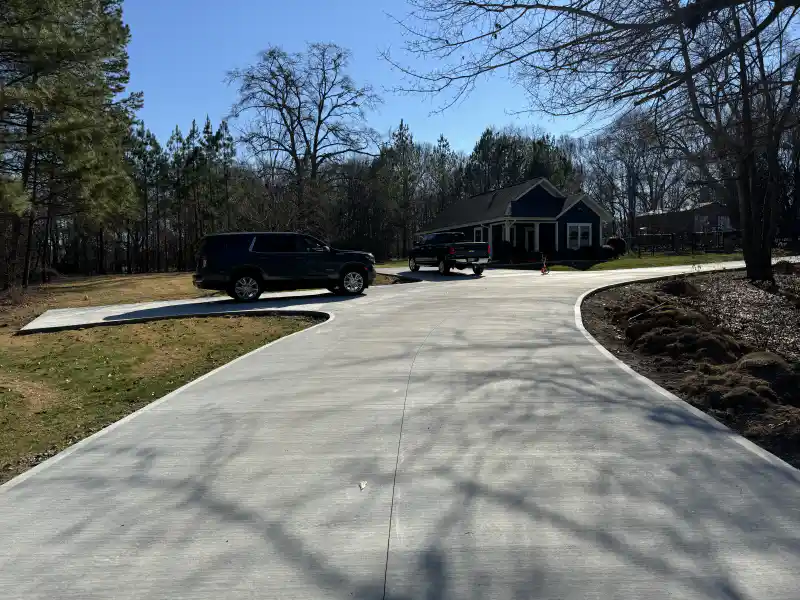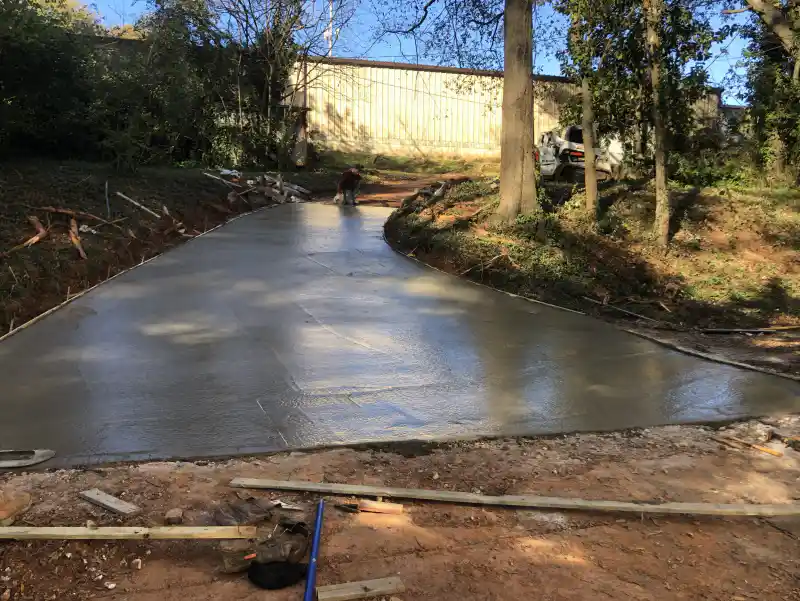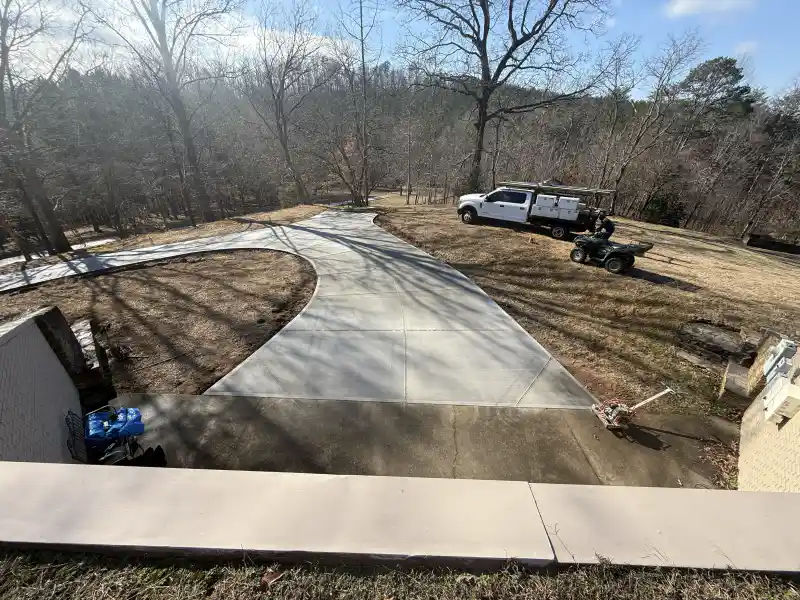
A steep lot changes most of the decisions on a concrete driveway, starting with how the bottom end meets the street. Everything below comes from what the City of Asheville, NCDOT, NOAA and the ready mixed concrete industry publish, so you can check it yourself before a permit visit or a site walk.
Ace's North Carolina office is at Biltmore Park in Asheville. For the broader picture of what we do as a concrete contractor in Asheville, start with that page. This one stays on the hill.
How steep can a driveway be in Asheville?
The City's residential driveway modification request form lists a maximum slope of 10.6% among the driveway standards in the Unified Development Ordinance. That form is the City's request for driveways that cannot meet its standards, so confirm the current limit with the City before the driveway is designed. That is 10.6 feet of rise for every 100 feet of run. A driveway that can't meet the standards goes through that modification request, and the form tells you to apply for the driveway permit first.
Width has its own rule. For single-family homes and duplexes, UDO Sec. 7-11-2 sets 9 feet minimum and 18 feet maximum inside the front setback, measured past the apron radius, and the access point has to sit at least five feet off the side property lines unless two neighbors share it. The code encourages sharing.
Really steep ground pulls in a separate section. Asheville's steep slope rules (Sec. 7-12-4) cover land at or above 2,220 feet of elevation with an existing grade of 15% or more. Development on ground at 36% or steeper, at any elevation, or on land the Buncombe County Slope Stability Index Map marks as High or Moderate Hazard, needs a geotechnical analysis by a North Carolina registered professional engineer before the building permit is issued.
City permit or NCDOT permit for an Asheville driveway?
That depends on who owns the street at the bottom. Section 3G of the City of Asheville Standard Specifications and Details Manual says every driveway built or replaced on a City street or alley needs a City Driveway Permit. A driveway onto an NCDOT street inside city limits may also need an NCDOT Driveway Permit.
A lot of Asheville streets belong to the state. The City's Public Works streets page says any street missing from the City Maintained Street Inventory is either private or maintained by NCDOT, and it links the inventory so you can look yours up. The City maintains about 404 of the 564 miles of City and State streets inside the limits.
On a state road, NCDOT's driveway permit FAQ says you apply through the local District Engineer's office. NCDOT charges no application fee, though inspections can carry a charge, and a small, simple request typically clears in four weeks or less after formal submittal. Start that paperwork before you set a pour date, especially for a late fall or winter pour when the weather window is already short.
Where a steep Asheville driveway meets the road
The transition at the street is where hillside driveways scrape bumpers. NCDOT's Policy on Street and Driveway Access to North Carolina Highways says a driveway should slope away from the road at the shoulder's rate, between 1/4 inch and 1 inch per foot, for at least the width of the shoulder. The same policy notes that breakover angles over 5% may not allow satisfactory driveway speeds.
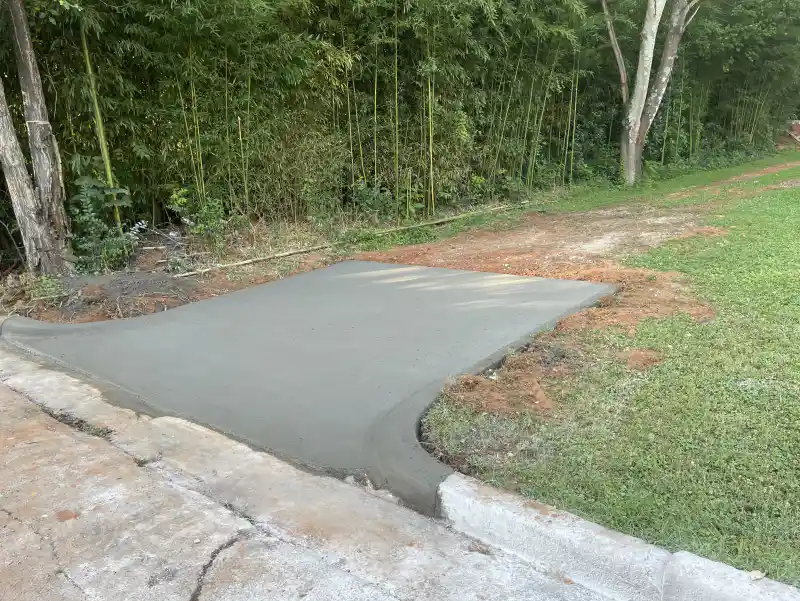
In plain terms, the steep part of the climb belongs on your lot, behind a short, gentle landing at the road. If a City sidewalk runs across the front, the manual wants 6 inches of concrete where the driveway crosses it and caps the walkway's cross slope at 2%, which keeps that band close to flat and pushes the grade change to either side of it.
State roads with a ditch out front add a pipe. The NCDOT policy calls for driveway pipe at least 15 inches inside diameter and 20 feet long, with the low point of the driveway at or near the ditch line. For a single-family home, NCDOT installs the pipe at its own expense if the owner buys it and delivers it to the site, and the District Engineer sets the size.
Keep the corner clear too. Asheville's UDO holds a sight triangle where a driveway meets a public street, 10 feet along the driveway edge and 50 feet along the street, with no walls, shrubs or parked cars blocking the view between 3 and 10 feet up.
Where does the water go off a sloped concrete driveway?
Downhill, and quickly. Asheville Regional Airport averages 49.59 inches of precipitation a year in NOAA's 1991 to 2020 normals, and a concrete slab on a grade sends most of what lands on it straight to the bottom.
NCDOT's policy says a driveway can't send water across the highway pavement, pond it on the shoulder or in the ditch, or cause erosion in the right-of-way, and private ditches, gutters and pipes can't empty into the highway drainage system without prior approval. On City streets the manual says pipes, drains and flumes can't discharge across a sidewalk and have to be piped or flumed under it instead.
That moves the drainage work uphill. A trench drain across the slab near the bottom catches what runs down the middle, and a cross slope can shed water toward a swale along one edge. Which mix fits depends on the lot and where the water can legally go. The City's stormwater utility section (Sec. 7-12-6) also lists private driveways as impervious surface, and impervious area is the main measure behind the stormwater fee, so a bigger slab can show up on that bill.
What finish and joints hold up on a steep concrete driveway?
NRMCA's Concrete in Practice sheet on scaling says a broom finish is adequate for most exterior surfaces, warns that overworking the surface strips entrained air from the top layer, and says to avoid steel trowels. On a grade that broom texture is also what tires and boots grip in wet weather.
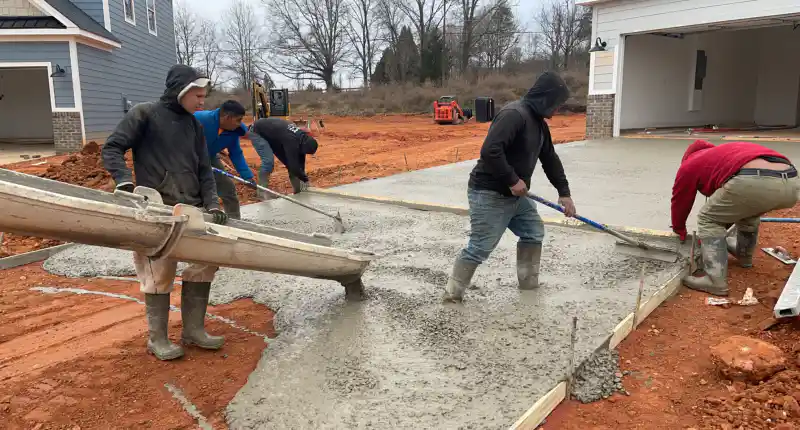
The same sheet's mix advice for slabs that see freezing and deicers: 4,000 psi, about 6% total air with 3/4-inch or 1-inch stone, a slump of 3 to 5 inches, and no excess water added at the site. The sheet says water added for slump raises the risk of segregation and bleeding and can leave a weak mortar layer on top.
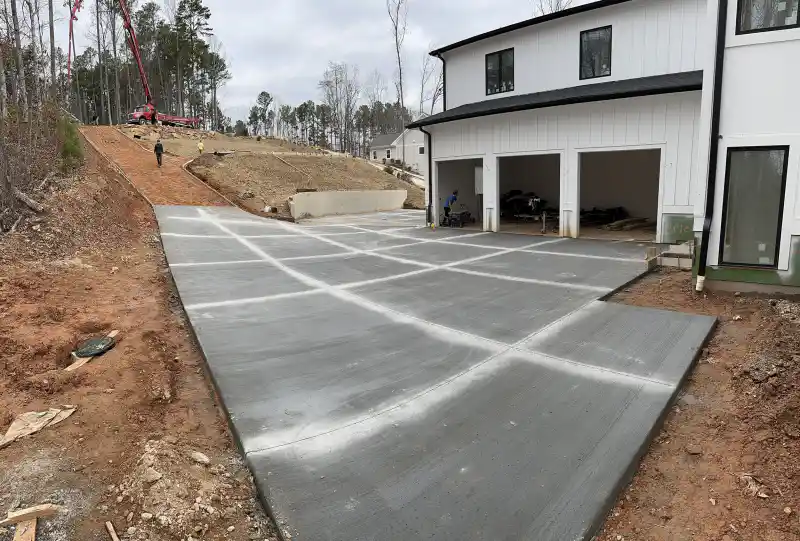
For joints, NRMCA's sheet on slabs on grade puts maximum spacing at 24 to 36 times the slab thickness, so about 10 feet for a 4-inch slab, with panels square or close to it and no longer than 1.5 times their width. Groove depth should be at least a quarter of the thickness. It also calls for isolation joints where a driveway meets walks, curbs or other fixed objects, and that list in the sheet includes garage slabs, sidewalks and stairs. Our piece on freeze-thaw damage to concrete covers winter wear in more depth.
Asheville winters on a steep concrete driveway
NOAA's 1991 to 2020 normals for Asheville Regional Airport count 87.5 nights a year at or below 32°F and 15 nights at or below 20°F, plus 10.3 inches of normal annual snowfall. Most of those freezes land between November and March.
| Month | Normal low (°F) | Nights at or below 32°F |
|---|---|---|
| October | 46.2 | 2.4 |
| November | 36.1 | 13.3 |
| December | 31.3 | 19.2 |
| January | 28.6 | 21.6 |
| February | 31.2 | 17.5 |
| March | 37.0 | 11.1 |
For a winter pour, NRMCA's cold weather sheet says fresh concrete freezes below about 25°F and can lose more than half its potential strength if it does. A 20°F drop in concrete temperature roughly doubles setting time, and the sheet recommends placing thin sections like a driveway at 55°F concrete temperature, and says blankets, tarps or other protection should be on site to cover it during and after placement.
Once it's in, the scaling sheet's winter advice is to skip deicing chemicals on new concrete where you can and use clean sand for traction. On a steep driveway that sand is doing real work, so keep a bucket near the top.
If you're weighing a hillside pour, our page on concrete driveways in Asheville covers the residential work we take on, and you can describe your lot in the estimate form below.
Sources: City of Asheville, Residential Driveway Modification Request; City of Asheville Code of Ordinances, Sec. 7-11-2 Parking, loading, and access standards, Sec. 7-12-4 Steep slope and ridgetop development and Sec. 7-12-6 Stormwater services utility; City of Asheville Standard Specifications and Details Manual, Sections 3G and 3H; City of Asheville Public Works, Streets; NCDOT, Driveway Permit FAQ; NCDOT, Policy on Street and Driveway Access to North Carolina Highways (July 2003); NOAA NCEI, 1991 to 2020 annual normals and monthly normals, Asheville Regional Airport (USW00003812); NRMCA Concrete in Practice CIP 2 Scaling Concrete Surfaces, CIP 6 Joints in Concrete Slabs on Grade and CIP 27 Cold Weather Concreting. All read October 9, 2026.