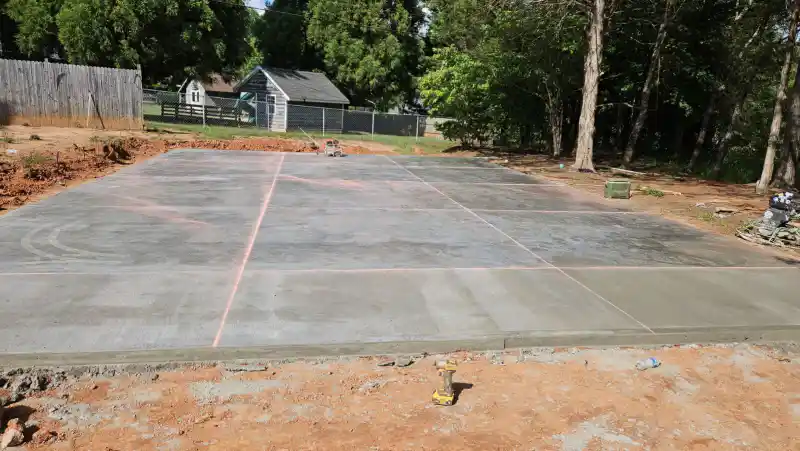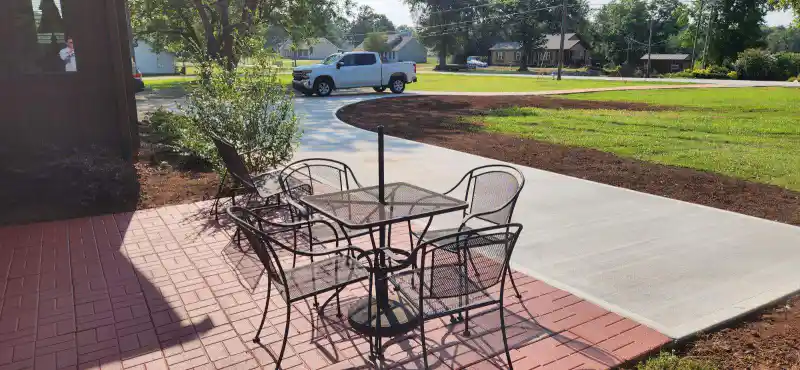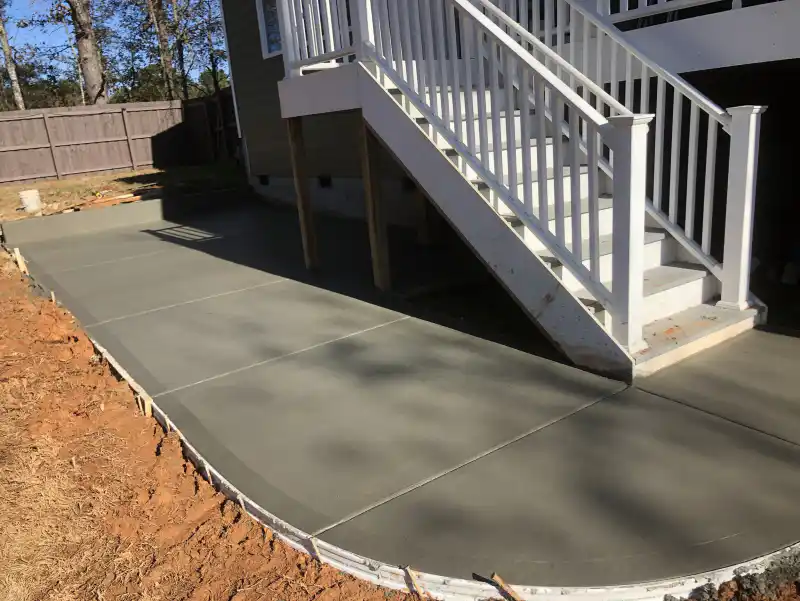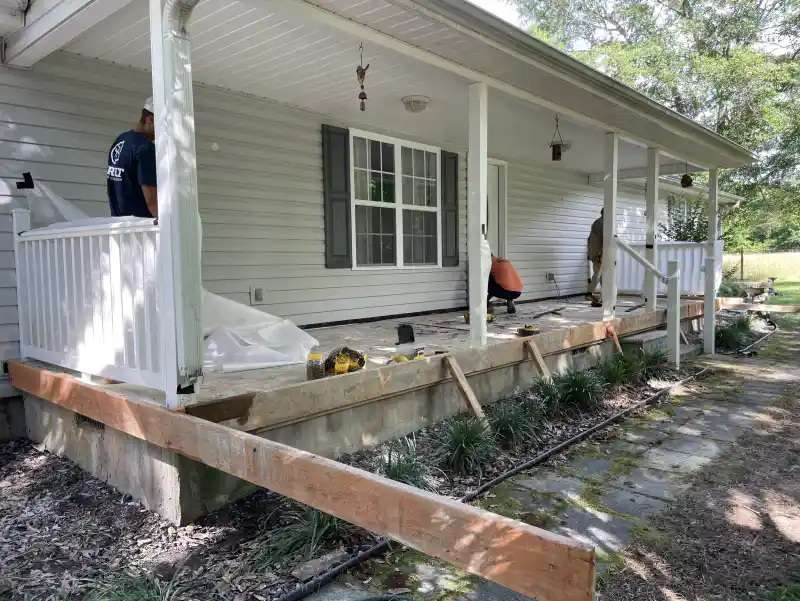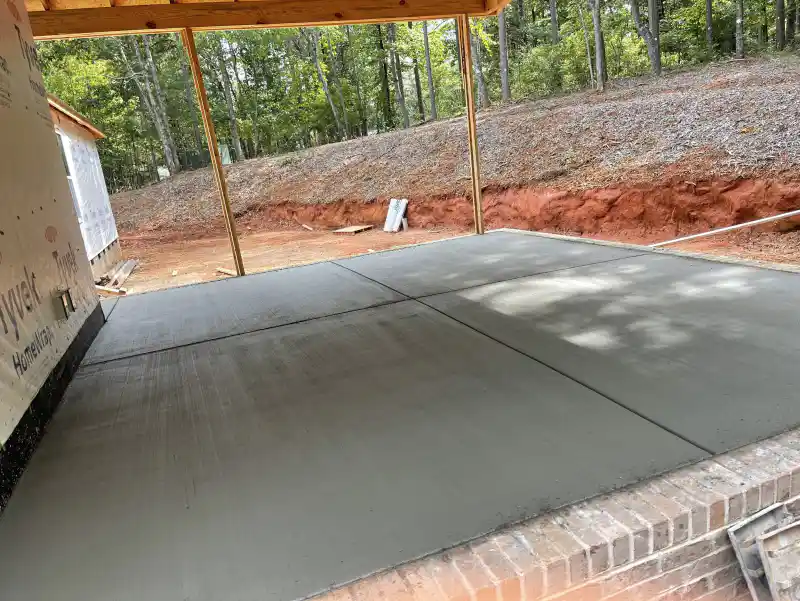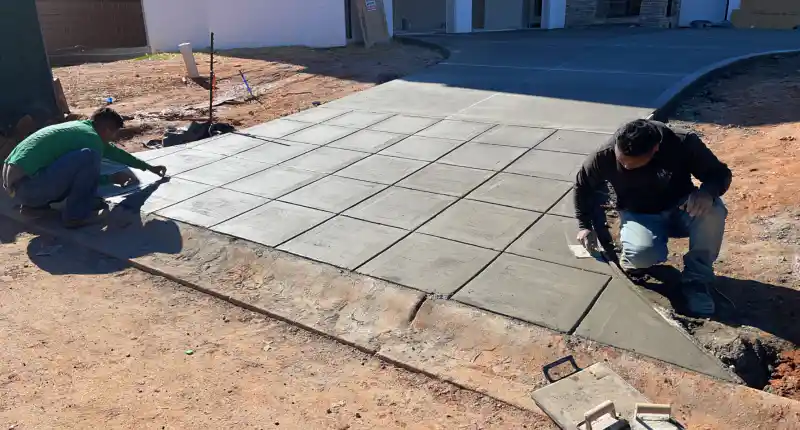
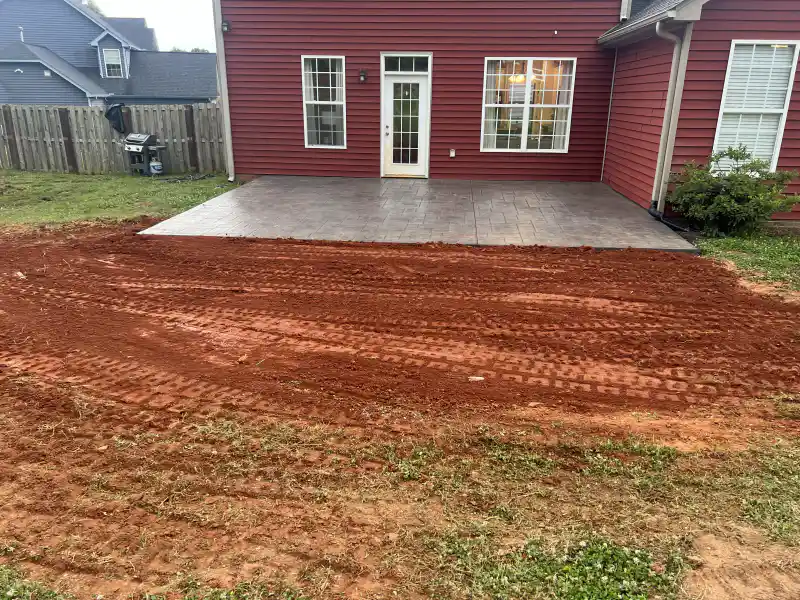
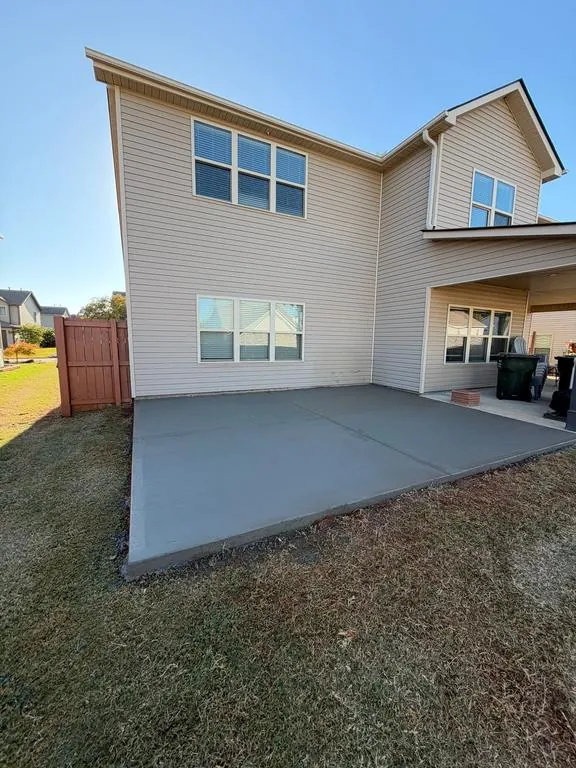
On October 21 our crew poured a 16 by 20 backyard patio in Simpsonville, plus a 4-foot sidewalk down the side of the house. That morning they dug out the red clay and set the sidewalk forms, and by the afternoon both were poured and finished, broom texture with a smooth picture-frame edge. The job is logged on our recent concrete jobs page with photos from before, during and after.
The pour itself took a day. Most of what decides how a patio turns out gets settled before that, and these seven are what we'd want worked out on any Simpsonville patio before the truck is booked. For what we pour and how pricing works, start with our page on concrete patio installation.
1. Who signs off on the work at your address
Inside city limits, the City of Simpsonville's residential development guide is the place to start. It says a grading permit is needed for reshaping or moving earth, and some grading projects also need a Land Disturbance Permit from Greenville County's Land Development Division. Planning and Zoning can tell you about setbacks for your lot, and City Hall is at 864-967-9526.
The same guide says any professional you hire needs a current City business license, and the city's permit acknowledgement adds a state license on top. Ours is South Carolina residential builder licence RBS.65343.
Is a patio permitted work in its own right? The 2021 International Residential Code exempts sidewalks and driveways from building permits in Section R105.2, and patios aren't named on that list. Ask the city's building inspector about yours before assuming either way. If your mailing address says Simpsonville but you're outside city limits, our page for a concrete contractor in Simpsonville covers how the county side works.
2. What's buried under the yard
SC811 is free, and it wants your locate request at least three business days before digging starts, not counting the day you file, weekends or holidays. It applies to projects of any size.
The catch is private lines. SC811's own page says utility companies only mark their lines up to the meter, inside their right-of-way. Past the meter you'd need a private locating service, and the examples it lists are the things a backyard patio tends to sit on top of: sprinkler lines, gas lines to a pool or grill, wiring out to a detached garage or shed, septic and irrigation lines.
3. What the slab sits on
NRMCA, the ready-mix concrete industry group, starts its advice on cracking with the ground. Topsoil and soft spots come out, and what's under the slab should be compacted soil or granular fill, compacted by rolling, vibrating or tamping. Its cracking sheet credits a smooth, level, uniformly compacted subgrade with helping prevent cracks.
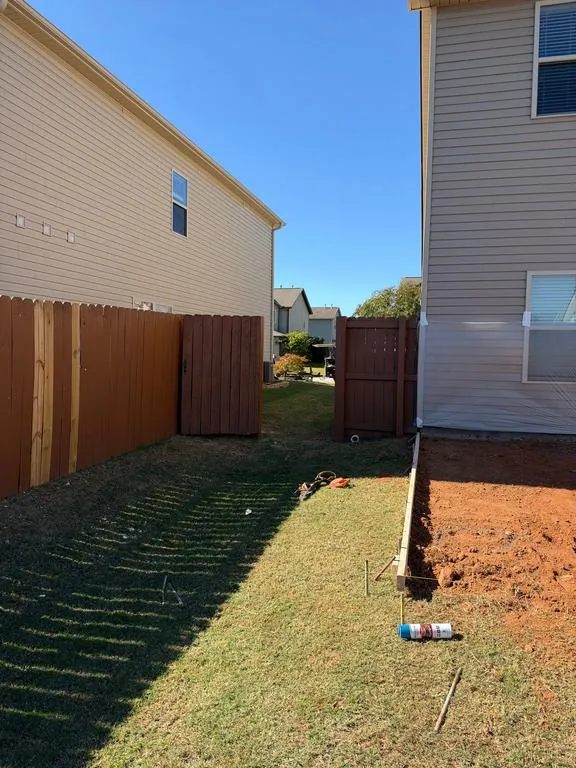
In this yard that meant digging out red clay. What comes out, and how deep, depends on the lot, which is one reason we price on site.
4. How high the patio sits at the back door
The 2021 International Residential Code wants a landing or floor on each side of every exterior door, so a patio poured up to a back door is that landing. Under Section R311.3 it has to be at least 36 inches deep in the direction of travel and at least as wide as the door, sloped no more than 2 percent.
Height matters too. For a door other than the required egress door, R311.3.2 allows the landing to sit up to 7 3/4 inches below the top of the threshold. At the required egress door, R311.3.1 holds it to 1 1/2 inches below, or up to 7 3/4 inches when the door doesn't swing over the landing. Measure from the threshold down before the forms are set, because the top of the form is the top of your patio.
5. Which way the water goes
Drainage is in the code too. R401.3 says impervious surfaces within 10 feet of a building foundation have to slope at least 2 percent away from the building. A patio built against the back wall falls inside that 10 feet.
The NOAA normals for the Greenville-Spartanburg airport weather station (listed under Greer) put average yearly precipitation at 49.67 inches. Water off a patio sloped away from the house ends up at its far edge, so it helps to know before pour day whether that edge is lawn, a bed or a fence line.
6. Where the joints go
NRMCA's joint sheet sets contraction joint spacing at 24 to 36 times the slab thickness, about 10 feet for a 4-inch slab, and recommends 15 feet as the maximum. Panels should be square or nearly so, with length no more than 1.5 times width, and L-shaped panels are on its avoid list.
A 16 by 20 patio is over that 15-foot cap in both directions, so it gets cut into panels. The sheet also calls for isolation joints where a patio meets a sidewalk, garage slab, stairs or other points of restraint, so a patio tying into an existing porch slab or a new walk needs one at that edge.
7. The finish, and the week after the pour
NRMCA's sheets recommend a broom finish for traction on exterior surfaces and say that for most outdoor slabs a broom finish is adequate. They warn against overworking the surface or finishing while bleed water is still on it. A broom finish with a smooth border is what went on the Simpsonville patio.
Curing starts right after finishing and typically runs 3 to 7 days, per NRMCA's curing sheet, which also says to keep the concrete above 50 degrees and protect it from freezing until it reaches at least 500 psi. Cold matters this time of year. The Greer station's normals average about 6 nights at or below freezing in November and about 14 in December, and NRMCA's scaling sheet suggests holding off on deicing chemicals the first winter and using clean sand for traction instead.
If you're planning a patio for this fall, our post on pouring concrete in the fall in the Upstate covers the calendar side.
Getting a price on a Simpsonville patio
Have the rough size you want, which door it serves and what's underground if you know it. Call 864-214-5271 or use the estimate form below, and someone comes out and prices it standing on it. Estimates are free.
Sources: City of Simpsonville, Residential Development Process guide; City of Simpsonville, Building Permits Acknowledgement; SC811, Homeowners; SC811, Private Lines; International Code Council, 2021 International Residential Code, Section R105.2; 2021 International Residential Code, Section R311.3; 2021 International Residential Code, Section R401.3; NRMCA, CIP 4 Cracking Concrete Surfaces; NRMCA, CIP 6 Joints in Concrete Slabs on Grade; NRMCA, CIP 11 Curing In-Place Concrete; NRMCA, CIP 2 Scaling Concrete Surfaces; NOAA NCEI, 1991 to 2020 monthly normals, Greer SC station. All read October 24, 2026. Job details are from our own job log.