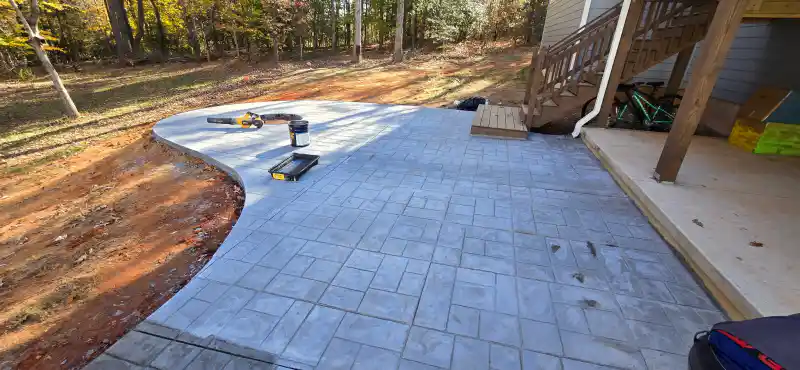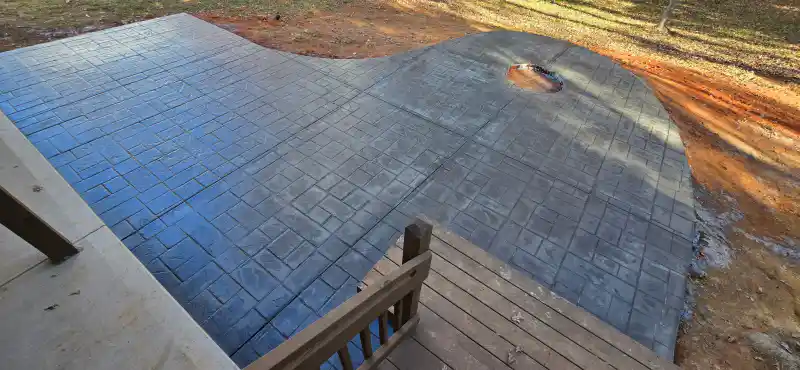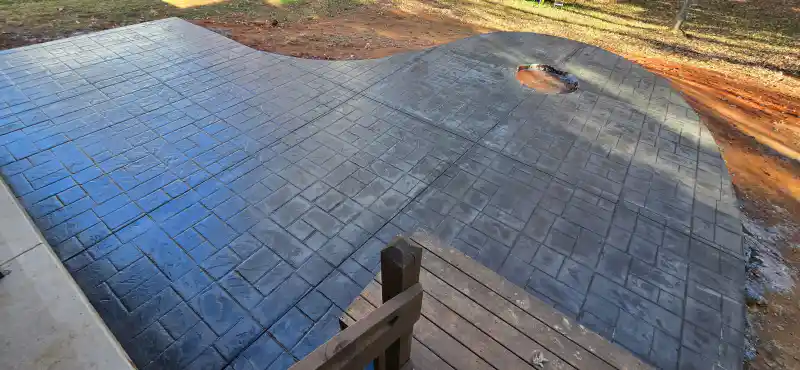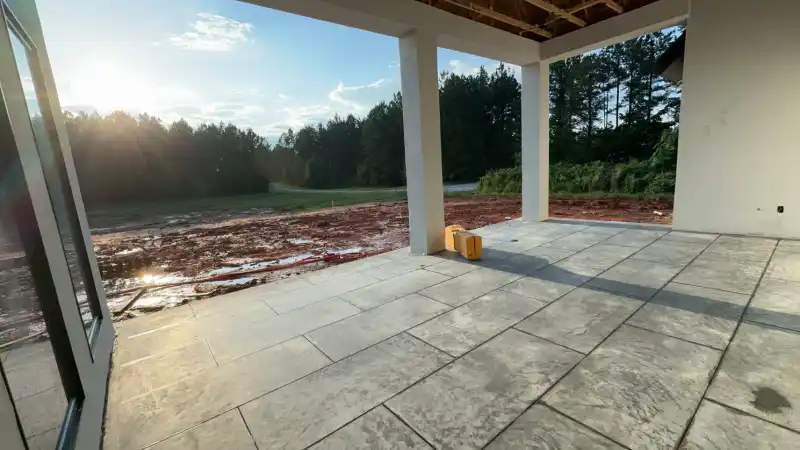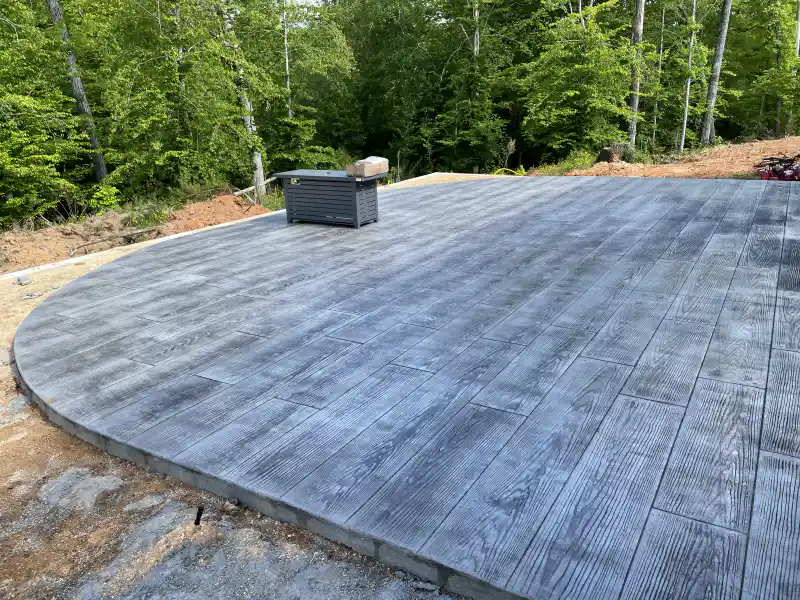
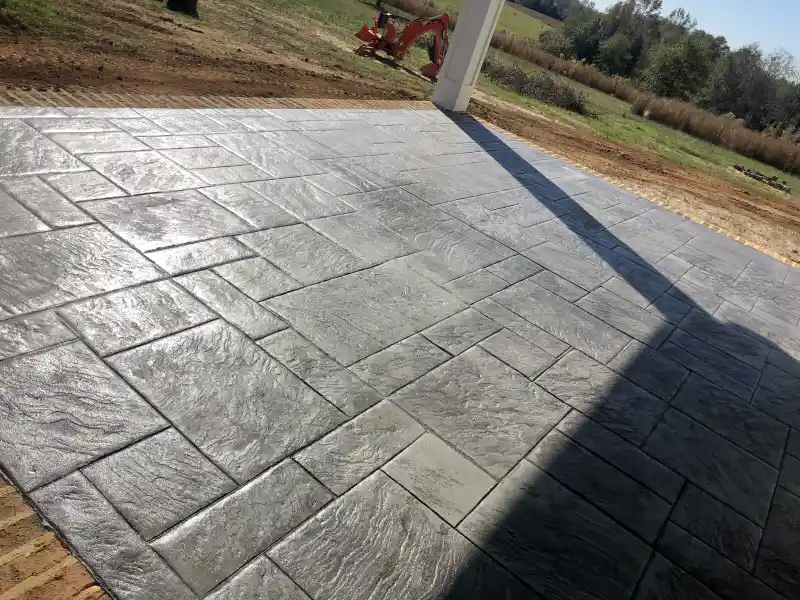
Hendersonville is on the service list for our Asheville office, and a stamped patio there gets judged by how it looks after a mountain winter. Most of what decides that happens before the truck shows up, and the concrete contractor serving Asheville and Hendersonville page has our office details.
How many freezing nights does a Hendersonville patio get?
NOAA's 1991 to 2020 climate normals for the Hendersonville 1 NE weather station, at about 2,160 feet, average 87.7 days a year with a low of 32 degrees or colder. Only 4.8 days a year stay at or below freezing all day long.
So most freezing nights end in a thaw by afternoon, over and over from fall into spring. The station also averages 59.05 inches of precipitation a year, and that keeps water around to soak into a slab before it freezes.
The National Ready Mixed Concrete Association (NRMCA) puts the blame for scaling on saturation: water expands as it turns to ice and stresses the concrete, and the risk climbs with each cycle. Deicers raise the surface saturation further. Our article on how freeze-thaw damages concrete covers the mechanism in more depth.
Timing comes out of the same numbers. The station averages 13.1 freezing nights in November and 11.2 in March, against about 2 in October and April. NRMCA's CIP 2 sheet advises caution about placing exterior concrete in late fall, winter or early spring, when it can freeze soon after placement while still saturated.
What should the mix sheet say for a stamped patio in Hendersonville?
Stamping doesn't change what the concrete underneath needs for freezing weather. For exterior slabs that stay wet, freeze and get deicers, CIP 2 recommends 4,000 psi concrete with entrained air, at 6 percent total air for mixes with 3/4 inch or 1 inch coarse aggregate. Where the slab won't stay continuously moist or see deicer, it lists 3,500 psi.
The sheet also calls for a slump of 3 to 5 inches with no extra water added on site. Watering the load down leaves a weak mortar layer on top, which is right where the pattern gets pressed in.
Finishing counts as much as the ticket. CIP 2 says not to finish while bleed water is on the surface and warns that overworking the surface reduces the entrained air in that top layer. Ask whoever is pricing your patio how they time the stamping against the bleed water, and what air content they order.
How do pattern, color and joints fit together on a stamped patio?
Choose the pattern with the joint layout in front of you. NRMCA's CIP 6 puts maximum joint spacing at 24 to 36 times the slab thickness, which works out to about 10 feet on a 4 inch slab, and recommends a cap of 15 feet. Panels should be square or close to it, no longer than 1.5 times their width, and L shaped panels are out.
Ask to see those joint lines drawn over the pattern before the pour so you know where the cuts will fall.
CIP 6 also calls for isolation joints where a slab meets building walls, footings and stairs, so the patio can move on its own. Where your patio butts the house or runs up to steps, that strip of joint filler belongs in the plan.
Color depends partly on the sealer. The Decorative Concrete Council of the American Society of Concrete Contractors (ASCC) says topical film-forming sealers are the most used option on stamped work because they enhance color, and that most penetrating sealers don't enhance it. When you look at a color sample, ask what sealer is on it.
The patterns and finishes we pour are on our decorative concrete in Asheville page.
Will a sealed stamped patio be slippery when it is wet?
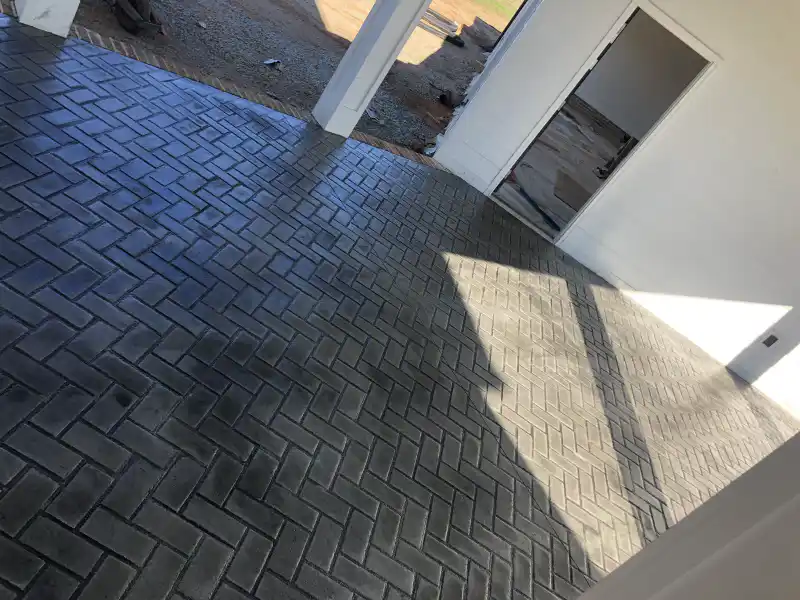
It can be, and one fix goes into the sealer. Euclid Chemical's data sheet for Increte Ultra-Grip describes a colorless polypropylene grit for solvent-based sealers, with exterior stamped concrete on its list of uses. The dose is 1 cup per gallon of sealer.
Euclid says it can produce a static coefficient of friction of 0.8 or greater, and that results vary with the coating, the surface and how it is applied. The same sheet says to apply the sealer without over-rolling and to re-mix any batch that has been sitting so the grit hasn't settled out.
ASCC's guidance gives sealer coverage rates of 200 to 350 square feet per gallon depending on the product, and warns that coats that are too thick, or too many coats, hurt breathability and bond.
Winter grip is a separate problem from sealer. CIP 2 says to avoid deicing chemicals on newly placed concrete if possible and to use clean sand for traction.
It also says never to use ammonium sulfate, ammonium nitrate or magnesium-based salts as a deicer, because they are chemically aggressive and destroy concrete surfaces. Worth remembering on the steps between the patio and the back door.
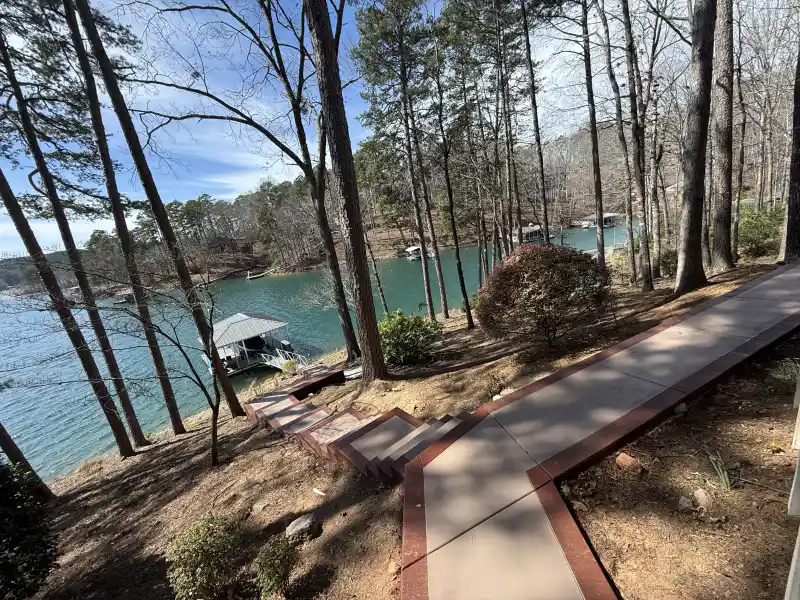
What does a sloped Hendersonville yard change before the pour?
On a hillside lot, the uphill edge of a patio is where the water arrives. CIP 2 lists poor drainage that lets salt solutions sit on the surface as something that makes the exposure more severe and can cause scaling, and the same sheet ties scaling to concrete that is saturated when it freezes.
So walk the yard with whoever is pricing it before you talk patterns. Ask where runoff from above will go once the patio is in, and which way the finished surface will pitch. On a steep drop, the low side may need a step or a short wall to hold the base.
Our earlier article on planning a patio on a sloped yard goes through those site questions in more detail.
Does a patio in Hendersonville need a permit?
First, who handles it. Henderson County Permits and Inspections covers unincorporated Henderson County and, through contracts, the City of Hendersonville along with Laurel Park, Mills River, Fletcher, Flat Rock and Saluda. The city's Community Development FAQ confirms that Hendersonville contracts with the county for all building permits and inspections, and that Community Development reviews those applications for property in the city limits and its extraterritorial jurisdiction.
The county's permit FAQ lists the kinds of work that need a building permit, starting with building or altering any building or structure and adding or replacing load bearing structures. An on-grade patio isn't named there either way. Fences, for comparison, need no building permit but still go to the zoning office for the property.
So call before anything is ordered. The county permit office is at 100 N King Street, Suite 220, in Hendersonville, and the department lists its number as (828) 697-4830.
Ask whether your patio's size and spot on the lot need a building permit. Inside city limits, ask Community Development whether it needs zoning review, and if the house is in a local historic district, the city says exterior work needs a Certificate of Appropriateness first.
Planning a roof over the patio later? Mention that on the same call.
When should a stamped patio in Hendersonville be resealed?
ASCC's Decorative Concrete Council says to reseal as needed instead of on a set schedule. The signs it names are lost water and stain repellency and color that has lost depth. Resealing every year to keep a high gloss builds up a film that is slow and expensive to remove.
When it is time, ASCC calls for a power wash at 3,500 psi or more followed by 24 hours of drying, with any loose, flaky or discolored acrylic sealer stripped first. The new coat goes on out of direct sun at a time of day when the slab temperature will be falling for 3 to 4 hours afterward, which in summer can mean evenings.
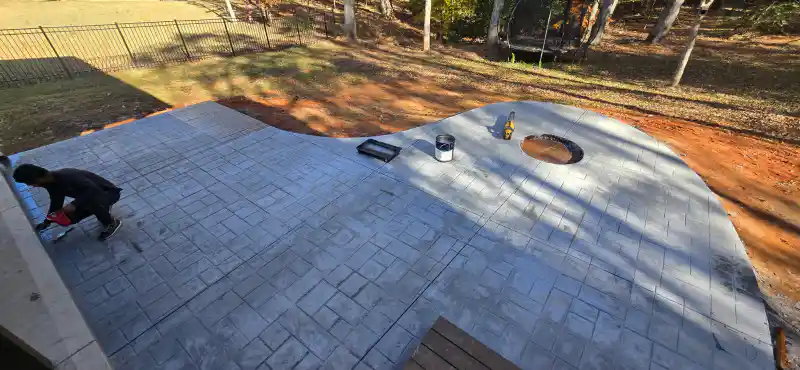
NRMCA's CIP 2 names late summer, after a few dry days, as an ideal time to apply a breathable sealer, so a coat in August or September is down before Hendersonville's freezing nights pick up in November. For what goes into a new stamped patio, see our page on stamped and decorative concrete in Asheville and Hendersonville, or send the details through the estimate form below.
Sources: NOAA NCEI 1991 to 2020 annual and seasonal normals, Hendersonville 1 NE (USC00313976) and monthly normals for the same station; NRMCA CIP 2, Scaling Concrete Surfaces; NRMCA CIP 6, Joints in Concrete Slabs on Grade; ASCC Decorative Concrete Council, Best Practices: Sealing Stamped Concrete (March 2025); Euclid Chemical, Increte Ultra-Grip data sheet; Henderson County Permits and Inspections and its permit FAQ; City of Hendersonville Community Development FAQ. All read October 9, 2026.