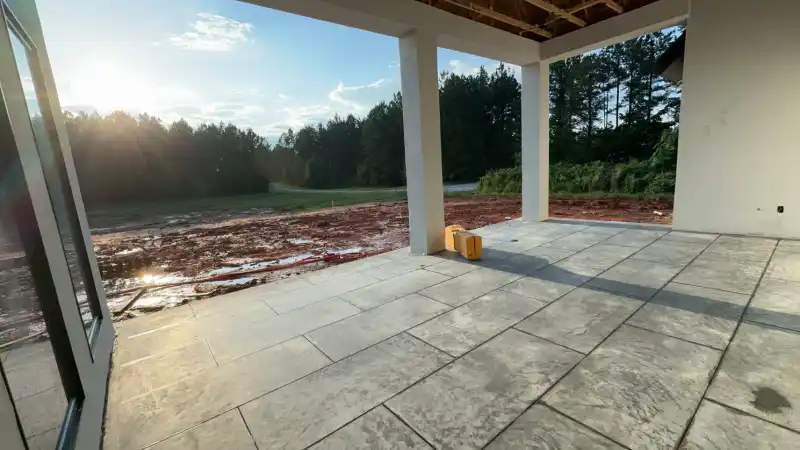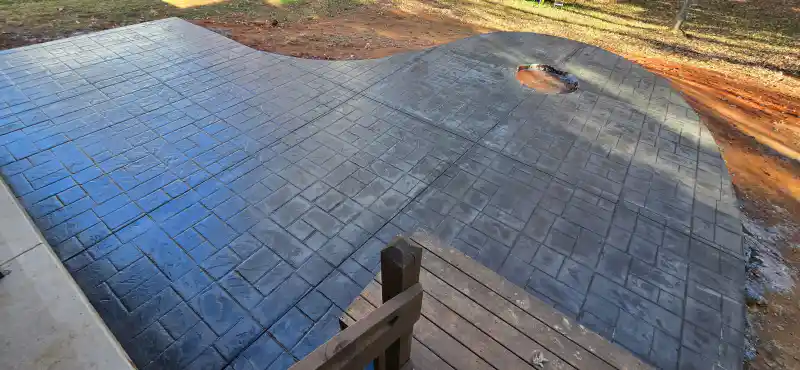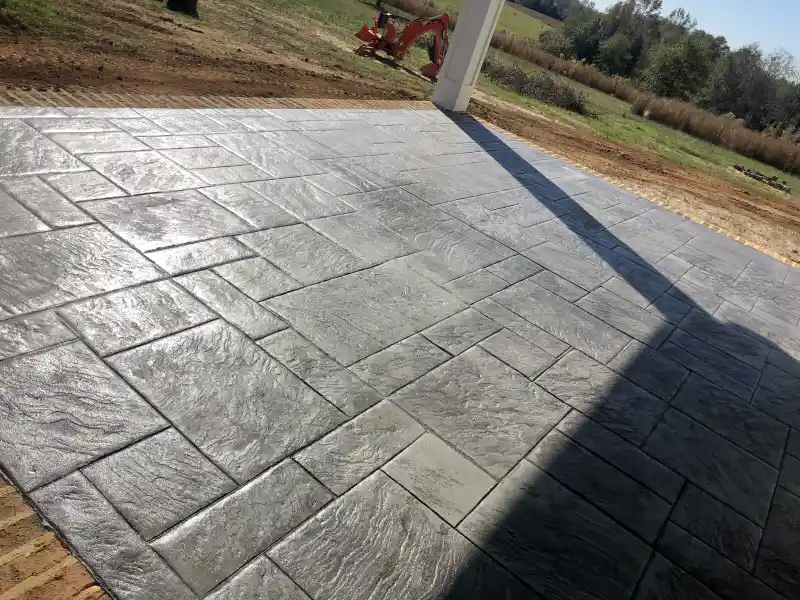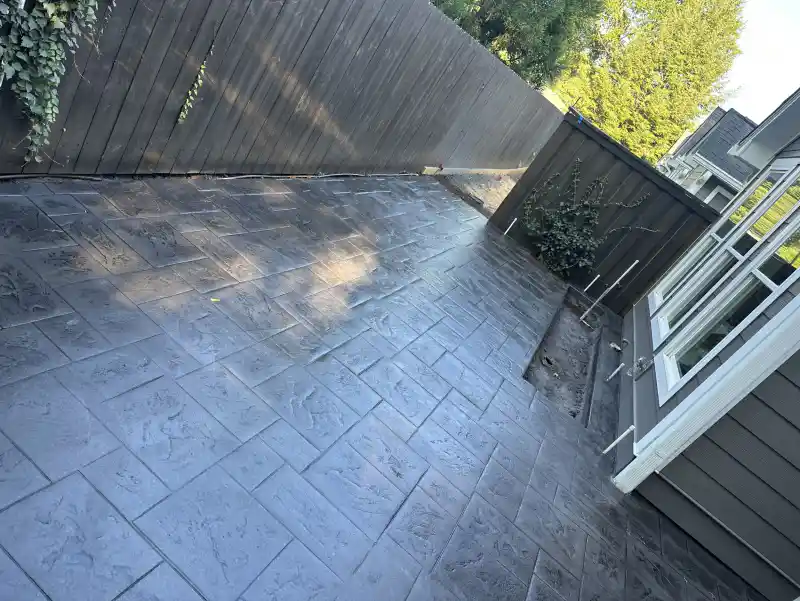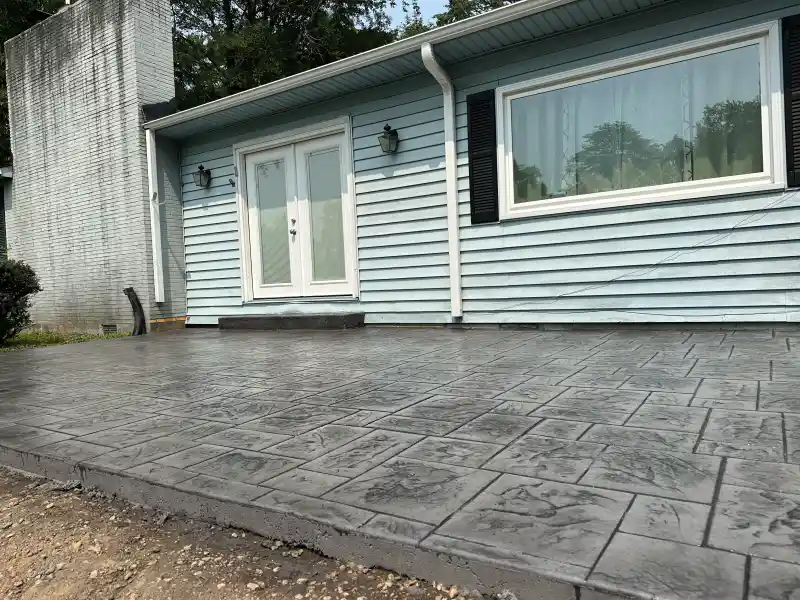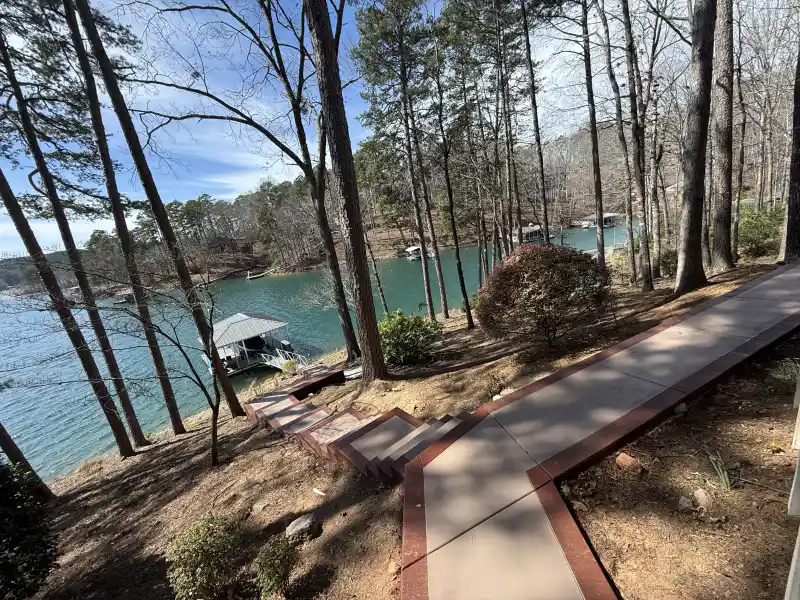
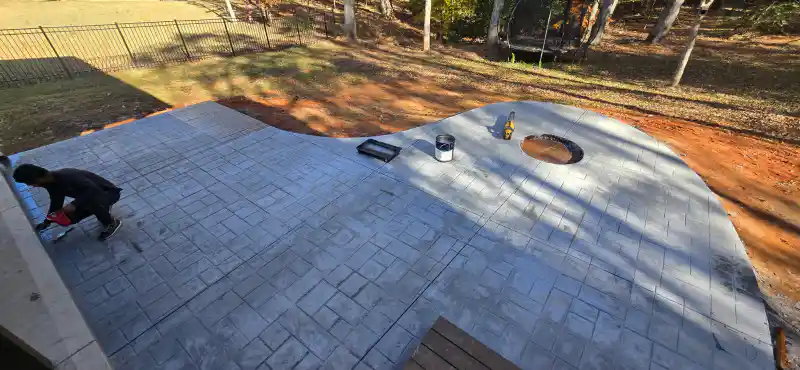
A stamped slab gets one shot. Once the mats come off and the concrete hardens, the color, the pattern and the joint lines are fixed for the life of the patio, so most of the decisions that matter happen on paper before the truck shows up. This is the list we would want an Easley homeowner to have settled before a stamped patio, walkway or pool deck is poured.
If you are still deciding between stamped and plain, start with our comparison of stamped and broom finish patios. This guide assumes stamped is the plan.
Does a stamped patio in Easley need a permit?
The City of Easley Building Department's page lists what needs a permit: any structure of 200 square feet or more, anything that will need plumbing or electricity regardless of size, and remodeling that changes the structural condition of a home. A flat patio on the ground is not named on that list.
That gap is why we tell people to call the department before the pour. A stamped patio that later gets a roof, a wired outdoor kitchen or a hot tub hookup starts to look like the structures the list does name. The department is at Easley City Hall, 205 North First Street, phone (864) 855-7908, open 8:30 to 5 with the office closed for lunch from 1 to 2.
Planning to pull it yourself? The same page says a homeowner can, but only for a primary residence, not a rental, and has to file an Owner/Builder Disclosure form with Pickens County.
Pick the base color and the release color as a pair
Most stamped work has two colors in it. The base color is in the concrete itself, either mixed through the load or worked into the top as a color hardener. The release is a colored powder broadcast over the fresh surface so the stamping mats lift off clean, and some of it stays behind in the low spots of the texture.
Brickform's technical sheet for its Antique Release spells out that split. The release is not meant to be the main coloring agent, it goes over integrally colored or color-hardened concrete, and the part that stays behind settles where the texture has relief, which is what gives a stamped slate or flagstone its darker joints. Brickform lists 40 standard release colors and strongly recommends jobsite samples.
So pick the two together, from a sample. A gray base under a charcoal release reads very differently from the same gray under a tan one.
One line in that sheet is worth knowing if you might add on later. Brickform notes that pigment colors can drift over time and recommends using the same lot numbers. A walkway poured two years after the patio may not match exactly.
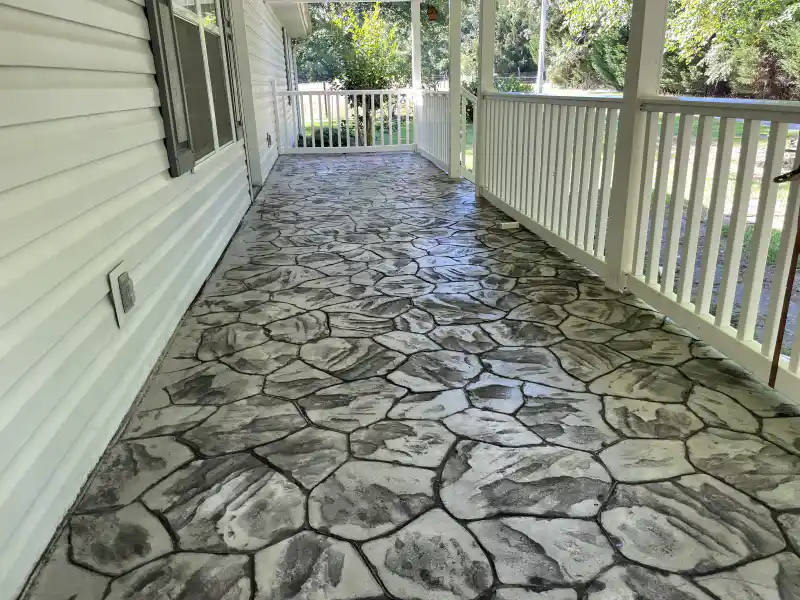
Where the joints land in an Easley stamped pattern
Every slab needs control joints, and a stamped one is no exception. NRMCA's Concrete in Practice sheet on joints (CIP 6) calls joints pre-planned cracks and says to plan the exact location of every joint, including when the contraction joints get sawn, before construction starts.
On a stamped job the pattern makes that planning visible. The same NRMCA sheet says panels should be square or close to it, with the length no more than 1.5 times the width, and that L-shaped panels should be avoided. It also sets the joint groove at a minimum depth of one quarter of the slab thickness, and never less than 1 inch.
That depth matters for stamped work because the grout lines pressed in by the mats are shallow by comparison and do not do the job of a joint. Ask to see the joint layout drawn over the patio shape at the estimate. A curved patio or one that wraps around a corner of the house is where an L-shaped panel sneaks in, and that is the panel most likely to crack somewhere you did not plan.
Easley heat and the stamping window
Stamping only works while the concrete is still plastic, and summer shortens that window. NOAA's 1991 to 2020 climate normals for the Greenville-Spartanburg Airport station average 47.6 days a year at 90°F or hotter, and 40.4 of those fall in June, July and August.
The products have their own limits too. Brickform's sheet says to apply its Antique Release between 55°F and 80°F and to avoid windy conditions. On an Easley summer job that points to an early start, with the stamping done before the afternoon heat. Ask what time the truck is booked for.
Brickform says excess can be swept off once that can be done without damaging the surface, and the residue can be pressure-washed to the look you want after 48 to 72 hours. How much stays depends on how hard the concrete was when it was textured, so two pours of the same color can come out a shade apart.
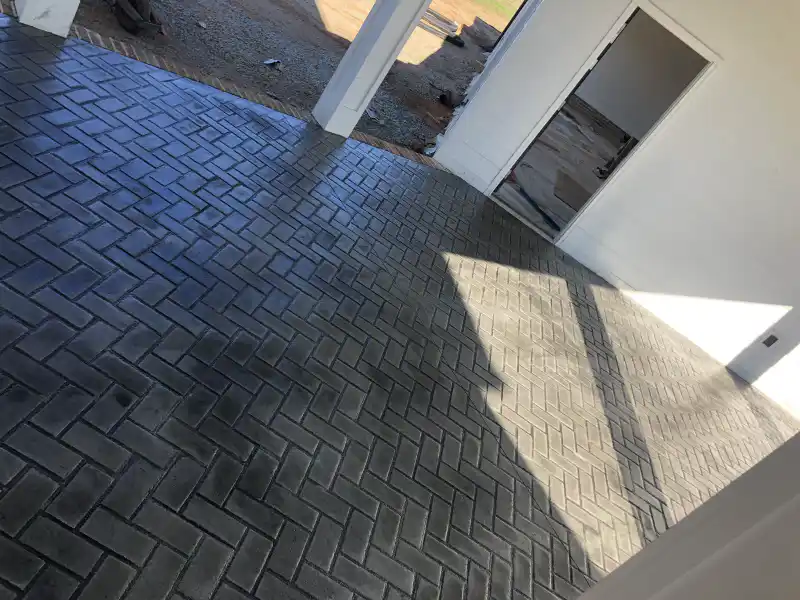
Slip resistance on a sealed stamped pool deck or walkway
Sealer is what brings out the color on stamped concrete, and it also changes how the surface feels underfoot when wet. Euclid Chemical's data sheet for Everclear, a solvent-based acrylic cure and seal it markets for stamped concrete, says the sealer will greatly darken concrete and dry to a medium-gloss finish, and it strongly recommends a small test area first.
For a pool deck, a walkway to the driveway or a set of stamped steps, ask about a grit additive in the sealer. Euclid's sheet for Increte Ultra-Grip describes a colorless polypropylene additive stirred into solvent-based sealers, lists exterior stamped concrete among its uses, and says it can be used to reach a static coefficient of friction of 0.8 or greater, with the caveat that results vary with the coating, the surface and how it is applied.
Colorless is the point there. A sand-type grit can show on a dark stamped color, which is the case Euclid names for using Ultra-Grip on decorative concrete.
When an Easley stamped patio gets its first seal, and when to reseal
The first seal does not happen on pour day. Brickform's release sheet says to let the concrete cure for 28 days before sealing, then keep foot traffic off for 24 hours and vehicles off for 5 days.
Count forward from the pour date. A patio poured in mid-October reaches 28 days in mid-November, and NOAA's normals for the Greenville-Spartanburg station average 6.4 nights at or below freezing in September through November and 41.4 in December through February. Euclid's Everclear sheet says surface and air temperature must be between 40°F and 90°F during application, that it should not go on a frozen surface or in hot direct sun, and that rain or heavy fog should not be expected within 12 hours. NRMCA's CIP 2 on scaling calls late summer, after a few dry days, an ideal time to seal and says to avoid deicing chemicals the first winter. A late fall pour may mean the first proper seal waits for a mild, dry stretch, which is worth agreeing on up front. There is more on sealer types and timing in our guide to sealing concrete in the Upstate.
Resealing has no fixed calendar date. Brickform says to inspect the sealed surface periodically for thin or traffic-worn sealer. Euclid's Everclear sheet warns that resealing too often, or putting it on too heavy, can cause bubbling, whitening, peeling and flaking, and that the sealer is not resistant to gasoline, which matters on a stamped driveway or a parking pad. It also says that over a previous sealer of unknown makeup, a small test section should come first. Keep the product name of whatever went on your slab with the house paperwork.
To talk through colors, joints and timing on your own lot, see our page on stamped and decorative concrete in Easley and the Upstate, and if you are comparing contractors, here is our page as a concrete contractor in Easley. Put the address and the area you want stamped in the estimate form below.
Sources: City of Easley Building Department, permits, homeowner permits and office hours (cityofeasley.com/entities/building-department), read October 9, 2026. NOAA NCEI U.S. Climate Normals 1991 to 2020, Greenville-Spartanburg Airport station USW00003870, days at or above 90°F and nights at or below 32°F, read October 9, 2026. NRMCA Concrete in Practice CIP 6, Joints in Concrete Slabs on Grade, read October 9, 2026. NRMCA Concrete in Practice CIP 2, Scaling Concrete Surfaces, read October 9, 2026. Brickform Antique Release Technical Information Sheet, read October 9, 2026. Euclid Chemical Everclear technical data sheet (Rev. 04.22), read October 9, 2026. Euclid Chemical Increte Ultra-Grip technical data sheet (Rev. 03.26), read October 9, 2026.