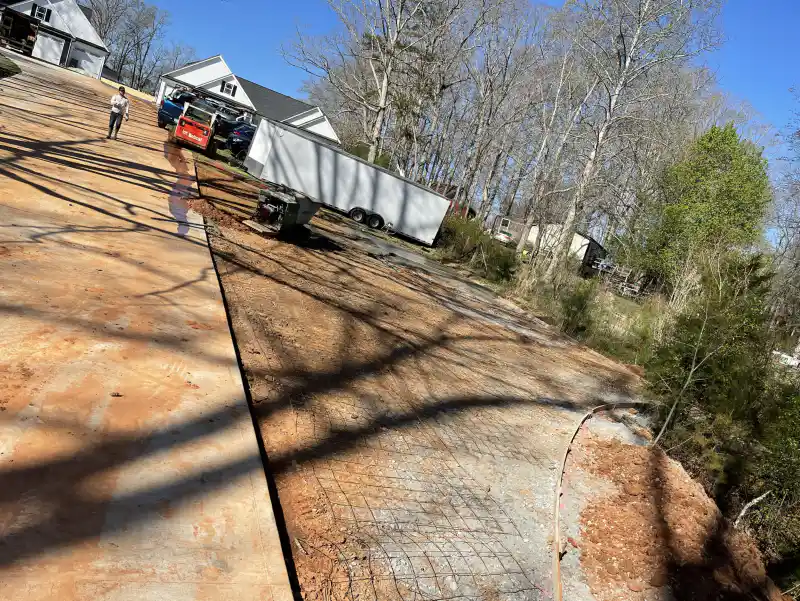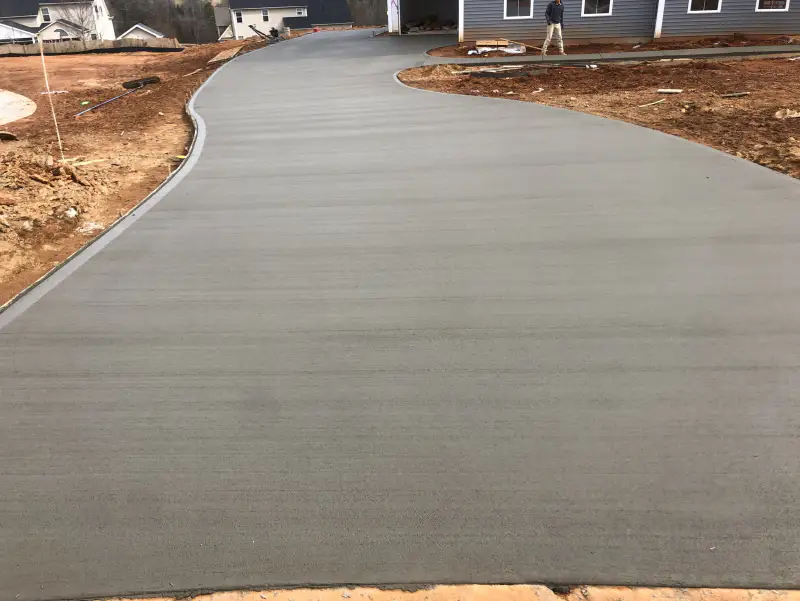
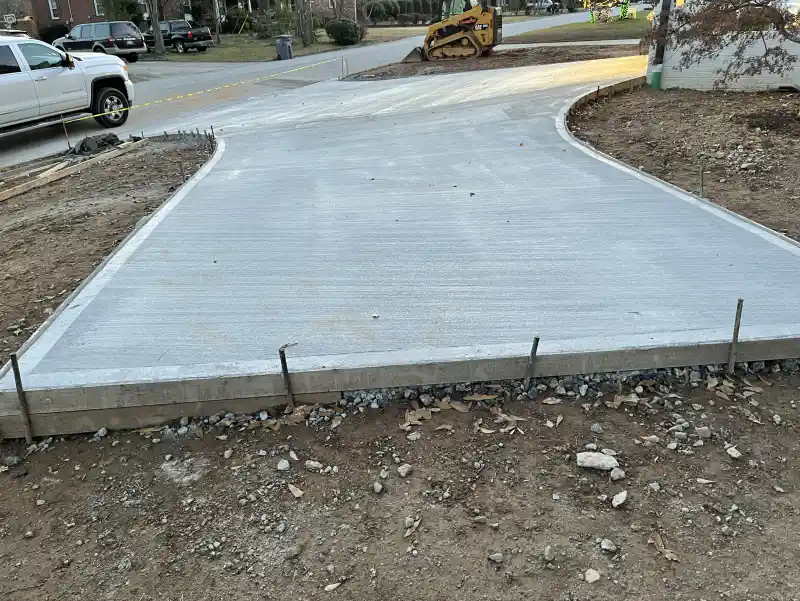
A crack in a concrete driveway in Asheville usually looks worse than it is. A few kinds are worth acting on before the coldest weeks of winter, and the trick is telling those apart from the ones you can leave alone. The facts below come from the National Weather Service, NOAA, the City of Asheville and the National Ready Mixed Concrete Association (NRMCA).
For the broader picture of what Ace Concrete Construction does as a concrete contractor in Asheville, start with that page. This one stays on cracks.
Are cracks in a concrete driveway normal?
Yes, some cracking is normal. NRMCA's sheet on cracking says all concrete tends to crack and completely crack-free concrete can't be produced, and that most random cracks showing up early "rarely affect the structural integrity or the service life" of the slab.
Start with the saw-cut lines. NRMCA calls joints "pre-planned cracks": the groove makes the slab crack along a straight line instead of wherever it wants, so a hairline sitting in the bottom of a joint is the joint working.
Two other early cracks look alarming and usually aren't. Crazing is a web of fine surface cracks, rarely more than about an eighth of an inch deep, that NRMCA says does not affect structural integrity. Plastic shrinkage cracks form within hours of the pour, run roughly parallel 1 to 3 feet apart, stay fairly shallow and generally don't reach the edge of the slab.
When should you worry about a driveway crack?
Worry when the crack changes: it gets wider over a season, one edge sits higher than the other, a panel rocks or drops when you drive over it, or pieces start to break loose near the joints.
| What you see | What it usually is | Usual next step |
|---|---|---|
| A fine web of shallow lines on the surface | Crazing from finishing or early drying | Leave it, or clean and seal the surface |
| Short parallel cracks that stop short of the edge | Plastic shrinkage from pour day | Seal them to keep water out |
| A hairline running down a saw-cut joint | The joint doing its job | Nothing, or reseal the joint |
| One side of the crack higher, or a sunken corner | The base under that panel moved (a settlement crack) | Get it looked at; usually that section comes out |
| Cracks spreading out from the joints of an older slab | Possibly D-cracking from freezing and thawing | Usually replacement of the affected panels |
NRMCA names D-cracks as one of two exceptions to the "early cracks are harmless" rule. They come from freeze-thaw damage to some porous types of aggregate, start at joints at the bottom of exterior slabs and tend to show up later in a slab's life.
What does an Asheville winter do to an open crack?
It fills the crack with water and freezes it, over and over. The National Weather Service office for Greenville-Spartanburg puts Asheville's average first freeze at October 21, about two weeks ahead of the November 5 average it lists for Greenville-Spartanburg, and Asheville's earliest recorded first freeze came on September 30, 1967.
NOAA's 1991 to 2020 normals for Asheville Regional Airport count 87.5 nights a year at or below 32°F, but only 5.2 days when the high stays at or below freezing. That leaves roughly 82 days in a normal year that freeze overnight and climb back above 32°F by afternoon, which is the thaw-and-refreeze pattern that works on open cracks. The same normals put yearly precipitation at 49.59 inches, so there's rarely a dry month to wait out.
An unsealed shrinkage crack is worth the afternoon it takes to seal. NRMCA's plastic shrinkage sheet says those cracks can let in aggressive chemicals and act as weak points where later cracking starts. Seal on a dry day inside the temperature range printed on the sealant, and with the average first freeze already behind us this year, that means picking a mild stretch.
How do you measure and photograph a driveway crack?
Mark it, measure it at the same spots, photograph it with a scale in the frame, and check again after a few freezes, because one reading can't show whether a crack is moving.
- Mark both ends with a paint pen or a strip of tape and write the date beside each mark. If the crack later runs past your mark, it's growing.
- Pick two or three spots along it, mark them too, and measure the width at each with a ruler or a set of feeler gauges.
- Lay a straightedge or a level across the crack. Note it if one side sits higher; that offset matters more than the width.
- Photograph each marked spot straight down with a coin or tape measure beside it, then take one wide shot from the street showing the whole driveway.
- After the next rain, see where water runs and where it pools, and note any downspout, tree or parked trailer near the crack.
Repeat it in late winter and compare the two sets. Those same photos, with the street address, are what we ask for when someone sends a damaged slab through our estimate form.
What makes an Asheville driveway crack keep moving?
Most cracks that keep moving trace back to the ground under the slab rather than the concrete itself, and in Asheville that usually means water getting into the base, either softening it or washing it out from the low side. Roots lifting a panel are the other common one.
NRMCA lists improper subgrade preparation and missing or badly placed joints among the main causes of cracking, along with too much water in the mix and poor curing. On a sloped Asheville lot, runoff collects along the low edge and at the bottom of the driveway, and that's often where a washed-out corner shows up first. A crack with a raised edge that follows a line toward a nearby tree points at roots.
Reinforcement doesn't stop any of this. Both NRMCA sheets on cracking and joints say wire mesh can't prevent cracking, though steel placed at the right depth can keep cracks from opening as wide. If drainage on a hillside is part of your problem, our guide to steep concrete driveways in Asheville covers where the water goes.
Does a cracked driveway mean a problem with the house?
Usually not. A driveway is its own slab on its own base, so a crack in it says very little about the house. If you're also seeing new cracks in interior walls, doors that started sticking or gaps opening at window frames, that's a question for a structural engineer or a home inspector, not a driveway contractor.
Seal, repair or replace a cracked Asheville driveway?
Sealing is enough while the slab is still flat and solid. Once the base under a panel has moved, that panel has to come out, and when it's happening across most of the driveway you're looking at a replacement.
The middle case is the one people try to patch. On our own Asheville jobs, a section whose base has failed gets broken out and hauled off, the base is put right, and new concrete goes down, because filling the crack in a panel that's still sinking doesn't fix what's under it.
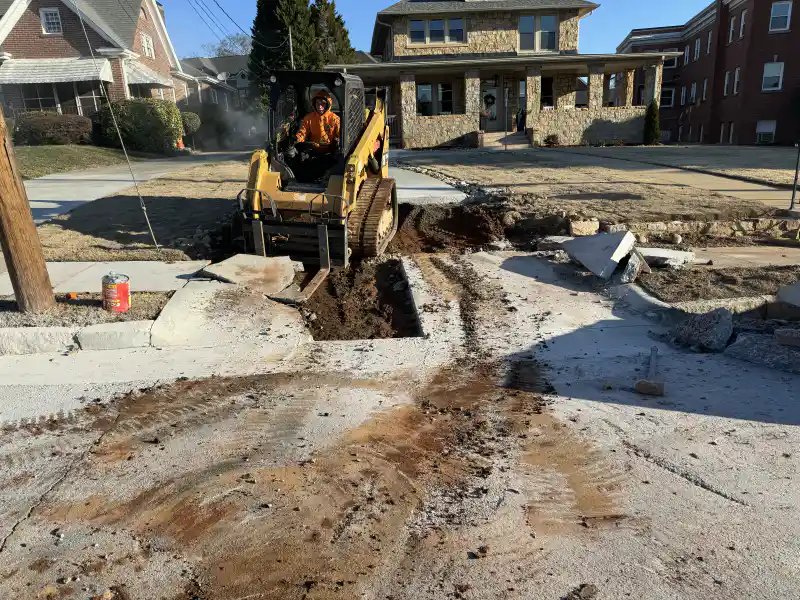
Check who owns the strip at the street before any of that work starts. The City of Asheville says anyone cutting concrete, asphalt, brick or dirt in the City right-of-way, including a contractor, needs a Right-of-way Cut Permit from the Streets Division of Public Works. The minimum permit covers 25 square feet, the repair has to be done and inspected within 10 working days, and an accepted repair starts a 2-year warranty period.
Not every street out front is the City's. Public Works maintains about 404 miles of streets, out of 564 miles of City and State streets inside city limits, and any street missing from the City's maintained street inventory is private or maintained by NCDOT. The permits page advises contacting NCDOT about cuts in an NCDOT right-of-way. A cracked or uneven public sidewalk crossing your driveway can be reported to the City through the Asheville App.
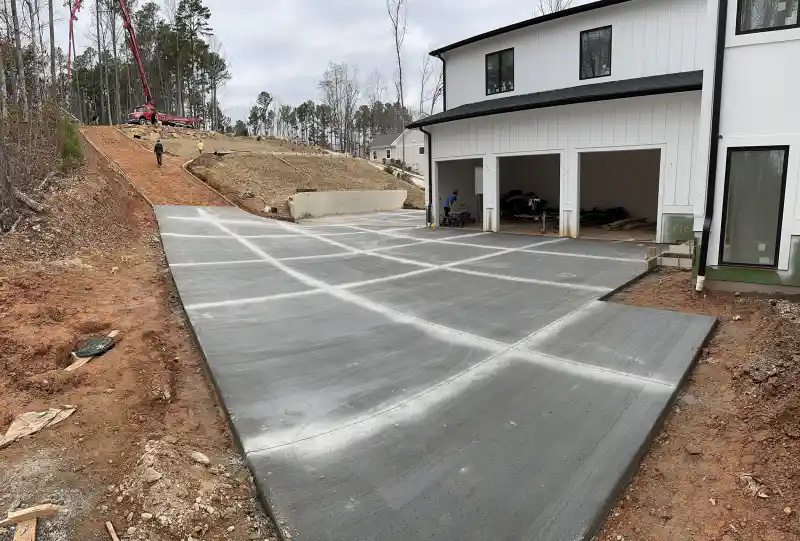
If your crack is moving, our page on concrete driveways in Asheville covers the driveway work we take on. Send your photos and the address through the estimate form below, or call 828-229-5853.
Sources: National Weather Service Greenville-Spartanburg, Cold weather and first freeze dates; NOAA NCEI, 1991 to 2020 annual normals, Asheville Regional Airport (USW00003812); City of Asheville Public Works, Street Services permits, Streets and Sidewalk repairs; NRMCA Concrete in Practice CIP 3 Crazing Concrete Surfaces, CIP 4 Cracking Concrete Surfaces, CIP 5 Plastic Shrinkage Cracking and CIP 6 Joints in Concrete Slabs on Grade. All read November 10, 2026.