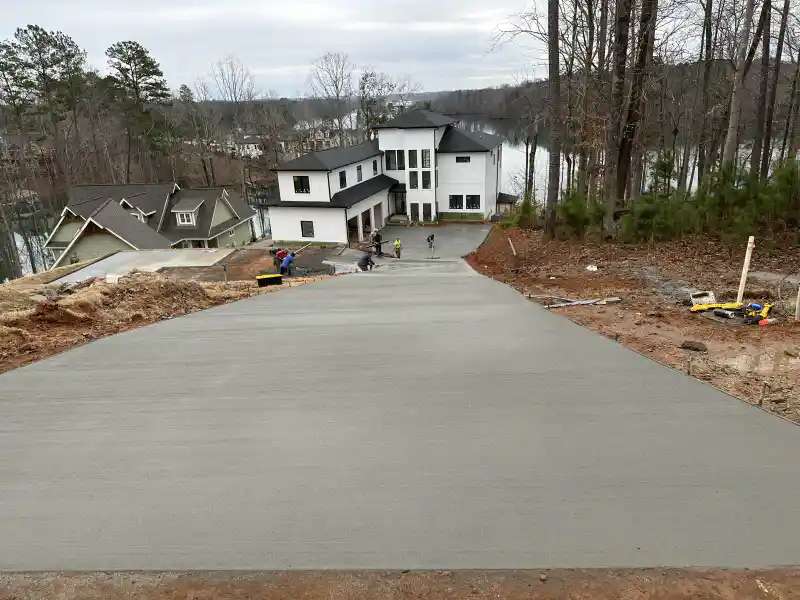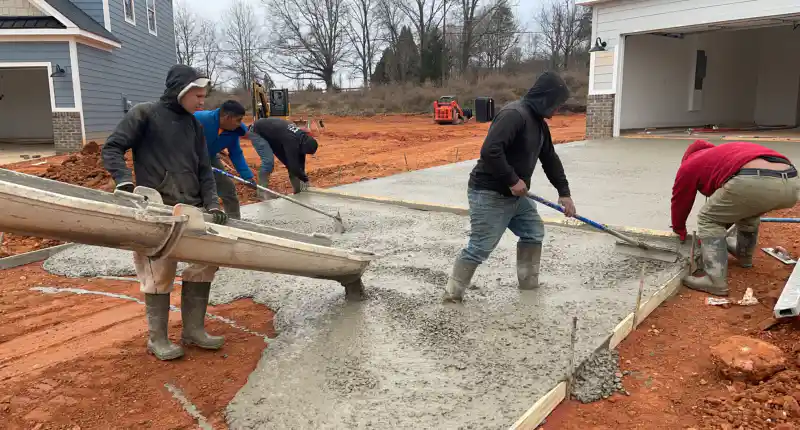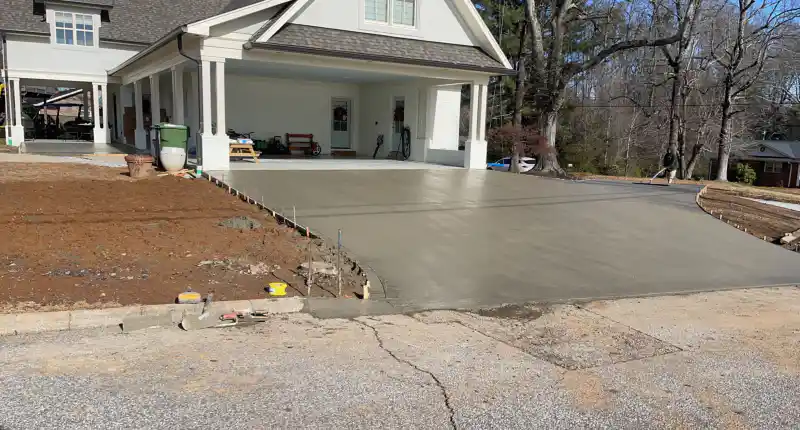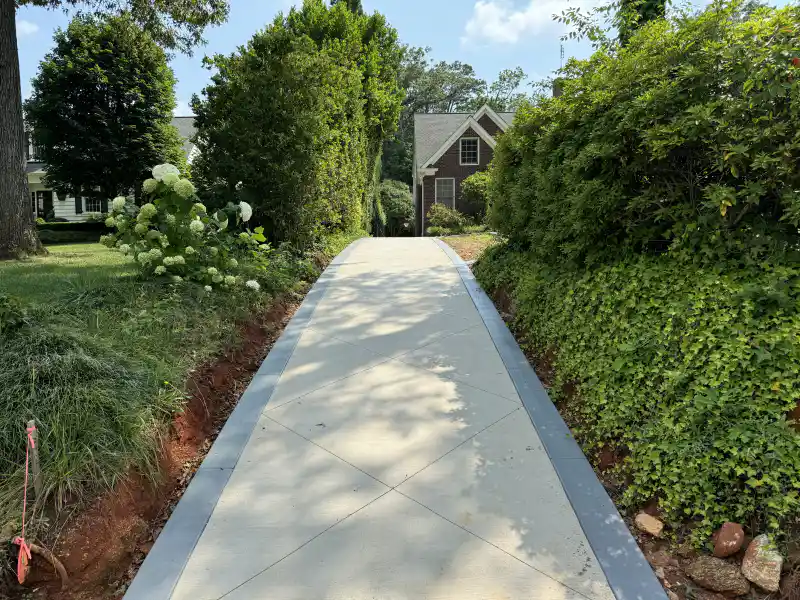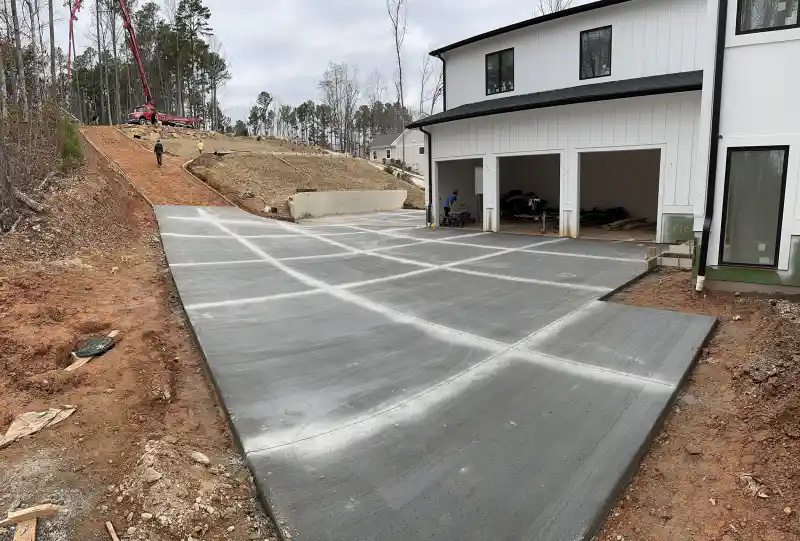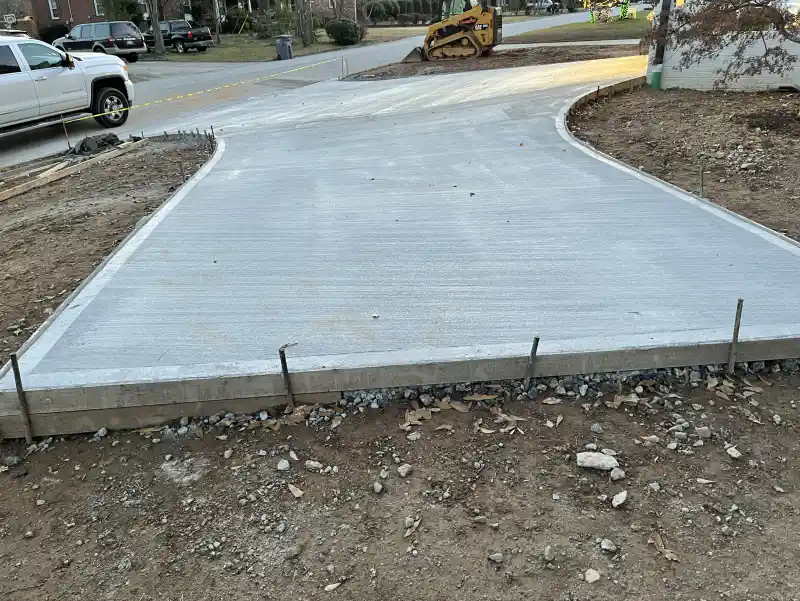
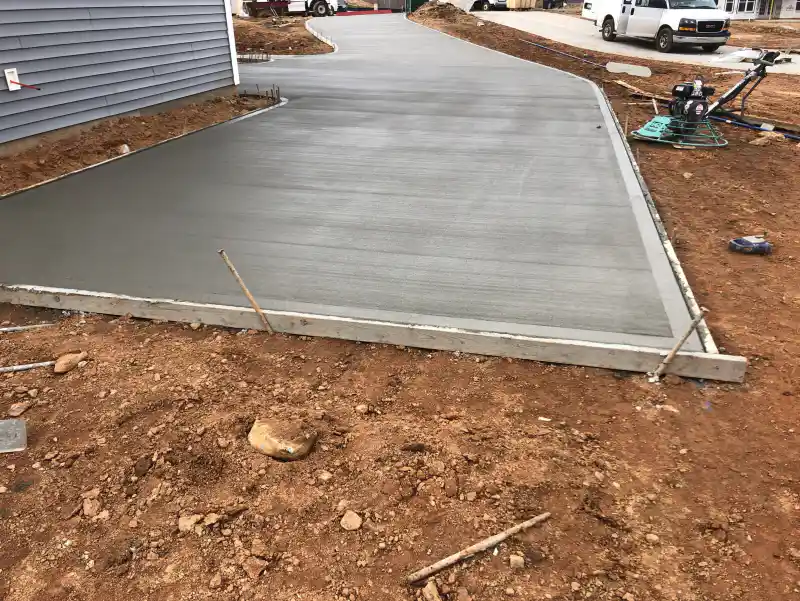
A driveway gets one chance at most of what makes it last. Once the concrete is down, you can't add thickness, change the slope or move a joint without cutting something out. So nearly every mistake on this list has to be caught before or just after the pour.
If your driveway is already failing, our list of signs a driveway needs replacing is the better read. This one is for anyone about to pour, and our page on concrete driveways in Greenville and our page for a concrete contractor in Greenville cover how we handle the job.
1. Pouring over soft ground
Improper subgrade preparation is one of the main causes NRMCA lists for cracked concrete, and it's the mistake you can't see once the slab is down. Its fix is plain: all topsoil and soft spots come out, and the soil or granular fill under the slab gets well compacted by rolling, vibrating or tamping. The same sheet says never to place concrete on a frozen subgrade.
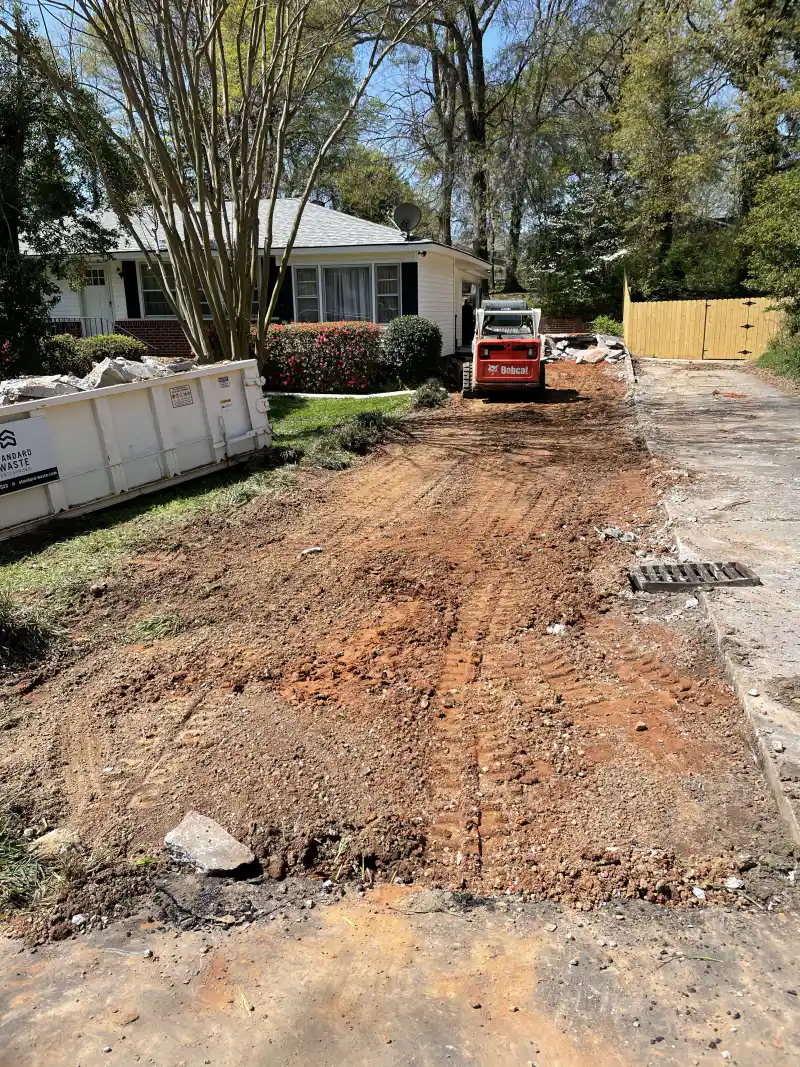
Settlement cracks are also on that sheet as a common form. Ask to see the base before the truck comes.
2. Letting the slab tip toward the house
Section R401.3 of the 2021 International Residential Code says impervious surfaces within 10 feet of a foundation have to slope at least 2 percent away from the building, just under a quarter inch per foot. The NOAA normals for the Greenville-Spartanburg airport station, listed under Greer, average 49.67 inches of precipitation a year, so a slab that tips the wrong way gets tested often.
Check it when the forms are set, with a level or a string line, while a change only means moving a form board. After the pour, fixing it means cutting out the section that falls the wrong way.
3. Pricing every driveway at the same thickness
Four inches is the usual floor for a passenger vehicle or SUV. As our driveway page notes from Concrete Network's guidance, 5 to 6 inches gets called for once heavier trucks or an RV park on it regularly.
So tell the estimator what will really be on it: the work truck, the camper, the delivery that comes twice a year. Comparing two bids also means checking they quote the same thickness. Thickness changes the joint spacing too, which leads to the next one.
4. Leaving the joints to chance
NRMCA's joint sheet sets maximum spacing at 24 to 36 times the slab thickness, about 10 feet for a 4-inch slab, and recommends going no further than 15 feet. Panels should be close to square, never more than 1.5 times as long as they are wide. Avoid L-shapes, which are easy to end up with at a garage corner or a curved flare.
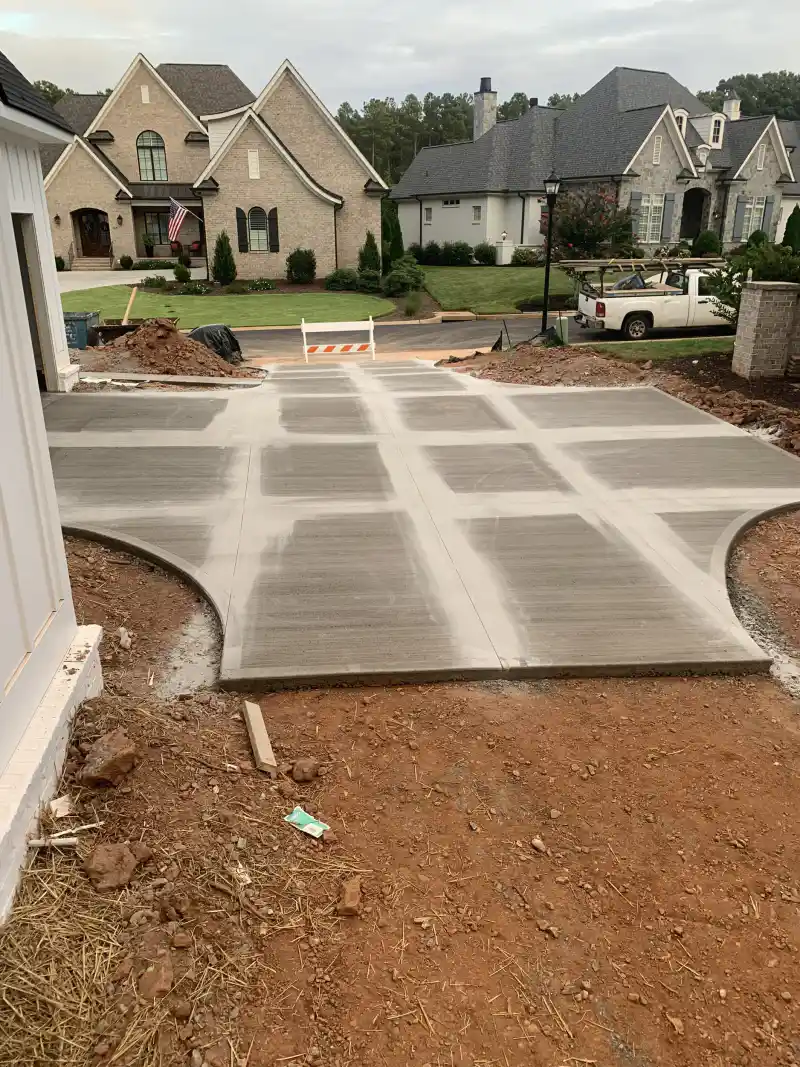
Timing counts as much as layout. Conventional saw cuts belong 4 to 12 hours after finishing, and if the cut is left too long, uncontrolled cracking may occur. Wire mesh won't rescue a bad layout either, as the sheet says outright that mesh does not prevent cracking.
5. Assuming the edge of the road is yours
The last few feet of a driveway often sit in a right-of-way, and whoever owns that road has a say. Greenville County's permitting desk handles county roads and has its own rule on aprons, which we cover on our driveway page and in our concrete vs asphalt comparison. Work inside a right-of-way that SCDOT maintains needs an SCDOT encroachment permit, which SCDOT issues with no fee. An address inside city limits can answer to the city as well.
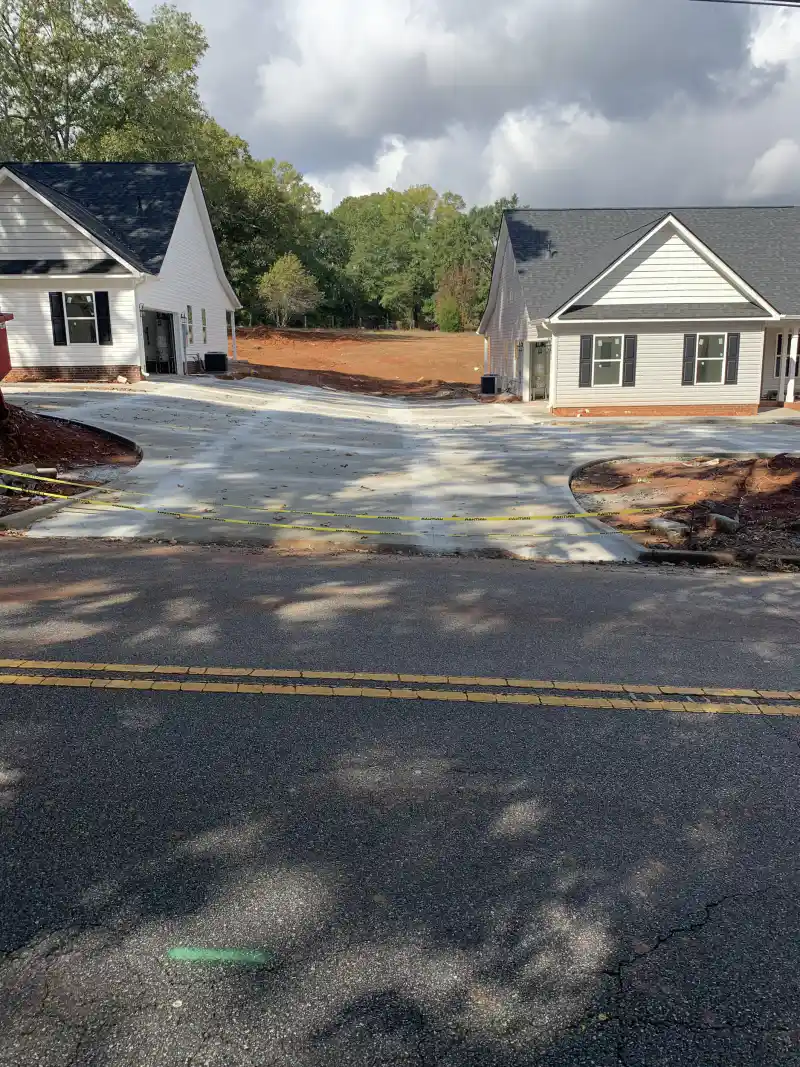
Sort out which one applies to your address before the forms go in.
6. Cutting the curing short
NRMCA's curing sheet says curing starts right after finishing and typically runs 3 to 7 days. Without it, concrete in a dry environment can lose as much as 50 percent of its potential strength compared with moist-cured concrete, and the surface wears worse and is more likely to craze, dust and scale.
An occasional hosing does not count, because the sheet rules out alternate wetting and drying as a curing practice. Ask what your contractor will use. The cracking sheet names a liquid curing compound sprayed on the surface, or damp burlap kept moist for at least 3 days.
7. Driving on it too soon
Concrete Network says to wait at least 7 to 10 days after placement before driving and parking a standard vehicle on a new concrete driveway, because going too soon can cause cracking and other permanent damage.
The heavy visitors are the ones to plan around. Ask your contractor for a date, then move the furniture delivery, the dumpster and the landscaper's trailer past it. In cooler weather ask again, since a 20 degree drop in concrete temperature roughly doubles setting time.
8. Treating the first winter like any other
The same NOAA normals average about 54 nights a year at or below freezing, and about 41 of them fall in December, January and February. A pour heading into those months needs a plan. NRMCA's cold weather sheet says fresh concrete should be protected from freezing until it reaches 500 psi, about two days after placement, and from freeze and thaw cycles until it reaches 3500 psi. It also advises against water curing when freezing temperatures are imminent.
Then go easy on the salt. NRMCA's scaling sheet lists excessive deicing chemicals as a cause of scaling, especially on newly installed concrete, and warns that magnesium-based road salts can get tracked in on cars and build up on the slab. Our guide on sealing a concrete driveway in the Upstate covers what a sealer adds.
Before you sign anything
Three of these get settled on paper: thickness, joint layout and who handles the right-of-way. Three more get settled on site before the truck comes: the base, the slope and the utility locate through SC811, which wants at least three business days. The rest come down to patience after the pour.
Planning a pour in Greenville? Send us the address through the form below or call 864-214-5271, and someone will come look at the ground before pricing it. The estimate is free.
Sources: NRMCA, CIP 2 Scaling Concrete Surfaces; NRMCA, CIP 4 Cracking Concrete Surfaces; NRMCA, CIP 6 Joints in Concrete Slabs on Grade; NRMCA, CIP 11 Curing In-Place Concrete; NRMCA, CIP 27 Cold Weather Concreting; International Code Council, 2021 International Residential Code, Section R401.3 Drainage; NOAA NCEI, 1991 to 2020 annual and seasonal normals, Greer SC station; SCDOT Encroachment Permits; SC811 Homeowners; Concrete Network, Frequently Asked Questions About Concrete. The code section was read October 24, 2026, and the rest November 4, 2026.