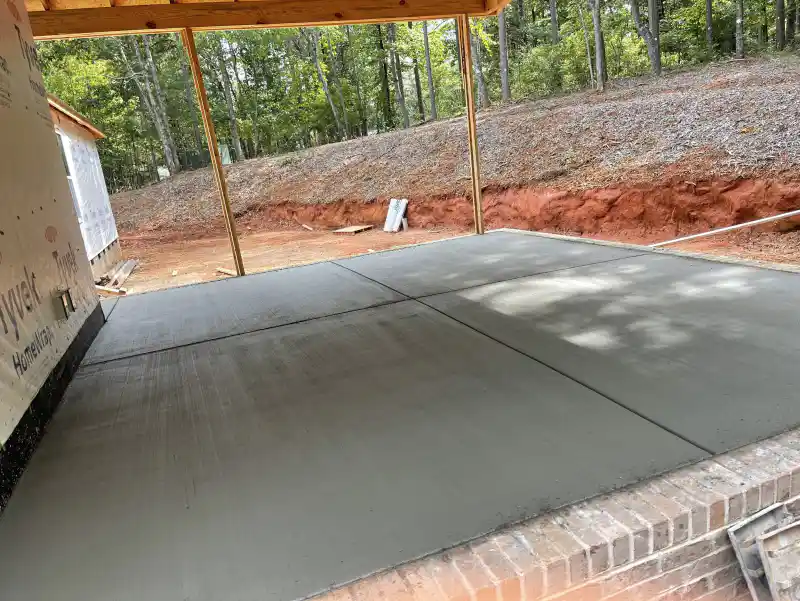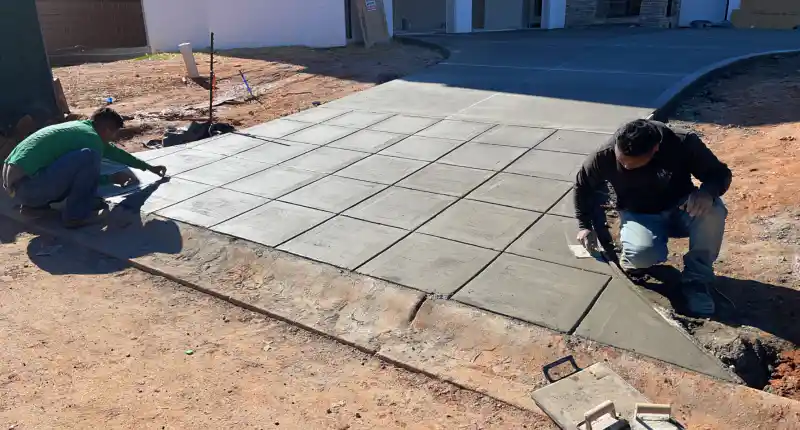
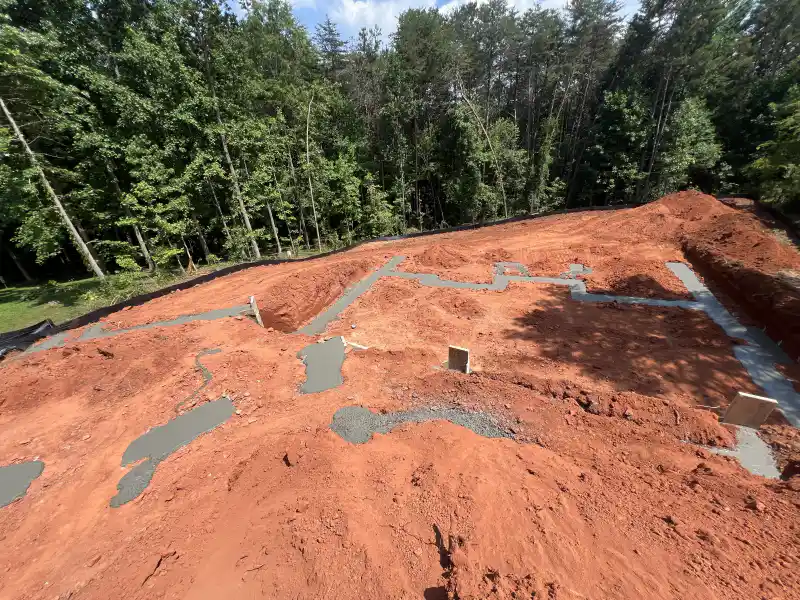
A garage, an addition or a detached shop all rest on a part nobody sees once the job is done, the footing. In most of Spartanburg County that footing sits in red clay. This guide pulls together what USDA soil data, the 2021 International Residential Code, NOAA weather normals, NRMCA's data sheets and SC811 say about it, all read October 21, 2026. Permits and inspections are the county's to explain, so a call to Spartanburg County Building Codes comes before any digging.
What the red clay under Spartanburg County really is
USDA's Soil Data Access covers the county as survey area SC083, about 523,700 mapped acres. Weighting each map unit by its share of a named soil, Cecil comes to roughly 329,000 of those acres. That is more than 60 percent of the county, and Pacolet adds about 36,600 more. Bethlehem, a third upland soil, is mapped here too.
NRCS's official description of Cecil reads like the yard most people dig into. A sandy loam topsoil up to 8 inches thick lies over a red clay subsoil that runs 24 to 50 inches deep, firm and described as sticky and plastic when moist. The series data lists 35 to 70 percent clay in that layer. Bedrock sits deeper than 60 inches.
The same description rates shrink-swell potential low, and so do the descriptions for Pacolet and Bethlehem. This is kaolinitic clay, which NRCS classes as low-activity. That doesn't make it easy ground. It does mean swelling soil isn't what NRCS flags here, so the footing questions turn to other things.
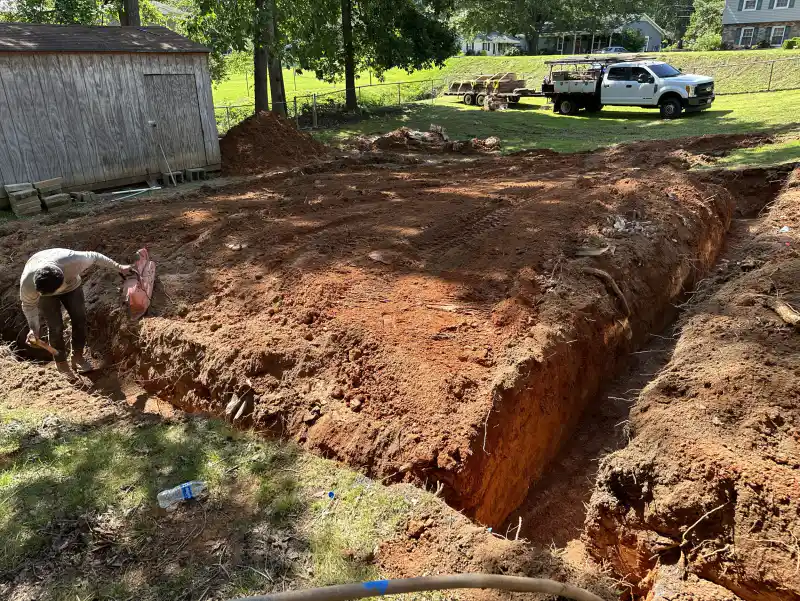
The soils that change a footing plan
Pacolet has a thinner clay layer, 12 to 26 inches, and in the typical profile the clay starts 3 inches down. Slopes there commonly run 15 to 25 percent and can reach 60. On ground like that the footing follows the hillside in steps rather than in one long run, and the code has a rule for it, covered below.
Bethlehem is the one with rock close by. Its description puts soft bedrock at 20 to 40 inches, against more than 60 for Cecil and Pacolet.
Creek bottoms are different again. Chewacla is somewhat poorly drained, with a seasonal high water table 6 to 24 inches down from November to April. Toccoa is listed as occasionally to frequently flooded from October to May. NRCS rates both very limited for dwellings without basements, citing flooding for each and, for Chewacla, wetness and ponding as well.
For the three uplands the story is calmer. In the county's survey data, the only thing that limits Cecil, Pacolet and Bethlehem for dwellings without basements is slope of 8 percent or more. NRCS rates map units, not soil names, so one Cecil unit on a gentle rise and another on a 15 percent side slope can land in different classes.
What the model code asks of a footing
We read the 2021 IRC on ICC's public site, where it carries a historical-version label. Which edition Spartanburg County enforces, and any local changes to it, is for the county's building office to say.
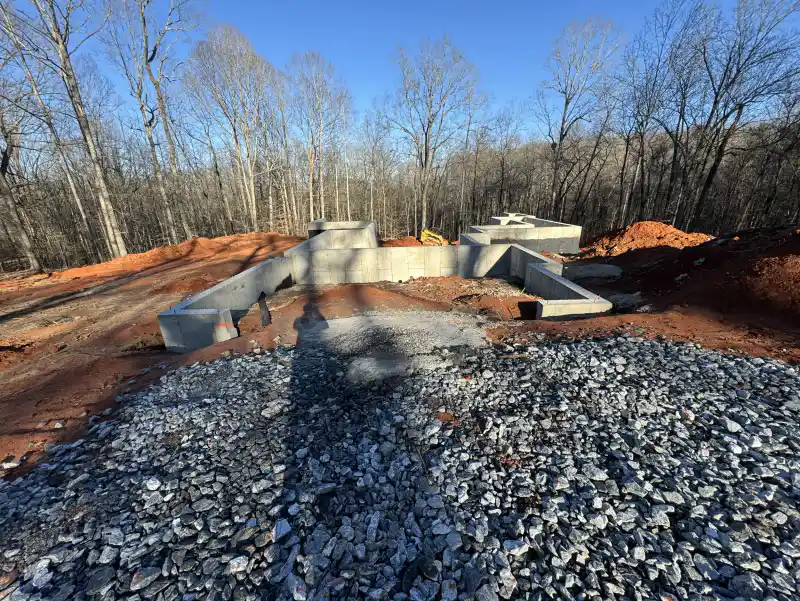
Section R403.1 says footings are supported on undisturbed natural soil or engineered fill. Section R401.2 adds that fill under a footing has to be designed, installed and tested under accepted engineering practice. So the trench bottom should be native clay, or fill with a test behind it, and loose dirt pushed around while grading the pad doesn't count.
On depth, R403.1.4 puts exterior footings at least 12 inches below the undisturbed ground surface, then sends you to the frost rule. R403.1.4.1 says to extend below the frost line in Table R301.2, and a footnote to that table says the jurisdiction fills in the minimum footing depth. The number isn't in the model code. It lives in the county's adoption, so ask the building office for it. The same section bars footings from bearing on frozen soil.
It also has an exception that matters for a shop. Free-standing light-frame accessory buildings of 600 square feet or less, with eaves 10 feet or lower, need no frost protection under the model text. An attached garage or an addition isn't free-standing, so that exception doesn't reach it. Whether the county kept the exception is another question for the office.
Without a soils report, R401.4.1 lets a designer assume a bearing pressure by soil class. The clay and silt classes get 1,500 pounds per square foot, the lowest on the list. At 1,500, Table R403.1(1) calls for a footing 12 inches wide by 6 thick under a one-story slab-on-grade building in its lightest-load row, and 16 inches wide for one story over a basement. R401.4 also lets the building official order a soil test where expansive, compressible or shifting soils are likely.
Footing slope is covered too. R403.1.5 keeps the bottom of a footing no steeper than 1 foot in 10 and says to step it where it would otherwise run steeper, which answers the Pacolet hillside problem. Drainage comes down to R401.3, which has the ground fall at least 6 inches in the first 10 feet away from the walls, with paving inside that distance sloped at least 2 percent away.
Before the trench opens
Call Spartanburg County Building Codes first and ask which permit the job needs, which inspections come before concrete, which code edition applies and what frost depth they use. Then file with SC811, which is free. Counting starts the day after you file, and weekends and holidays don't count, so the locate takes three working days at the least.
SC811's notice says to allow a 24 inch tolerance zone, plus half the width of the line when it is known, on either side of the marks, and to hand dig inside that zone until the line is exposed. Operators mark only the horizontal position, never the depth. They also skip private lines, like a plumber's water line or the power run to a detached garage, so a private locator is the fix for those.
Timing a pour on the Piedmont
NOAA's 1991 to 2020 monthly normals for Greer, South Carolina show where the weather bites. January averages 16.3 nights with a low at or below 32 degrees, December 13.6 and February 11.5. March and November each average about 6, and April and October each average less than one.
NRMCA's CIP 27 defines cold weather as more than three days in a row with an average temperature under 40 degrees and not above 50 for more than half of any day. Fresh concrete freezes at about 25 degrees, and frozen concrete can lose more than half its potential strength. It has to be kept from freezing until it reaches 500 psi, around two days after placement. Snow and ice come off the ground first, and the subgrade may need heat to sit above freezing. For sections under 12 inches in the smallest dimension, the sheet's table asks for concrete at 55 degrees as placed. The footings in the code table run 6 inches thick, so that first row is the one that applies.
Summer has its own sheet. High temperature, wind, low humidity and sun speed up evaporation and set, and CIP 12 says to avoid the hottest part of the day when possible. Greer averages 17.5 days at 90 or hotter in July, 12.6 in August and 10.3 in June. On hot or dry days the sheet says to dampen the subgrade and forms without letting water pond.
Rain doesn't take a season off. Greer's monthly precipitation normals run from 3.59 inches in October to 4.82 in July, so there is no dry month to bank on.
Before you ask for estimates
If you're comparing foundation contractors in Spartanburg County, ask each one what footing depth the county's building office gave them and what the trench bottom will be, native clay or tested fill. Our page on foundations and retaining walls across the Upstate covers how we build them, and the foundation project gallery shows finished work. If the footing is for a shop floor, our garage and shop slab guide goes through the slab that sits on it. Send the address through the estimate form below.
Sources: USDA NRCS, Soil Data Access, survey area SC083 Spartanburg County, South Carolina; NRCS Official Series Description, Cecil; NRCS Official Series Description, Pacolet; NRCS Official Series Description, Bethlehem; NRCS Official Series Description, Chewacla; NRCS Official Series Description, Toccoa; ICC, 2021 International Residential Code, Chapter 4 Foundations (R401, R403); ICC, 2021 International Residential Code, Chapter 3, Table R301.2; SC811, Homeowners; SC811, FAQs; NOAA NCEI 1991 to 2020 monthly normals, Greer, SC (USW00003870); NRMCA CIP 27, Cold Weather Concreting; NRMCA CIP 12, Hot Weather Concreting. All read October 21, 2026.